
Energy pyramids
One small step at a time. Ask for a clue whenever you need one.
Ask about your own question- Step 1
- Step 2
- Step 3
- New question
A meadow's grass stores 10,000 units of energy. Why do the hawks at the top end up with so little of it?
Common mix-up
In this example, a student wrote Because hawks eat less often than the smaller animals..
Each level up holds about a tenth of the energy of the level below, because the rest is used and lost as heat.
Guided example. Your answers aren’t saved or sent.
See why this works
Why are there so few wolves and so many plants?
You said the top of the pyramid holds the most energy because it holds the biggest animals. The pyramid is wide at the bottom, and each level up holds roughly a tenth as much energy.
Only about 10% of the energy at one level passes to the next; the rest is used up or lost as heat.
Stack a food chain into levels and you get a pyramid. At the bottom sit the producers, the grass and algae that capture the Sun's energy. Above them are the plant eaters, and above them the meat eaters. The base of the pyramid is always the biggest, with more energy and usually more organisms than any level above it. Top predators are the fewest in number, but they are not the energy-rich level.
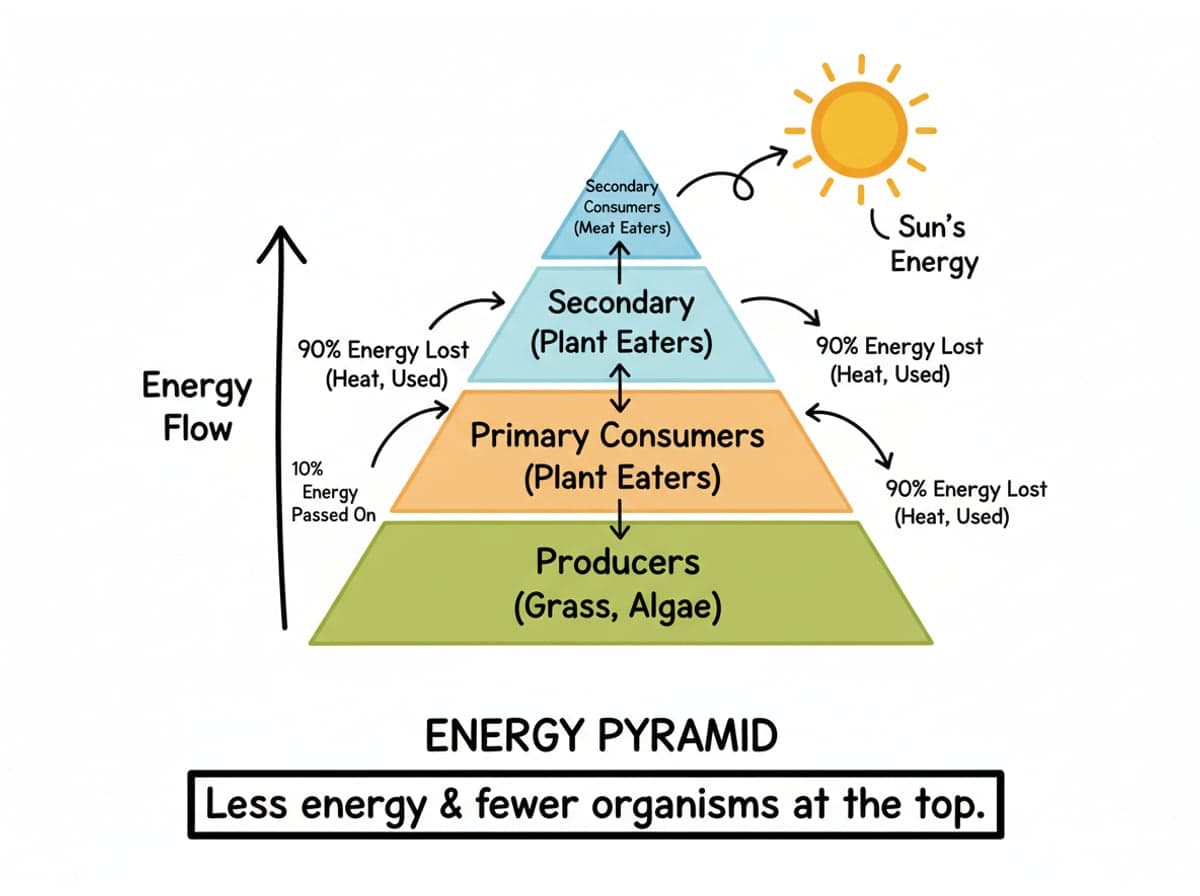
The reason is the 10 percent rule. About 10% of the energy at one level is passed up to the next as food. The other 90% is spent by the organism's own life: moving, repairing, keeping warm, and radiating heat. Every animal is an energy spendthrift, and the energy it spends is gone to the atmosphere. It cannot be eaten by anyone, because it never becomes body tissue.
Chain the levels together: if the grass holds 10,000 units of energy, the rabbits receive about 1,000, the snakes about 100, and the hawks about 10. By a fourth or fifth level, the energy is nearly gone. This is a real limit on life. It helps explain why there are far more rabbits than hawks and why food chains rarely stretch beyond four or five links.
The shrinking pyramid also explains why top predators are rare and wide-ranging: each wolf needs the energy of many rabbits. It is also why food grown low on the pyramid feeds more people: a grain field feeding humans directly beats the same field fed to livestock, because every livestock step loses about 90% of the energy. Energy cannot be recycled like water; it is lost as heat at every step, so the bottom must hold a lot.
Keep this idea
About 10% of energy passes from each level to the next; most is lost as heat, so the pyramid thins quickly and food chains stay short.
The practice checks apply only to the displayed examples. Follow your teacher’s guidance for your own assignments.
Get help with your own questionA practice lesson each week.
A short practice lesson for your inbox. Free, with a one-click unsubscribe.