Acids, bases and pH
One small step at a time. Ask for a clue whenever you need one.
Ask about your own question- Step 1
- Step 2
- Step 3
- New question
A solution has pH 3. Is it acidic or basic? What do we call pH 7? Then compare pH 3 with pH 5.
Common mix-up
In this example, a student wrote pH 3 is basic, and pH 5 is more acidic because 5 is a bigger number..
The student said pH 3 is basic because the number is small, and chose pH 5 as the more acidic solution.
Guided example. Your answers aren’t saved or sent.
See why this works
Is pH 3 more acidic than pH 5?
pH 7 is the midway point. Learn which direction means acid strength, and why pH 3 and pH 5 differ by a hundred times.
pH below 7 is acidic, pH 7 is neutral, pH above 7 is basic, and each pH unit is a factor of 10 in H+ concentration.
The pH scale runs from 0 to 14 and measures how much hydrogen ion, H+, is in a solution. Each single pH unit is a factor of 10 in H+ concentration. A pH of 3 means 10 times more H+ than pH 4, and 100 times more than pH 5. The scale is logarithmic, so small numbers hide enormous differences.
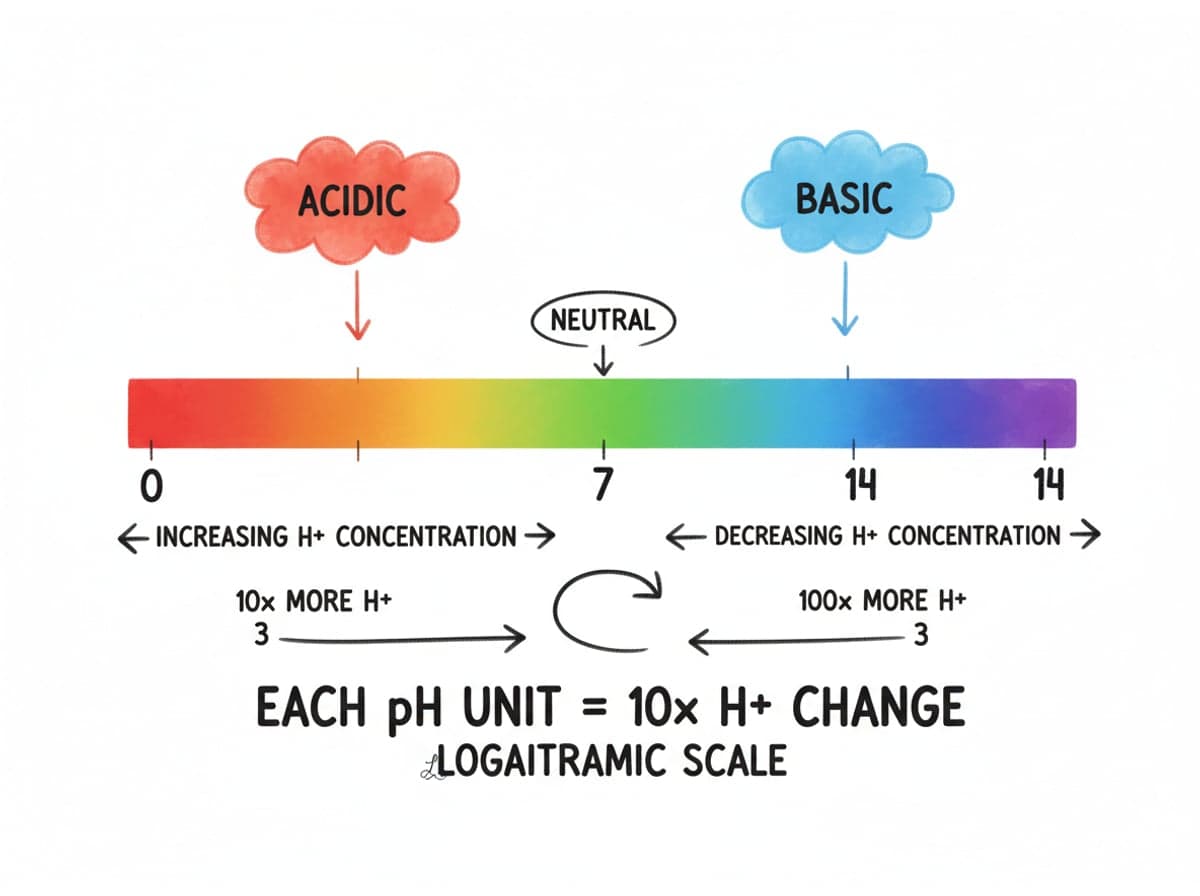
The middle of the scale, pH 7, is neutral: the H+ and OH- concentrations are equal in pure water at 25 degrees C. Below 7 is acidic, and the lower the number, the stronger the acid. Above 7 is basic or alkaline, and the higher the number, the stronger the base. The same 7 sits at the middle of every pH question because water itself is balanced.
The common mistake is reading the scale like a number line where bigger means stronger. For pH it is the opposite direction: small numbers mean lots of hydrogen ions, so pH 3 beats pH 5 on acidity. The scale counts down for acidity, not up, and 0 means the most acidic end. A pH number line is a strength ladder where the acidity rungs go downward.
The formula pH = -log[H+] shows where the direction comes from, since a larger H+ concentration pushes the pH down. Lemon juice near pH 2 and bleach near pH 12 sit on opposite sides of the scale, about ten billion times apart in H+ concentration. The minus sign before the log is what flips the direction; without it the scale would read backwards.
Keep this idea
pH below 7 is acidic, above 7 is basic, 7 is neutral, and each unit down multiplies H+ by 10.
The practice checks apply only to the displayed examples. Follow your teacher’s guidance for your own assignments.
Get help with your own questionA practice lesson each week.
A short practice lesson for your inbox. Free, with a one-click unsubscribe.