
Neutralization reactions
One small step at a time. Ask for a clue whenever you need one.
Ask about your own question- Step 1
- Step 2
- New question
Complete the neutralization: HCl + NaOH → ?
Common mix-up
In this example, a student wrote NaClO + H2 (it looked balanced at a glance).
The student paired the sodium and chlorine as the products but left out the water, writing only NaCl.
Guided example. Your answers aren’t saved or sent.
See why this works
What is the second product of acid plus base?
Acid and base do not vanish. Their ions trade partners and become a salt and water. Fill in the two products.
Acid + base → salt + water. The H+ and OH- combine to form water, and the other ions form the salt.
In a neutralization reaction, an acid and a base react to form a salt and water. The hydrogen ion from the acid meets the hydroxide ion from the base: H+ + OH- → H2O. That combination is what makes the product neutral, and it is the heart of the reaction. The two partners always leave the same two families of products behind.
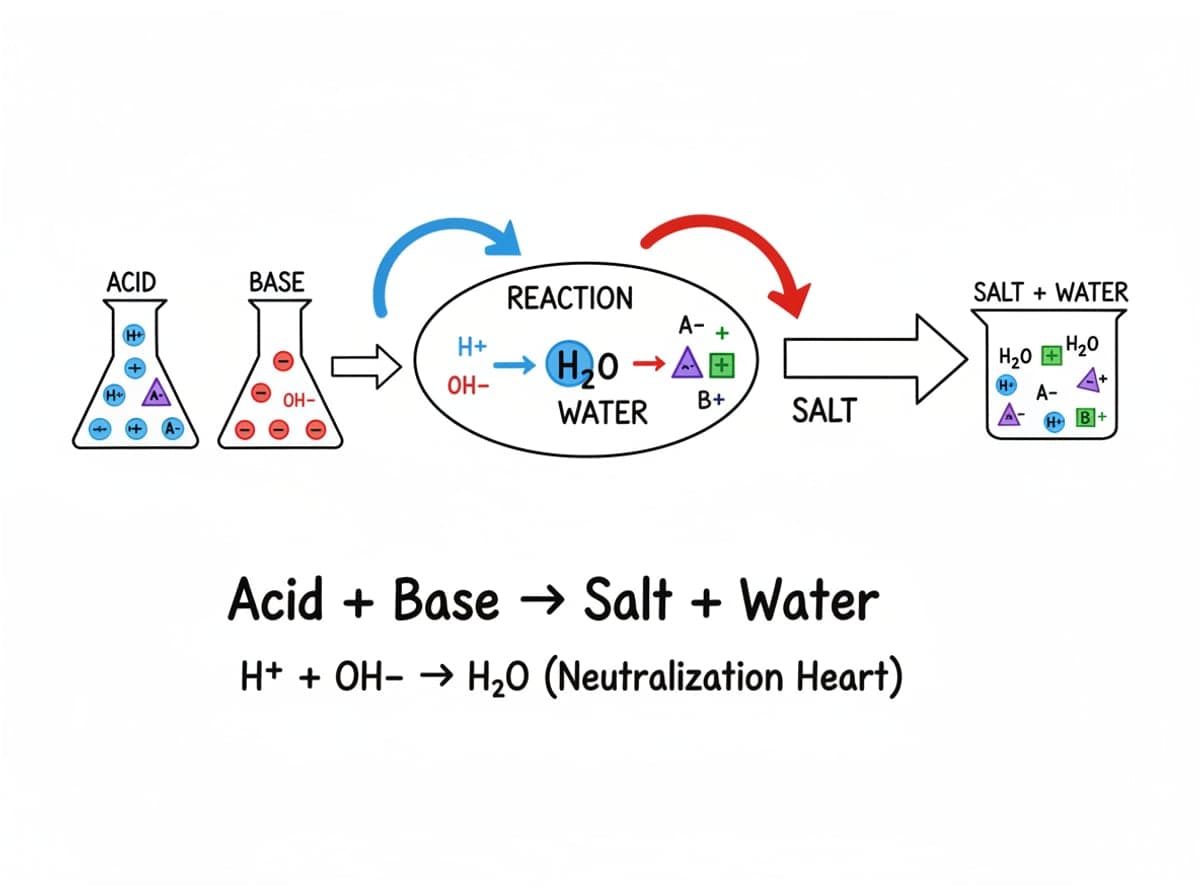
Everything else in the solution becomes the salt. In HCl + NaOH, the Na+ from the base pairs with Cl- from the acid, giving sodium chloride, and the leftover H+ and OH- make the water. The common mistake is writing the salt and forgetting the water entirely, or inventing an oxygen atom in the salt. The water is not an afterthought; it carries the neutral in the name neutralization.
Check by balancing. HCl + NaOH → NaCl + H2O is already 1 to 1: one H, one Cl, one Na, one O on each side. With H2SO4 and KOH, the acid has two H+ to give, so two KOH are needed: H2SO4 + 2KOH → K2SO4 + 2H2O. Balancing first also tells you how many moles of base to use for the acid at hand.
Neutralization is also what an antacid does in the stomach. The name comes from reaching a neutral pH when the acid and base are present in the exact reacting amounts. The salt is named from the ions left behind, with the metal first and the nonmetal with -ide. Knowing the stoichiometry tells you exactly how much base you need to neutralize the acid.
Keep this idea
Acid + base → salt + water. The H+ and OH- make the water; the remaining ions make the salt.
The practice checks apply only to the displayed examples. Follow your teacher’s guidance for your own assignments.
Get help with your own questionA practice lesson each week.
A short practice lesson for your inbox. Free, with a one-click unsubscribe.