Comma splices and run-on sentences
One small step at a time. Ask for a clue whenever you need one.
Ask about your own question- Step 1
- Step 2
- Step 3
- New question
Fix this sentence: The weather was sunny, we decided to go to the beach.
Common mix-up
In this example, a student wrote The weather was sunny, we decided to go to the beach..
Dev joined two complete sentences with a comma because the two halves felt connected. They were connected in meaning, but the comma is not the mark that joins them.
Guided example. Your answers aren’t saved or sent.
See why this works
Why is my comma wrong here?
“The weather was sunny, we decided to go to the beach.” Every word is fine and the sentence is still wrong, because each half could stand on its own.
Two complete thoughts need a full stop, a semicolon, or a comma with a joining word.
A complete thought has a subject and a verb and could be a sentence by itself. “The weather was sunny” is one. “We decided to go to the beach” is another. When you join two of them with only a comma, the comma is doing a job it cannot do, and the result has a name: a comma splice.
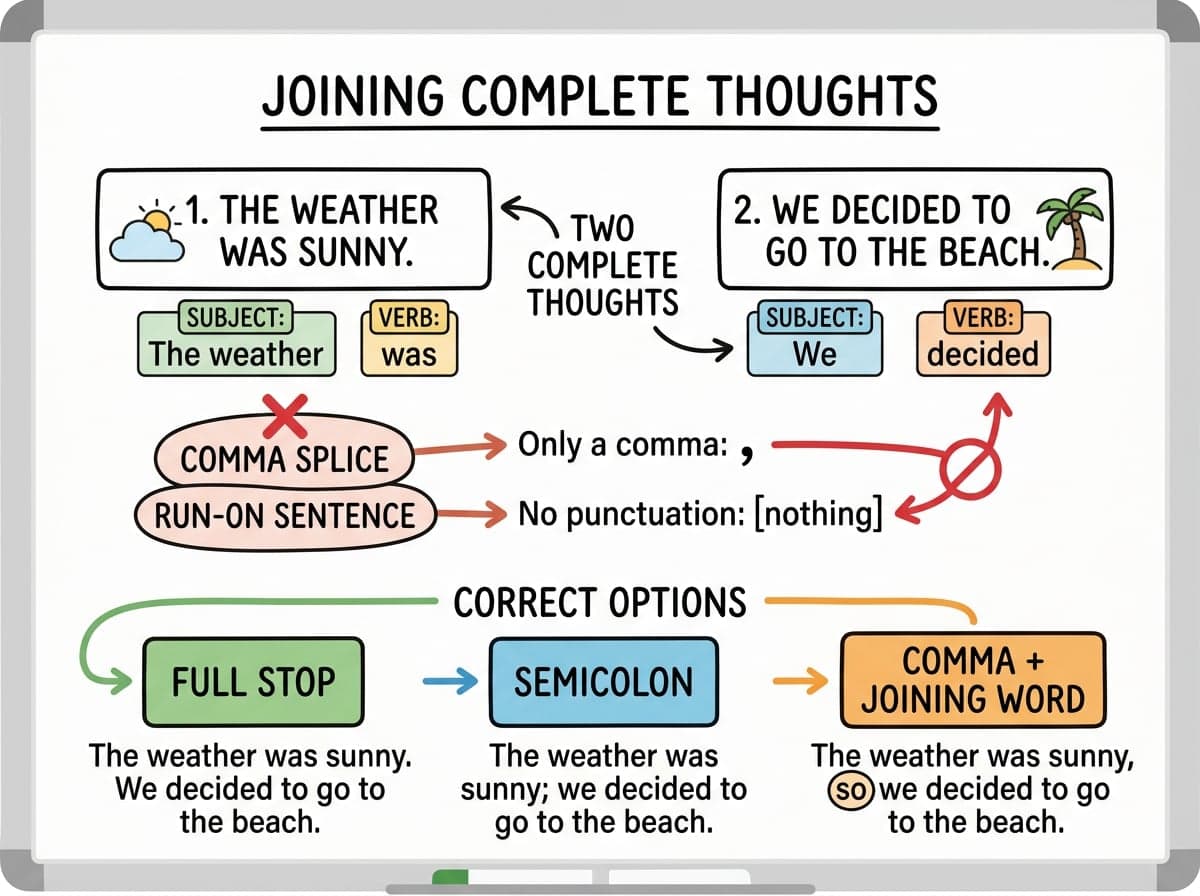
Leave the comma out entirely and the fault is the same, though it is called a run-on. The two versions feel different to read — one hesitates, one rushes — but the cause is identical, so the fixes are identical too.
There are three reliable repairs, and choosing between them is a writing decision, not a rule. A full stop makes two short sentences, which is punchy and slightly formal. A semicolon keeps them tightly joined in one sentence, which suits two halves that explain each other. A comma plus a joining word such as and, but or so, keeps the flow and names the relationship — cause, contrast, result.
The test to apply is one question: can each half stand alone? If both can, you have a choice of three repairs. If one half cannot stand alone, the comma is actually correct, and this is the sentence students fix by mistake. “When the weather turned sunny, we went to the beach” needs its comma, because the first half cannot be a sentence by itself.
Keep this idea
Two complete thoughts need a full stop, a semicolon, or a comma plus a joining word. Check each half can stand alone first — when one half cannot, the comma is correct and should stay.
The practice checks apply only to the displayed examples. Follow your teacher’s guidance for your own assignments.
Get help with your own questionA practice lesson each week.
A short practice lesson for your inbox. Free, with a one-click unsubscribe.
Search all 106 free lessons for “Comma splices and run-on sentences”