Punctuation and apostrophes
One small step at a time. Ask for a clue whenever you need one.
Ask about your own question- Step 1
- Step 2
- Step 3
- New question
Fix both problems: The students are going over there notes. Its important to be ready.
Common mix-up
In this example, a student wrote The students are going over there notes. Its important to be ready..
Ravi read his paragraph aloud, heard nothing wrong, and handed it in. Both faults survive reading aloud, because both are about spelling rather than sound.
Guided example. Your answers aren’t saved or sent.
See why this works
Why does “there notes” look wrong?
The sentence sounds perfect when you read it aloud, and it is wrong twice. Both faults are invisible to your ear, which is why proofreading has to use your eyes.
Apostrophes show possession or a missing letter — never a plural.
The first fault is a word that sounds like the word you meant. “Going over there notes” passes the ear test, because there and their are pronounced the same. Their shows who owns something, there points at a place, and they're is short for they are. Since spelling cannot be heard, the only reliable check is to substitute: swap in they are, and if the sentence stops making sense, you wanted their or there instead.
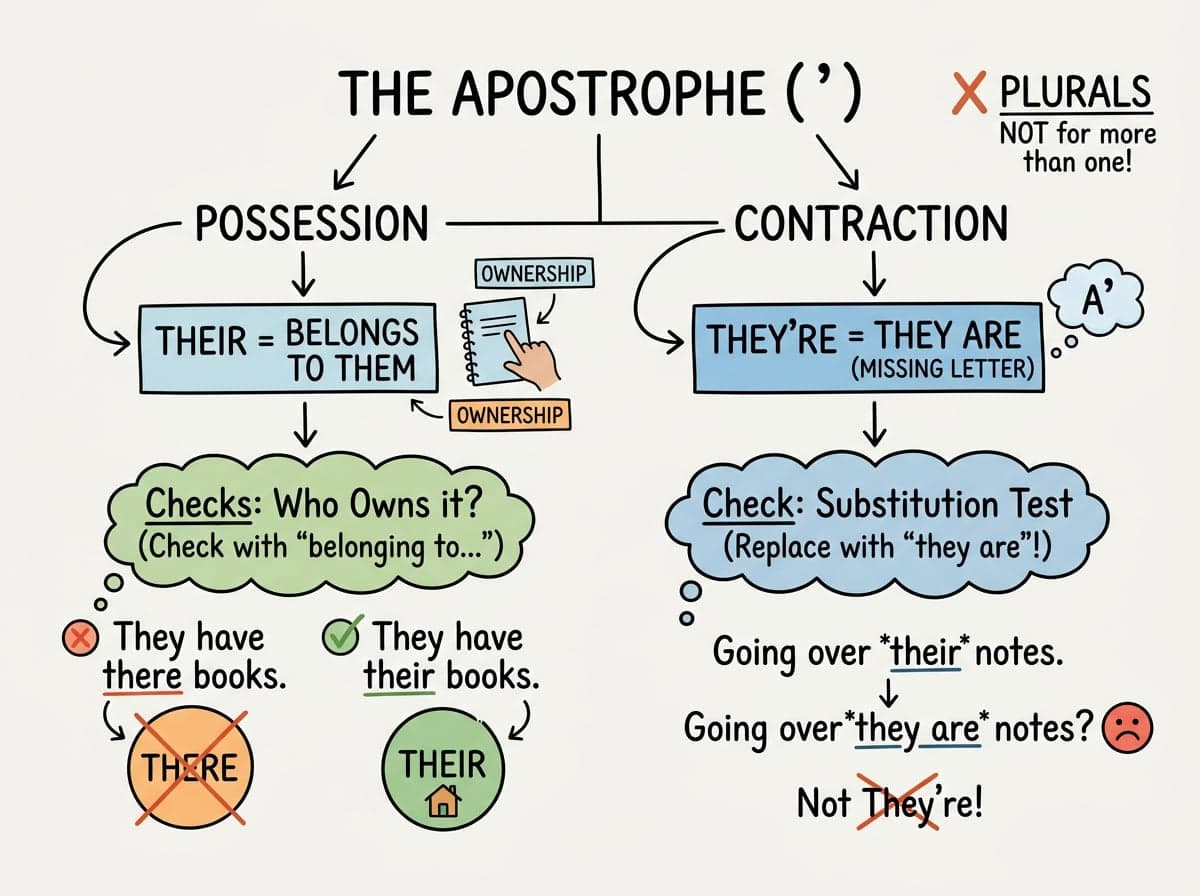
The second fault is a missing apostrophe, and the same substitution trick works. Its and it's are the pair that catch people out, because the family rule is backwards here: normally an apostrophe means possession, but with it the apostrophe always means the missing letter in it is. “Its important” is short for it is important, so it needs the mark; “the dog wagged its tail” shows possession and takes none.
Plural possession is the third case, and it is where the apostrophe moves. One student's notes becomes two students' notes, because the mark follows the owner rather than sitting inside the word. With an irregular plural like children, the mark goes before the s — children's — because the plural does not end in s to begin with.
None of this is caught by reading aloud, so build a habit instead: after the piece is finished, check only the apostrophes and the sound-alike words, in a pass of their own. A separate pass is far more accurate than trying to spot them while you are still deciding what to say.
Keep this idea
Check apostrophes and sound-alike words in a pass of their own, after the writing is finished. Substitute they are and it is to test the first pair, and remember the mark follows the owner — after the s for a plural.
The practice checks apply only to the displayed examples. Follow your teacher’s guidance for your own assignments.
Get help with your own questionA practice lesson each week.
A short practice lesson for your inbox. Free, with a one-click unsubscribe.
Search all 106 free lessons for “Punctuation and apostrophes”