
Periodic table trends
One small step at a time. Ask for a clue whenever you need one.
Ask about your own question- Step 1
- Step 2
- New question
Which atom is larger, sodium (Na) or chlorine (Cl)? Then compare sodium with potassium (K), which is directly below it.
Common mix-up
In this example, a student wrote Chlorine is larger because it has more electrons and more protons..
The student compared total electron counts and decided chlorine, which has more electrons, must be larger.
Guided example. Your answers aren’t saved or sent.
See why this works
Which is bigger: sodium or chlorine?
Sodium and chlorine sit next door in the same period, but one is much larger. Decide which, then test the down-a-group trend.
Atomic radius increases down a group and decreases left to right across a period; ionization energy and electronegativity run the other way.
Atomic radius is not random. Two trends explain almost every comparison in the main group. Across a period, from left to right, atoms get smaller. Down a group, atoms get bigger. Sodium and chlorine both sit in period 3, so they share the same three occupied shells. Any size difference between them has to come from the nucleus, because the shell count is identical.
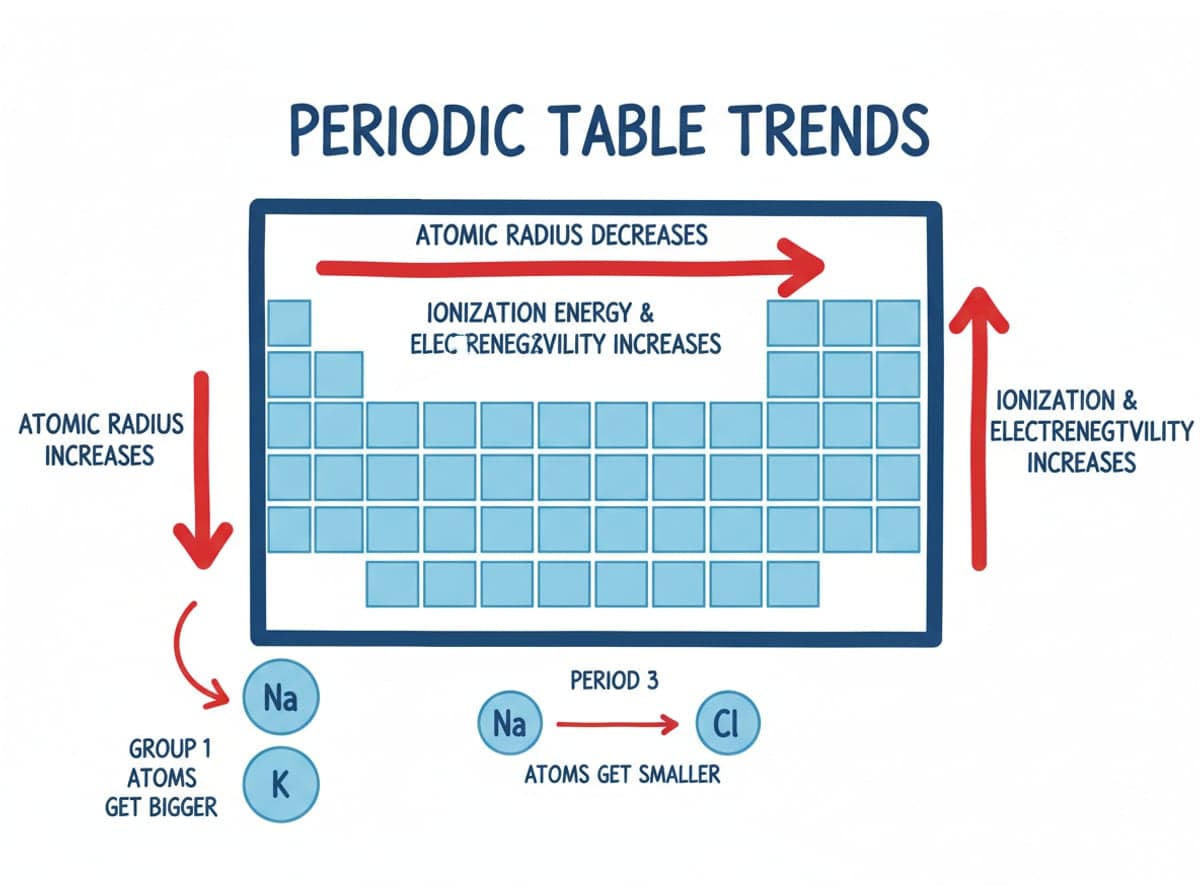
Moving left to right, protons are added one at a time while electrons land in the same outer shell. More protons pull the whole electron cloud inward. Chlorine's 17 protons grip the three shells far more tightly than sodium's 11, so chlorine is the smaller atom. The common mistake is picking the atom with more electrons, since more electrons feels like more size but is not.
Going down a group, each new element adds a complete new shell. Even though the nucleus gains protons, the outermost electrons are now much farther out. Potassium's valence electron sits in the fourth shell, so a potassium atom is larger than a sodium atom in the third. The new shell wins the race against the extra protons. The balance shifts with every row of the table.
Ionization energy and electronegativity move opposite to radius: they rise across a period and fall down a group. Tightly held electrons take more energy to remove, so chlorine needs more energy than sodium. If the size trend is clear, the energy trends come along with it, and you can predict either one from the other. Same atom, same shell: the pull that shrinks the radius also cements the electron in place.
Keep this idea
Across a period the nucleus wins and atoms shrink; down a group a new shell wins and atoms grow. Energy trends run the other way.
The practice checks apply only to the displayed examples. Follow your teacher’s guidance for your own assignments.
Get help with your own questionA practice lesson each week.
A short practice lesson for your inbox. Free, with a one-click unsubscribe.