
Valence electrons
One small step at a time. Ask for a clue whenever you need one.
Ask about your own question- Step 1
- Step 2
- New question
Sulfur is in group 16. Its electron configuration is 1s2 2s2 2p6 3s2 3p4. How many valence electrons does one sulfur atom have? Then check the shortcut on sodium.
Common mix-up
In this example, a student wrote Sulfur has 16 valence electrons, since its atomic number is 16..
The student counted all 16 electrons, using sulfur's atomic number as its valence electron count.
Guided example. Your answers aren’t saved or sent.
See why this works
Why does sulfur have 6 valence electrons, not 16?
Sulfur has 16 total electrons but only 6 that do chemistry. Learn where those 6 live and how the periodic table reveals them.
Valence electrons are the electrons in the highest occupied energy level, and for main-group elements the group number tells you how many.
Valence electrons are the electrons in the highest occupied energy level of an atom, and they are the ones involved in bonding. Sulfur has 16 total electrons, with the configuration 1s2 2s2 2p6 3s2 3p4. The first 10 electrons are core electrons, filling levels n = 1 and n = 2 completely. Only the two 3s electrons and the four 3p electrons sit in the outer level, and those are the electrons the chemistry of sulfur depends on.
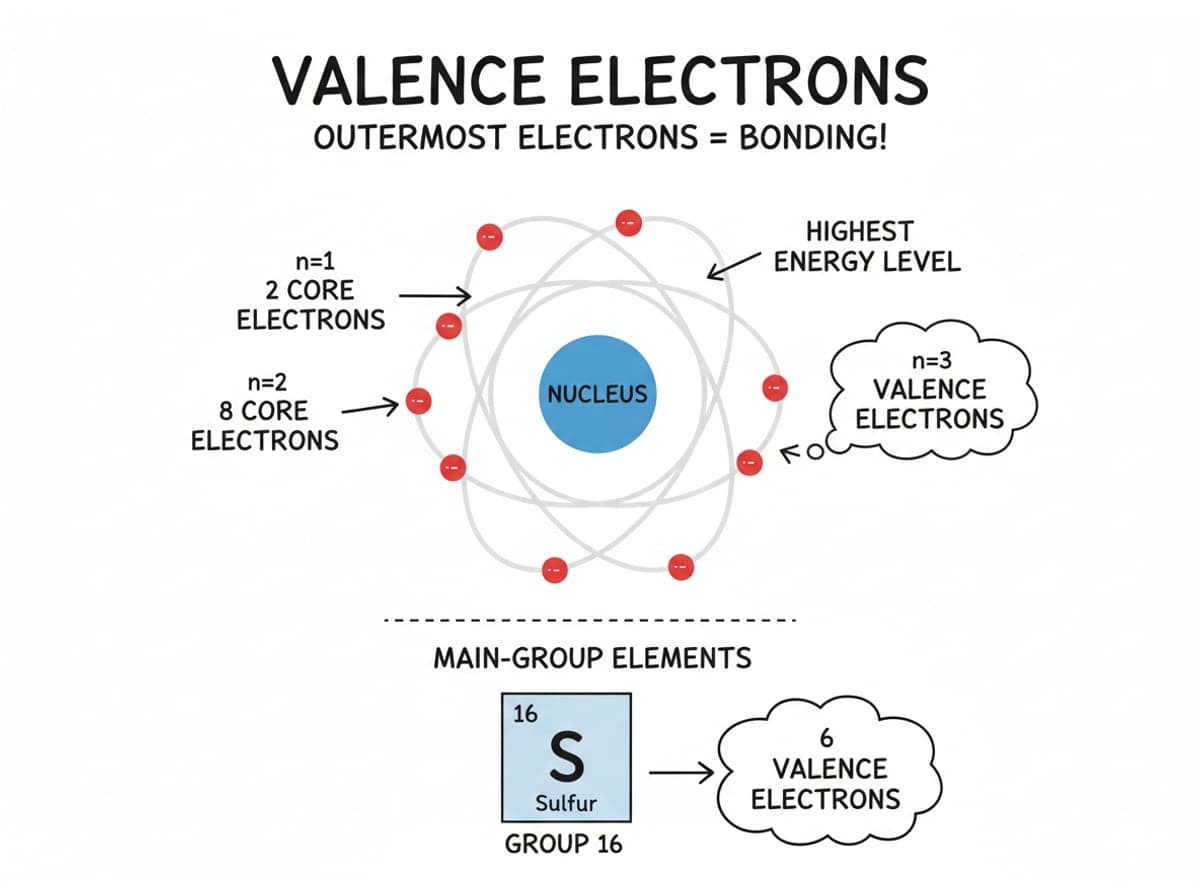
That makes 6 valence electrons in total. The common mistake is reporting the atomic number as the valence count, saying sulfur has 16. All electrons are not equal: the 2s2 2p6 pile in the second level is full, stable, and tightly held, while the six electrons in level n = 3 are the chemically active ones. Only the outer electrons form bonds and take part in reactions.
There is a fast check you can use. For main-group elements, the group number is the valence electron count. Group 1 alkali metals have 1, group 2 has 2, group 16 has 6, and group 17 halogens have 7. Sulfur sits in group 16, so it has 6 valence electrons. That shortcut works only for the main-group columns, not for the transition metals in the middle of the table.
The question matters because bonding depends on these electrons. Sodium has 1 valence electron, gives it up easily, and becomes Na+. Chlorine has 7 and wants exactly one more, so it grabs the electron sodium releases. Counting the right level keeps your predictions honest, and it explains why the elements in one group behave so much alike in their reactions.
Keep this idea
Only the electrons in the highest occupied energy level are valence electrons, and for main-group elements the group number gives them to you.
The practice checks apply only to the displayed examples. Follow your teacher’s guidance for your own assignments.
Get help with your own questionA practice lesson each week.
A short practice lesson for your inbox. Free, with a one-click unsubscribe.