
Trigonometric ratios
One small step at a time. Ask for a clue whenever you need one.
Ask about your own question- Step 1
- Step 2
- New question
In a right triangle with angle A, the side opposite A is 3 and the hypotenuse is 5. What is sin A?
Common mix-up
In this example, a student wrote sin A = 4/5.
The student used the adjacent side over the hypotenuse and wrote 4/5, finding cosine of A instead of sine.
Guided example. Your answers aren’t saved or sent.
See why this works
What is sin A when the opposite side is 3 and the hypotenuse is 5?
Trigonometry begins with one idea: a ratio of two sides. Label the sides for your chosen angle, and the ratio is mechanical.
sin = opposite/hypotenuse, cos = adjacent/hypotenuse, tan = opposite/adjacent (SOH CAH TOA).
Every trig ratio is a fraction of two side lengths, and the sides are named relative to the angle you chose. For angle A in a right triangle, the opposite side is the one across from A, the hypotenuse is the side across from the right angle, and the adjacent side is the remaining leg that touches A.
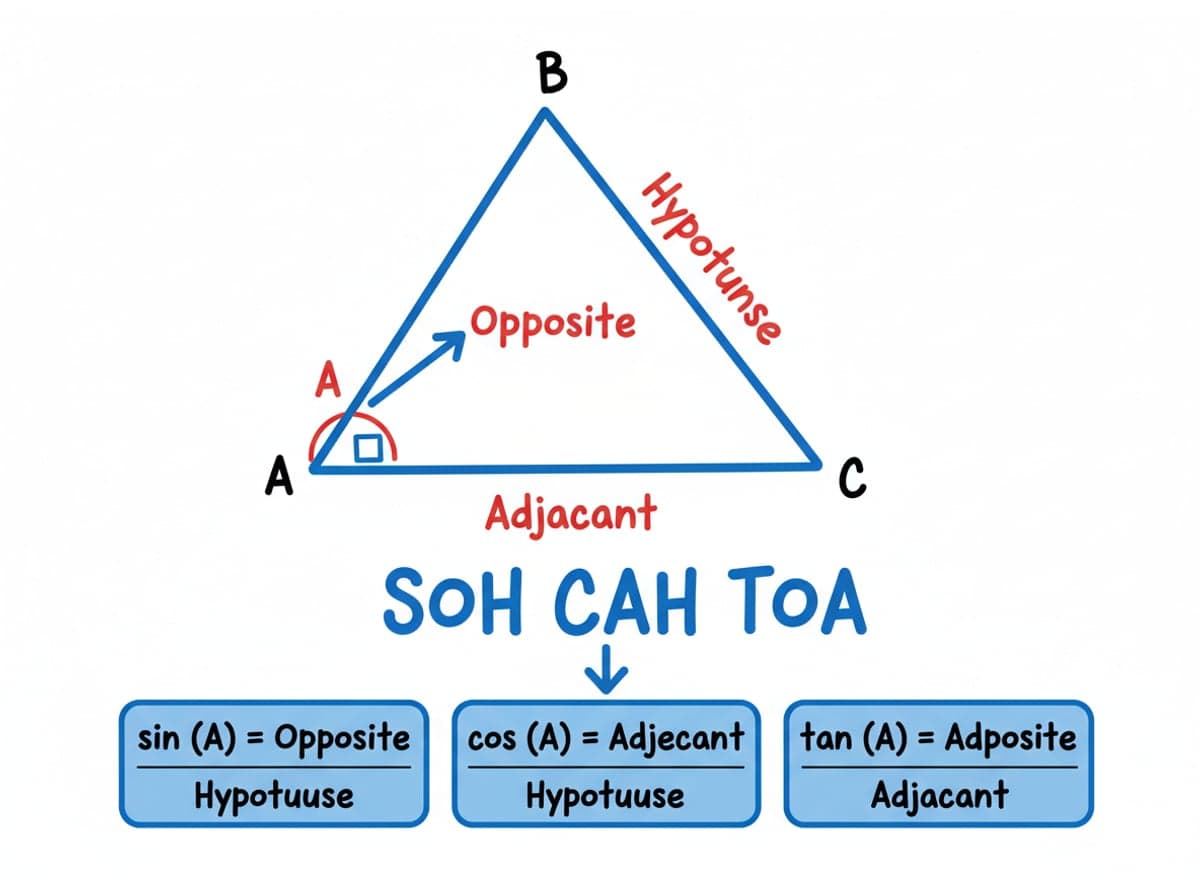
The three ratios are packed into SOH CAH TOA: sine is opposite over hypotenuse, cosine is adjacent over hypotenuse, and tangent is opposite over adjacent. With the opposite side 3 and the hypotenuse 5, sine is 3/5. The ratio is exact as a fraction, and 3/5 and 0.6 name the same number.
Getting the sides swapped is the usual stumble, and it changes the ratio. The adjacent side, if it is 4 in this 3-4-5 triangle, gives cosine 4/5, a different value entirely. One habit prevents the mix-up: from the angle you care about, point at the side across the room first, then the longest side, then the one left over.
The ratios also work in reverse: if you know sine of an angle and one side, you can solve a proportion for the other side. But before any algebra, the labeling has to be right. Sketch the triangle, mark the angle, name all three sides from it, and the ratio falls straight out of the letters.
Keep this idea
Label the three sides from the angle you care about: opposite, adjacent, hypotenuse. Then SOH CAH TOA hands you the ratio.
The practice checks apply only to the displayed examples. Follow your teacher’s guidance for your own assignments.
Get help with your own questionA practice lesson each week.
A short practice lesson for your inbox. Free, with a one-click unsubscribe.