
The unit circle
One small step at a time. Ask for a clue whenever you need one.
Ask about your own question- Step 1
- Step 2
- New question
The point on the unit circle at 30 degrees is (sqrt(3)/2, 1/2). What is sin(30 degrees)?
Common mix-up
In this example, a student wrote sin(30 degrees) = sqrt(3)/2.
The student used the x-coordinate for sine, writing sin of 30 degrees as sqrt(3)/2, which is actually the cosine.
Guided example. Your answers aren’t saved or sent.
See why this works
What is sin of a 30-degree angle on the unit circle?
On the unit circle, every point's coordinates are (cos, sin). Learn a few landmarks and the special angles are solved.
For a point on the unit circle, the x-coordinate is the cosine and the y-coordinate is the sine.
The unit circle is a circle of radius 1 centered at the origin. An angle measured from the positive x-axis marks a point on the circle, and the magic is that the point's coordinates are exactly (cos, sin). The x-coordinate is the cosine of the angle and the y-coordinate is the sine, so no memorized table is needed.
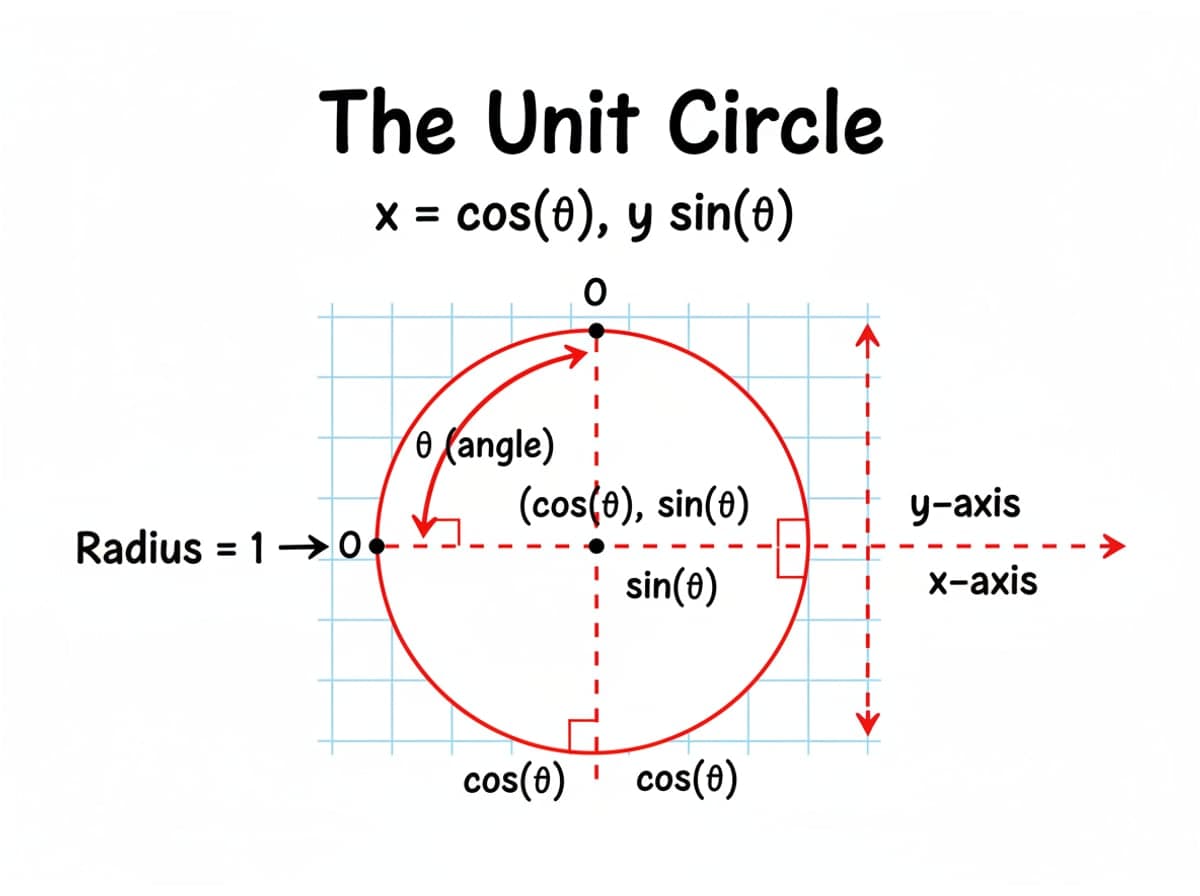
At 30 degrees, the point on the unit circle is (sqrt(3)/2, 1/2). Sine of 30 degrees is the y-coordinate, 1/2, and cosine is the x-coordinate, sqrt(3)/2. If you read the wrong coordinate, sine and cosine swap, which is exactly the classic slip: using sqrt(3)/2 for sin of 30 degrees.
The same point serves for 60 degrees with the coordinates switched. The 60-degree point is (1/2, sqrt(3)/2), because the two angles come from the same right triangle viewed from different corners. So cos(60 degrees) = 1/2, the same fraction that was the sine at 30 degrees.
The unit circle also tells you the signs. Points in the second quadrant have negative x-coordinates, so cosines become negative there while sines stay positive. With the coordinates full of meaning, the exact values for the common angles are placeholders you can reproduce instead of memorizing by rote.
Keep this idea
A unit circle point (x, y) means (cos, sin). Read x for cosine and y for sine, and the special angles are already solved.
The practice checks apply only to the displayed examples. Follow your teacher’s guidance for your own assignments.
Get help with your own questionA practice lesson each week.
A short practice lesson for your inbox. Free, with a one-click unsubscribe.