
What is a number bond, and why is the whole on top?
What is a number bond, and what is it actually for?
A number bond is a small diagram: the whole number sits in a circle at the top, and the parts it is made of sit in circles underneath, joined by lines. It shows that a number can be taken apart and put back together. Children use it to make ten while adding, and it is the same whole-and-parts idea they meet again in algebra when they solve x + 7 = 12.
Why it looks different from what you were taught
A number bond is not a new kind of arithmetic. It is a picture of something you already do: 14 is 9 and 5, or 10 and 4, or 7 and 7. The diagram just writes that fact down in a fixed shape — the whole at the top, the parts below it — so the child can see the same relationship in many different problems.
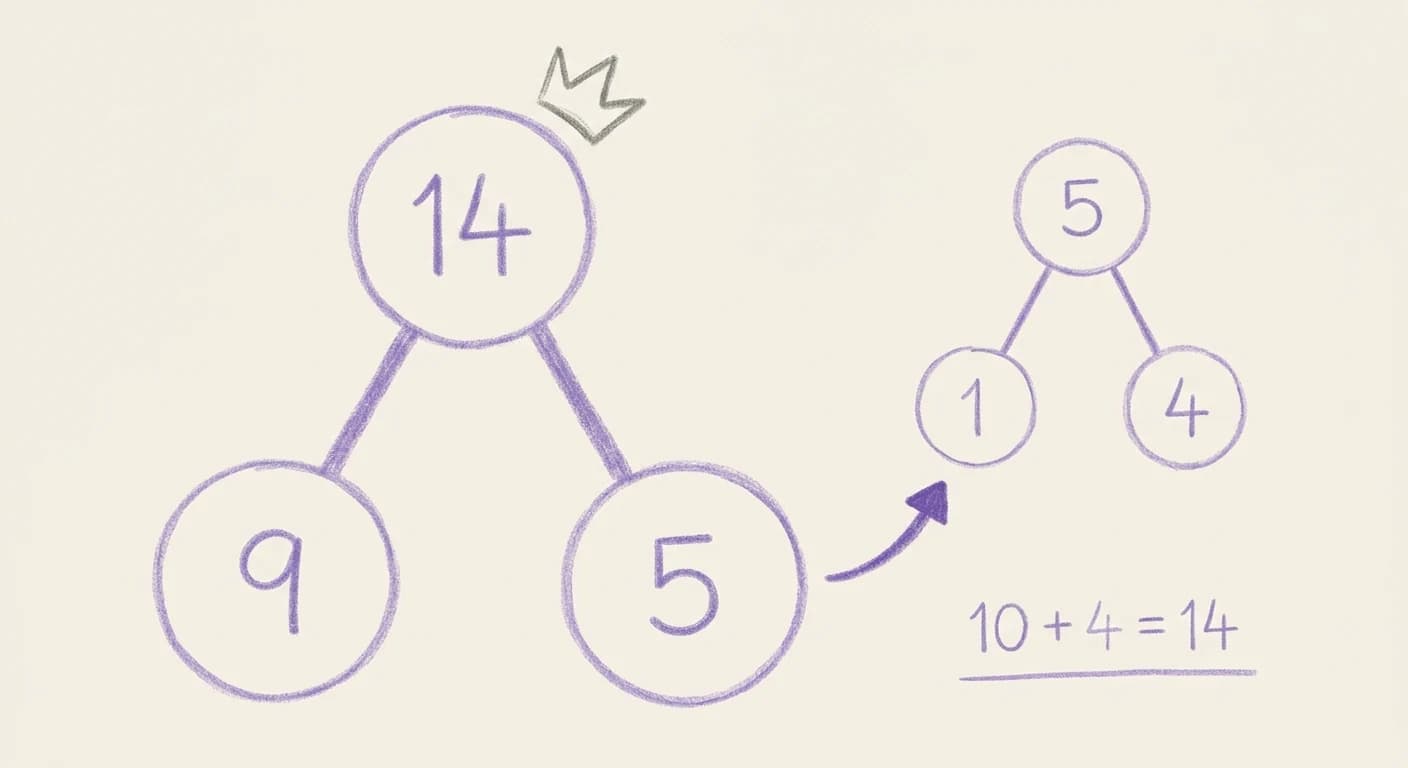
You probably learned the facts for sums to ten by repetition, which works, but leaves a child without a fallback when a fact slips. A child who can split 5 into 1 and 4 can turn 9 + 5 into 10 + 4. Adding to ten is the easiest addition there is, because no digit needs to be carried, so a child who makes ten first has a way to work out sums they have not memorized.
The same shape is the shape of an equation with a letter in it. x + 7 = 12 has a whole (12) and two parts (7 and x), exactly like a number bond, and the missing part is found the same way the missing part of a bond is found. Nothing about that is taught as algebra in kindergarten, but the diagram a child fills in at age five is the diagram they are using again when the letters appear.
The parts of the method
- The whole
- The circle at the top holds the total. In an addition problem it is the sum; in a subtraction problem it is the number being taken from. There is only one whole in a bond.
- The parts
- The circles underneath hold the numbers that combine to make the whole. A bond for 14 might have the parts 9 and 5, or 10 and 4, or 7 and 7. A number has many valid sets of parts, and any set that adds to the whole is a correct bond.
- The lines
- Each line joins a part to the whole, showing that the parts belong together and add to the top number. Reading the lines backwards is how a missing part is found.
- Making ten
- When a sum crosses ten, one number is split so that the other can be completed to ten first. For 9 + 5, the 9 needs 1 more to reach 10, so the 5 is split into 1 and 4; the 1 completes the ten and the 4 is added on. This is the number bond doing real work: the split is chosen for a reason, not at random.
- Reading a bond in either direction
- If the whole and one part are known, the other part is the whole minus the known part. If both parts are known, the whole is their sum. The same diagram answers both questions, which is why it is used for addition and subtraction at the same time.
A worked example: 9 + 5
- 9 + 5 is a bond for some whole, with 9 and 5 as partsSetting up the sum as a bond fixes what is being looked for: the whole.
- 9 + 1 = 10The 9 needs 1 more to make ten, and the 5 can supply it.
- 5 splits into 1 + 4The bond for 5: the 1 goes to the 9, the 4 stays behind. 1 + 4 = 5, so no amount has been lost or added.
- 10 + 4 = 14A ten plus a single digit, which needs no carrying and is easy to do in the head.
- The bond for 14 has the parts 9 and 5Writing the result as a bond shows the original numbers are still the parts of the total.
14, because 9 + 1 = 10, 1 + 4 = 5, and 10 + 4 = 14.
What you can do at the table
- Ask what would finish the ten. That single question is the whole strategy, and a child who can answer it for 8, 9 or 7 has the method.
- Ask for another bond for the same number. 14 is 9 + 5, but also 10 + 4 and 7 + 7. Seeing that many sets of parts are correct makes the diagram less mysterious than one right answer would.
- Use counters, pennies or blocks next to the paper. Move the 1 across to the pile of 9 so the child sees the ten being built, then write the bond that matches what just happened.
- When a fact slips, ask how they could make ten instead of prompting the answer. Supplying the fact yourself ends the useful part of the thinking.
The move that backfires: Do not tell your child to skip the bond and simply remember that 9 + 5 is 14, however well meant that is. The fact is worth knowing eventually, but asking for it mid-problem teaches them to guess at answers rather than build them, and removes the one move that works when the memory does not come. Let the split be written out; speed arrives on its own once the same split has been used a few times.
Free lessons that teach this step
What is the opposite of adding 7?
To undo an addition, subtract the same amount from both sides; the equation stays balanced.
Try the lesson freeWhy can't I add the x's to the plain numbers?
Only terms with the identical variable part combine; plain numbers combine only with plain numbers.
Try the lesson freeIf tonight’s question is not on this list
Bring the actual question — typed, or a photo of the page — and Clue gives one clue at a time and asks your child for the next step. The first 5 questions are free, follow-ups included, with no sign-up and no card.
Try 5 questions freeMethods are described as they are commonly taught, and your school may use different names for the same steps. Check with your child’s teacher when the working has to match their expectations.