
One-step equations
One small step at a time. Ask for a clue whenever you need one.
Ask about your own question- Step 1
- Step 2
- New question
Solve for x: x + 7 = 12.
Common mix-up
In this example, a student wrote 19.
Owen saw a plus and added on both sides: x = 12 + 7 = 19. The inverse of adding 7 is subtracting 7.
Guided example. Your answers aren’t saved or sent.
See why this works
What is the opposite of adding 7?
Owen solved x + 7 = 12 by computing 12 + 7 = 19. He added again instead of undoing the addition.
To undo an addition, subtract the same amount from both sides; the equation stays balanced.
An equation is a balance scale. x + 7 = 12 says the left pan and the right pan weigh the same. The goal is to find the weight of the mystery amount x alone, which means peeling off the +7 without disturbing the balance. Any change you make has to happen to both pans at once, or the scale tips and the equation stops being true.
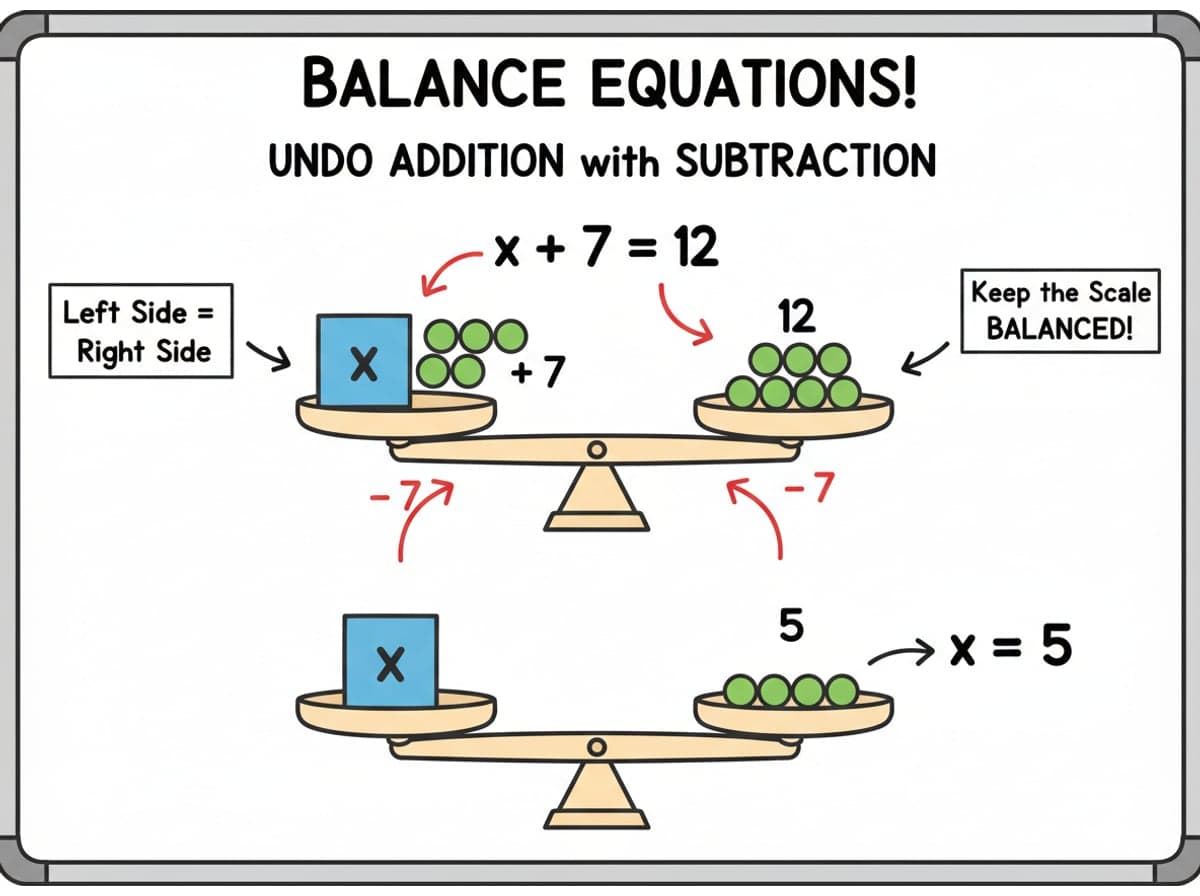
Owen's mistake was to keep adding: x = 12 + 7 = 19. He treated the equation as an instruction to compute with the visible numbers, a sign in both directions, but that ignores what the equation is saying. If x were 19, then x + 7 would be 26, not 12, so the equation would be a lie. Checking first would have revealed the lie before he moved on.
The fix is the inverse operation. Addition is undone by subtraction, and any move on one side must be mirrored on the other side. So subtract 7 from both sides: x + 7 - 7 = 12 - 7, which leaves x = 5. The equation stays balanced because both pans lose the same weight together. One operation, both sides, and the balance is the whole method.
Check by substituting 5 into the original: 5 + 7 = 12, and the two sides match. The inverse operation is the memory helper: whatever was added to x, do the opposite to free it, and the equation stays honest. Undo the visible operation, then verify the balance is back to its original claim. The answer always has to satisfy the equation it came from.
Keep this idea
Use the opposite operation on both sides, then check by substituting the solution back in.
The practice checks apply only to the displayed examples. Follow your teacher’s guidance for your own assignments.
Get help with your own questionA practice lesson each week.
A short practice lesson for your inbox. Free, with a one-click unsubscribe.