
Slope
One small step at a time. Ask for a clue whenever you need one.
Ask about your own question- Step 1
- Step 2
- Step 3
- New question
A line passes through (2, 3) and (6, 11). What is its slope?
Common mix-up
In this example, a student wrote 1/2.
Kai computed (6 - 2) / (11 - 3) = 4/8 = 1/2, putting the x-change on top. The vertical change belongs on top and the horizontal change on the bottom.
Guided example. Your answers aren’t saved or sent.
See why this works
Is it rise over run or run over rise?
Kai found the slope through (2, 3) and (6, 11) and wrote 1/2. He divided the run by the rise.
Slope equals the change in y divided by the change in x: vertical change over horizontal change.
Slope measures steepness: how much a line rises for every step it moves across. The formula is (change in y) / (change in x), and the points (2, 3) and (6, 11) give each change. The y-values, 11 and 3, differ by 8. The x-values, 6 and 2, differ by 4. So the line climbs 8 while it travels 4, which is a steep 2-up for every 1-across.
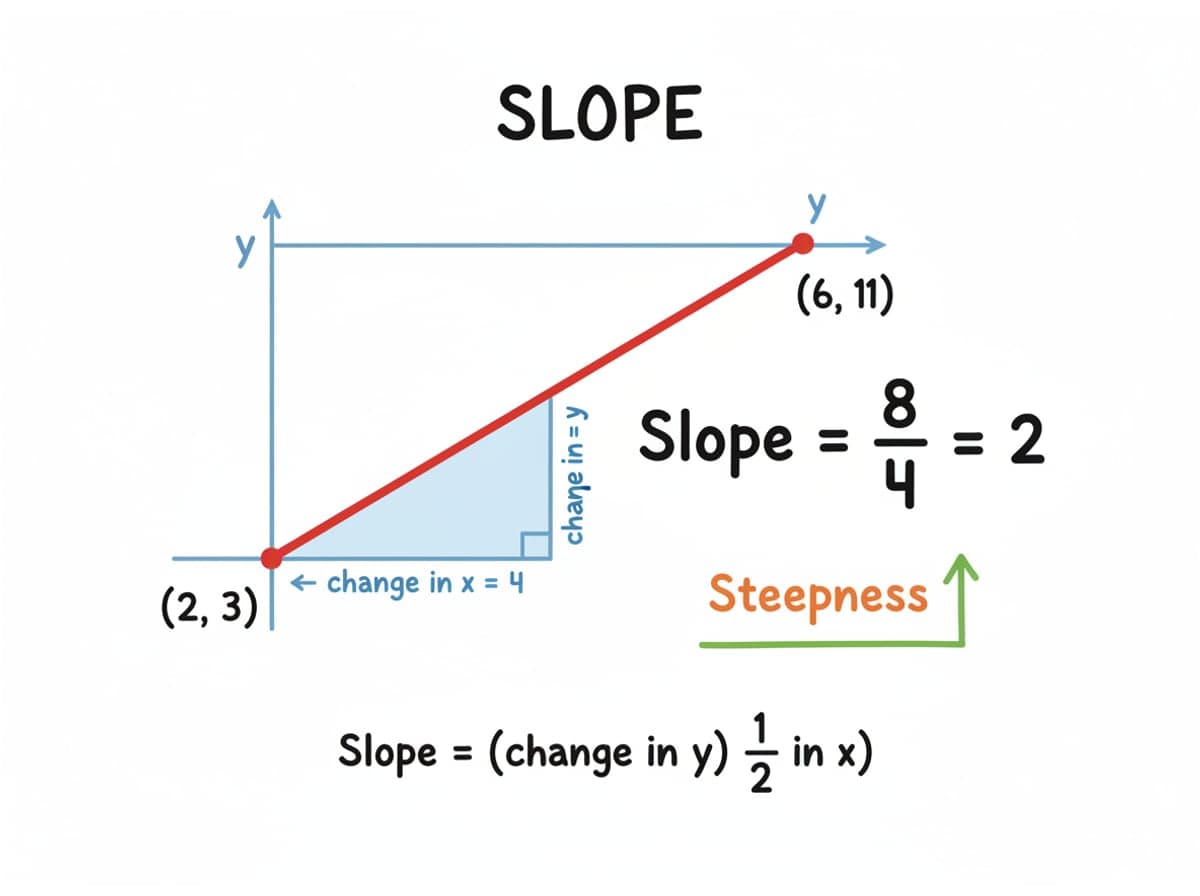
Kai's mistake was computing (6 - 2) / (11 - 3) = 4/8 = 1/2. That is the horizontal change over the vertical change, the x-change over the y-change, the reverse of the definition. His slope describes a line that rises 1 and moves 2, which is shallower than the actual line, and the two lines do not look anything alike.
The fix is remembering the letters: y goes on top because slope tells how much the line rises per step across. Begin at (2, 3) and go to (6, 11): you go up 8 and across 4, so the slope is 8/4 = 2, which means 2 units up for each unit across. Rise first, run second, exactly as the phrase says.
Check by stepping along the line: from (2, 3), add one x and two y's to reach (3, 5), then (4, 7), then (6, 11) after two more steps. The points land exactly on the line, confirming the steepness is 2. Every step of the walk matches the slope, so the rise and run really are in the right ratio.
Keep this idea
Slope is rise over run: y-change on top, x-change on the bottom, always.
The practice checks apply only to the displayed examples. Follow your teacher’s guidance for your own assignments.
Get help with your own questionA practice lesson each week.
A short practice lesson for your inbox. Free, with a one-click unsubscribe.