
Two-step equations
One small step at a time. Ask for a clue whenever you need one.
Ask about your own question- Step 1
- Step 2
- New question
Solve for x: 3x + 4 = 19.
Common mix-up
In this example, a student wrote 23/3.
Isla divided by 3 first, as if 3 divided the whole left side. She should subtract 4 from both sides first, then divide.
Guided example. Your answers aren’t saved or sent.
See why this works
Which move comes first?
Isla solved 3x + 4 = 19 by writing 3x = 23, giving x = 23/3. She never removed the +4 before dividing.
Undo the addition or subtraction first, then undo the multiplication or division: reverse the order of operations.
The expression 3x + 4 was built in a specific order: first multiply x by 3, then add 4. To solve, you take the building apart in reverse order: undo the add first, then undo the multiply. That is why removing the +4 comes before dividing by 3. Untangling a knot is easier when you undo the last knot you tied first.
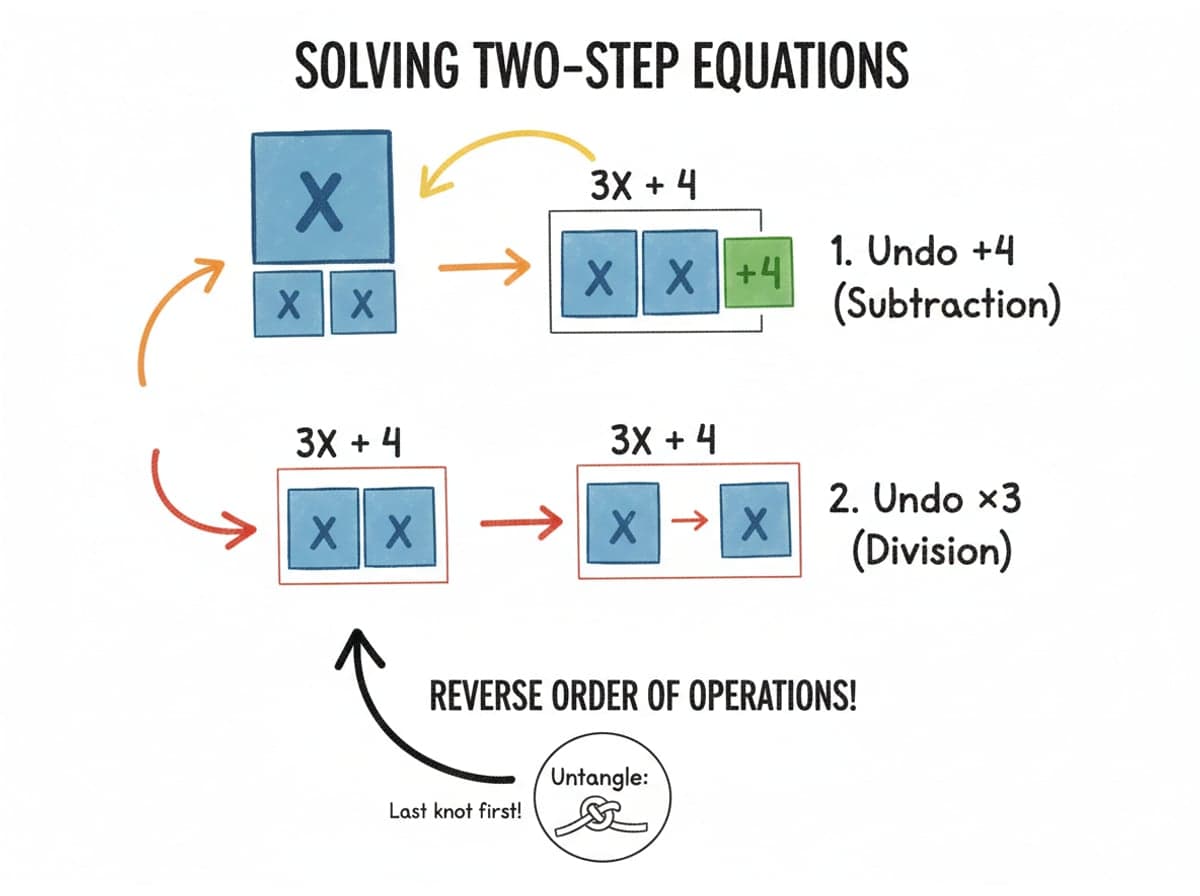
Isla's mistake was jumping straight to the division, splitting 19 by 3 while the +4 was still attached to the 3x. The 4 belongs to the whole expression 3x + 4, not to the x alone, so dividing first leaves a result that is still off by the hanging 4. She skipped a step, and the missing step shows up in the answer.
The fix is two balanced moves. First subtract 4 from both sides: 3x = 19 - 4 = 15. Then divide both sides by 3: x = 5. Each move mirrors the other side, and the equation stays level at every line. The moves are the same as a one-step equation: you just do two of them in the right order.
Check by substituting: 3 * 5 + 4 = 19, so the answer fits the original equation. The two-step order rule is reliable: addition or subtraction first, multiplication or division second, because that is the reverse of how the expression was assembled. Work backwards through the operations and the x frees itself. Build it, undo it in reverse, check it: the loop closes on the original equation.
Keep this idea
Reverse the order the expression was built: undo addition or subtraction first, then multiplication or division.
The practice checks apply only to the displayed examples. Follow your teacher’s guidance for your own assignments.
Get help with your own questionA practice lesson each week.
A short practice lesson for your inbox. Free, with a one-click unsubscribe.