
Solving inequalities
One small step at a time. Ask for a clue whenever you need one.
Ask about your own question- Step 1
- Step 2
- New question
Solve for x: -2x ≥ 10.
Common mix-up
In this example, a student wrote x ≥ -5.
Sofia solved the division correctly as -5 but kept the symbol pointing the same way. Dividing by -2 flips ≥ into ≤.
Guided example. Your answers aren’t saved or sent.
See why this works
Which way does the inequality flip?
Sofia divided -2x ≥ 10 by -2 and wrote x ≥ -5, keeping the symbol the way it was. The rule says it flips to ≤.
Multiplying or dividing an inequality by a negative number reverses the direction of the symbol.
An inequality is a statement about a whole range of values, and it behaves like an equation in most ways: whatever you do to one side, do to the other. The single exception is multiplying or dividing by a negative, which flips the direction of the symbol. Everything else is business as usual, so the solving moves stay exactly the same.
Sofia's mistake was solving the division but keeping the symbol unchanged. She got x ≥ -5, and by that rule x = 0 would be allowed. But 0 does not work: -2 * 0 = 0, and 0 is not greater than or equal to 10. A wrong direction fails its own first test, and the range of wrong answers is a whole line of misses.
The fix is the flip. Divide both sides by -2 to get x ≤ -5. Why? Multiplying an inequality by a negative reverses the arithmetic order: larger numbers become smaller and smaller ones become larger, so the relationship must turn around. Think of the number line folded at 0: everything lands on the mirrored side. The flip is a reflection, not a new rule invented for the moment.
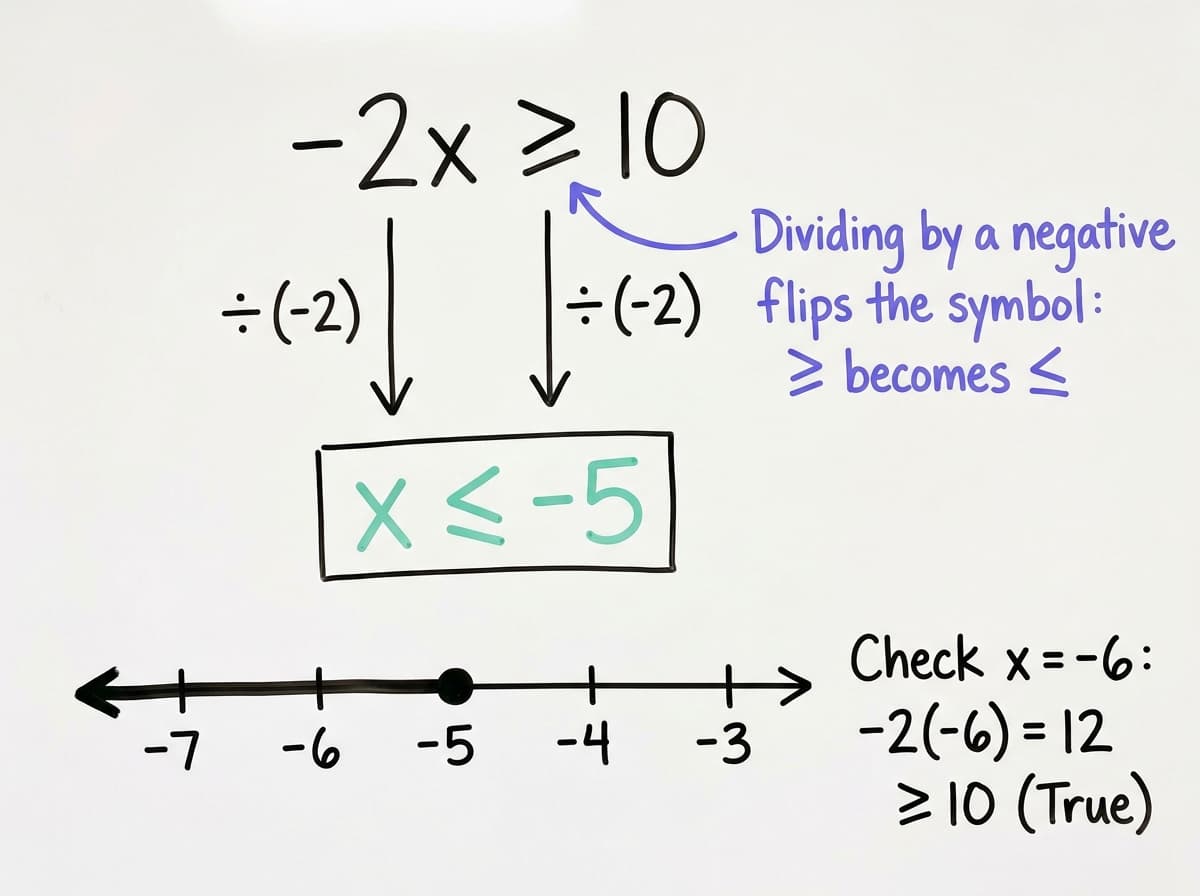
Check by picking a boundary number: x = -5 gives -2 * -5 = 10, and 10 ≥ 10, so -5 is allowed. Pick a value left of it, like x = -6: -2 * -6 = 12, which is ≥ 10. The solutions are exactly the numbers less than or equal to -5, matching the flipped symbol. The boundary and one neighbor are the whole test.
Keep this idea
When you multiply or divide an inequality by a negative, flip the symbol, then test a number to confirm.
The practice checks apply only to the displayed examples. Follow your teacher’s guidance for your own assignments.
Get help with your own questionA practice lesson each week.
A short practice lesson for your inbox. Free, with a one-click unsubscribe.