
Variables on both sides
One small step at a time. Ask for a clue whenever you need one.
Ask about your own question- Step 1
- Step 2
- Step 3
- New question
Solve for x: 3x + 2 = x + 10.
Common mix-up
In this example, a student wrote 3.
Milo added x to the left side instead of subtracting it from both sides, so he got 4x = 12 and x = 3, which fails the original equation.
Guided example. Your answers aren’t saved or sent.
See why this works
Why can't I just move the x?
Milo solved 3x + 2 = x + 10 by adding x to both sides: 4x = 12, so x = 3. Substitution showed 11 does not equal 13.
Keep the equation balanced: subtract the same variable term from both sides, then solve as usual.
The equation 3x + 2 = x + 10 has the mystery amount on both pans of the scale. To solve, gather all the x's in one place and all the numbers in the other. Every gather must be a balanced move, applied to both sides. The x-term on the right does not get to vanish; it has to be paid for by the same subtraction on the left.
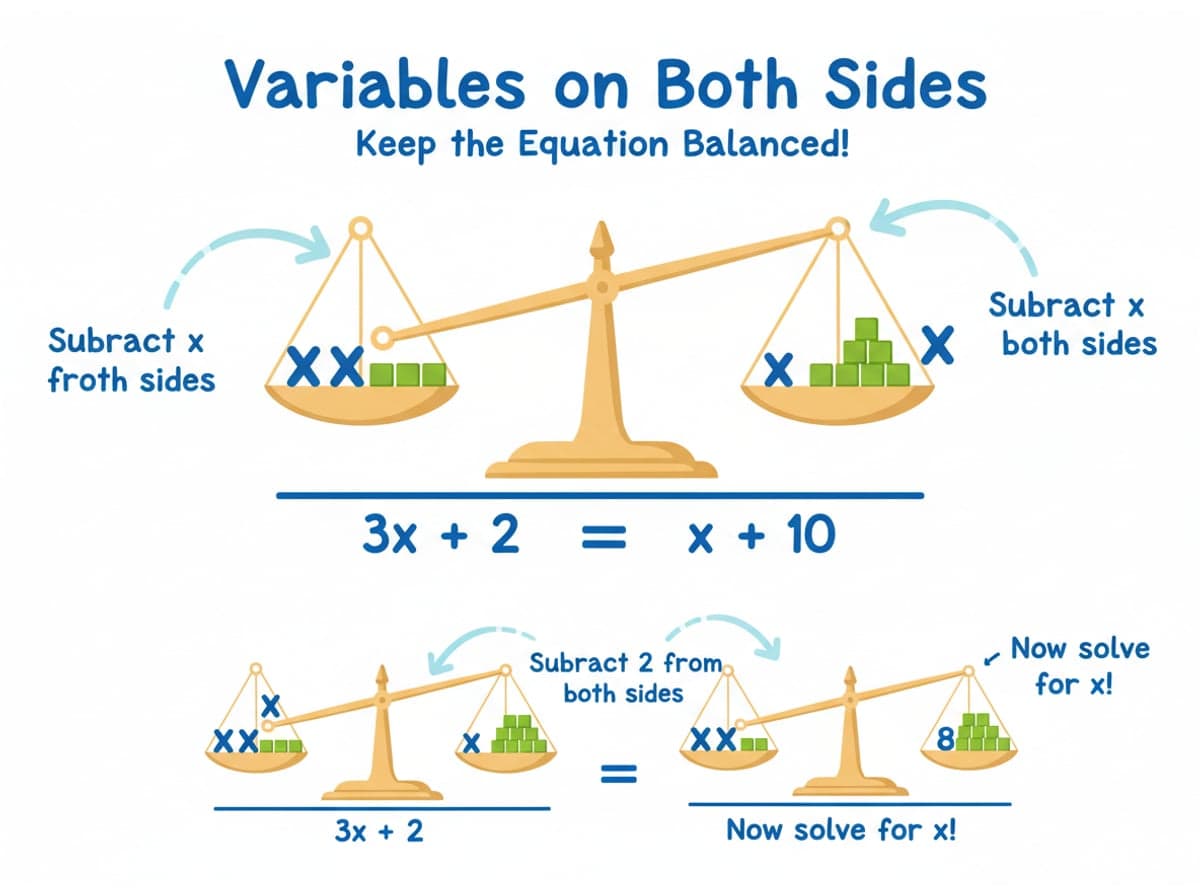
Milo's mistake was treating the move as a transfer with a sign change, like a carrier moving 3x to the right and flipping it, or adding x to the left. A true equation never gets carried; it only gets the same operation on both sides. Adding x made the left side 4x while the balance was silently broken, and 3 did not check in the original equation.
The fix is subtracting x from both sides. The left becomes 3x - x = 2x, and the right becomes x - x + 10 = 10, leaving 2x + 2 = 10. Then subtract 2 from both sides: 2x = 8, and divide by 2: x = 4. It is the same two-step recipe as before, with one extra gather at the front.
Check in the original: 3 * 4 + 2 = 14 on the left and 4 + 10 = 14 on the right, so the equation is balanced. The check is the whole point: an equation stays useful only if the value makes both sides truly equal. If a move felt like magic, substitution is the referee that shows whether it worked.
Keep this idea
Flip nothing: apply the same subtraction to both sides so the balance never breaks, then check the answer.
The practice checks apply only to the displayed examples. Follow your teacher’s guidance for your own assignments.
Get help with your own questionA practice lesson each week.
A short practice lesson for your inbox. Free, with a one-click unsubscribe.