
Balancing chemical equations
One small step at a time. Ask for a clue whenever you need one.
Ask about your own question- Step 1
- Step 2
- Step 3
- New question
Balance: H2 + O2 → H2O.
Common mix-up
In this example, a student wrote H4O2 (changed the subscripts to balance).
The student changed the formula to H4O2 so the atoms would match, inventing a molecule that is not water.
Guided example. Your answers aren’t saved or sent.
See why this works
Why can't you balance by changing H2O to H4O2?
Water is H2O, not H4O2. Learn how coefficients balance an equation without inventing new molecules.
Balance equations by writing coefficients in front of formulas; subscripts stay fixed because they define the substance.
A chemical equation must obey conservation of mass: the same number of every atom appears on both sides. H2 + O2 → H2O is not balanced. The right side has only one oxygen atom, while O2 supplies two. You cannot fix that by rewriting water as H2O2 or H4O2, because changing a subscript makes a different substance with different properties.
The only legal lever is the coefficient, the big number in front of a formula. Coefficients count whole molecules. Put a 2 in front of H2O: the right side now has 2 oxygen atoms and 4 hydrogen atoms. The left needs the same: a 2 in front of H2 gives 4 hydrogens, and O2 keeps its understood coefficient of 1.
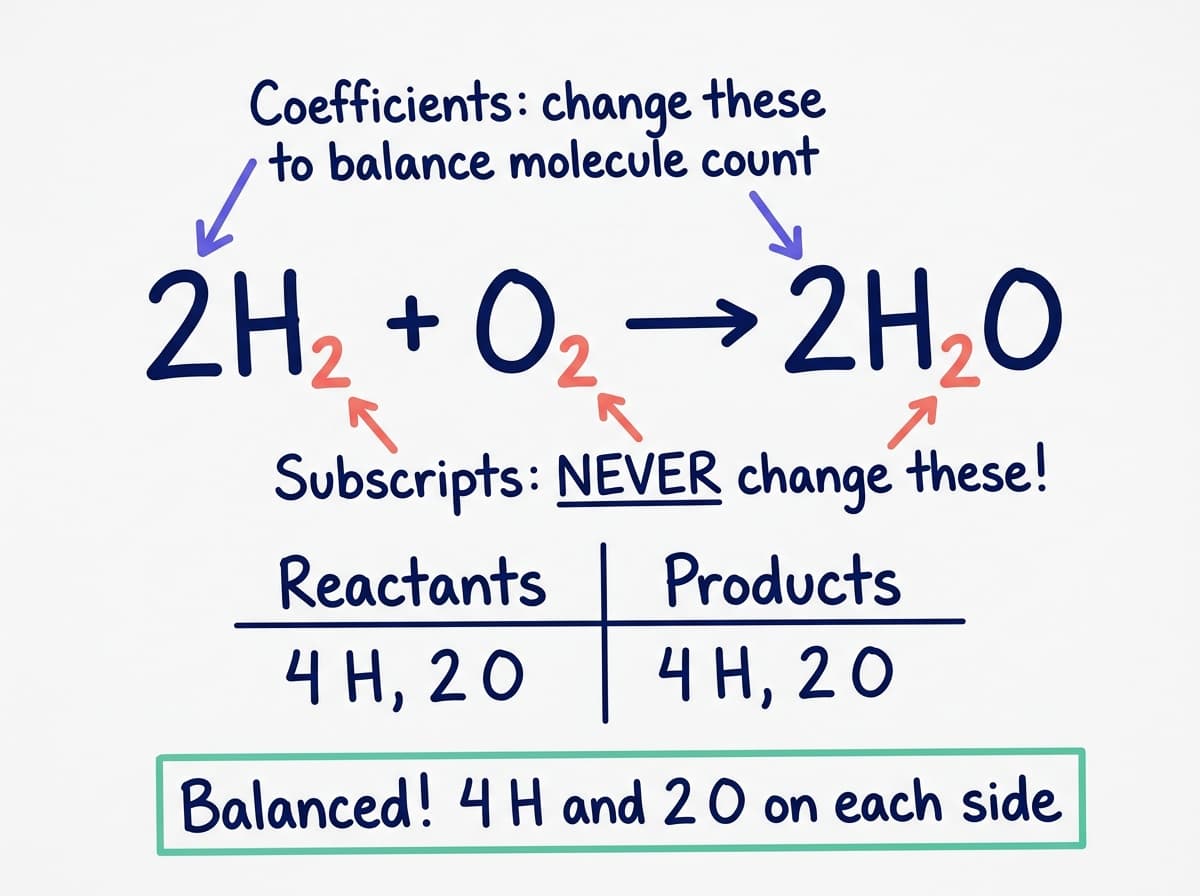
The balanced equation is 2H2 + O2 → 2H2O. The understood coefficient 1 is never written next to O2. Common mistakes are changing subscripts, or using coefficients that are not the smallest whole-number ratio. The smallest whole numbers that balance are the final answer, and any multiple of them is still balanced but not the simplest. Triple it and the equation is still true, but textbooks expect the simplest form.
Checking takes seconds: count each element on each side. Hydrogen is 4 and 4, oxygen is 2 and 2. Balanced. The formulas in the equation are still hydrogen, oxygen, and water: coefficients only changed how many, never what. A subscript change would have produced a different substance and a different equation, so the check protects both sides of the balance.
Keep this idea
Balance atoms with coefficients in front of formulas, never by changing subscripts, then check every element.
The practice checks apply only to the displayed examples. Follow your teacher’s guidance for your own assignments.
Get help with your own questionA practice lesson each week.
A short practice lesson for your inbox. Free, with a one-click unsubscribe.
Search all 106 free lessons for “Balancing chemical equations”