
Gas laws (Boyle, Charles, combined)
One small step at a time. Ask for a clue whenever you need one.
Ask about your own question- Step 1
- Step 2
- Step 3
- New question
A gas occupies 2.0 L at 1.0 atm. At constant temperature, the pressure doubles to 2.0 atm. What is the new volume? Then convert 25 °C to kelvins. Then find the new volume when 2.0 L at 300 K is warmed to 600 K.
Common mix-up
In this example, a student wrote 4.0 L, because twice the pressure should double the volume..
The student doubled the volume when the pressure doubled, treating Boyle's law as a direct relationship.
Guided example. Your answers aren’t saved or sent.
See why this works
Does doubling pressure double the volume?
Double the pressure and the volume halves; double the kelvin temperature and it doubles. Match each law to its direction.
Boyle: at constant T, pressure and volume are inversely related. Charles: at constant P, volume and kelvin temperature are directly related. Use kelvins.
Gas laws describe how pressure, volume, and temperature relate. Boyle's law says that at constant temperature, pressure and volume are inversely related: raise the pressure and the volume shrinks. P1V1 = P2V2. A gas at 2.0 L and 1.0 atm, squeezed to 2.0 atm, occupies 1.0 L, not 4.0 L. The squeezing and the shrinking happen in opposite directions, like a see-saw about the constant held in the middle.
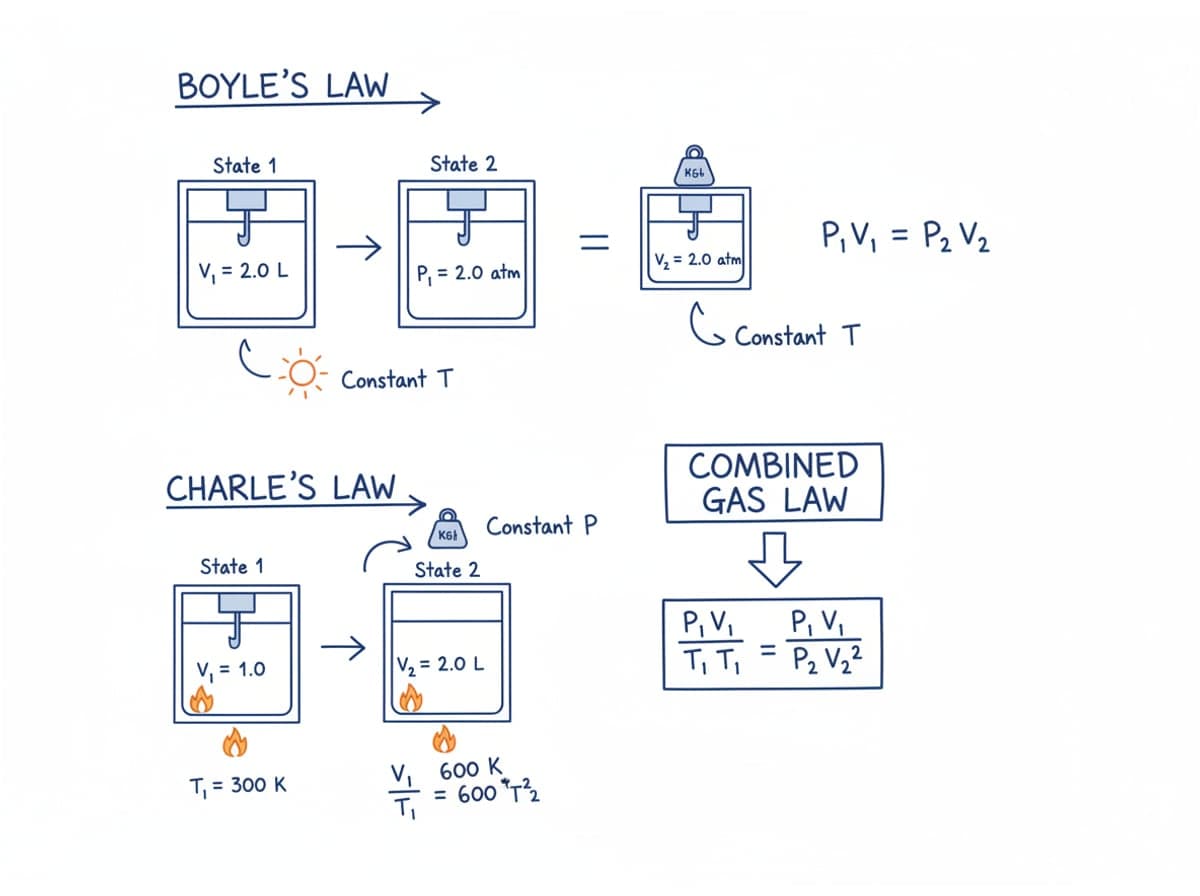
Charles's law says that at constant pressure, volume and temperature move together: V1/T1 = V2/T2. Warm a gas and it expands. The common mistake is treating both pairs the same way. Pressure and volume move opposite; volume and kelvin temperature move together. Test the direction on the equation before plugging numbers in. The temperature scale, not just the numbers, decides whether the ratio is correct.
Temperatures must be in kelvins before any gas law is used. The conversion is T(K) = T(°C) + 273. Celsius adds another trap: using 25 and 75 in a ratio would distort the answer, because kelvin is the only scale that starts at absolute zero and makes the ratios honest. Kelvins start at absolute zero, so 300 K is genuinely double 150 K. Celsius values are offsets, not true ratios.
The combined gas law, P1V1/T1 = P2V2/T2, folds both into one equation. Whatever is held constant cancels automatically. Plug in the values, solve for the one unknown, and keep the units with the answer. Check the direction once more at the end against the trends. If the two temperatures cancel and the pressure halves, expect the volume to expand. That direction check catches inverted equations before they cost you the question.
Keep this idea
Boyle: P and V move inversely. Charles: V and T move together in kelvins. The combined law solves for any one of P, V, or T.
The practice checks apply only to the displayed examples. Follow your teacher’s guidance for your own assignments.
Get help with your own questionA practice lesson each week.
A short practice lesson for your inbox. Free, with a one-click unsubscribe.
Search all 106 free lessons for “Gas laws (Boyle, Charles, combined)”