
Types of chemical reactions
One small step at a time. Ask for a clue whenever you need one.
Ask about your own question- Step 1
- Step 2
- Step 3
- New question
Classify: 2Na + Cl2 → 2NaCl. Then classify CaCO3 → CaO + CO2, and CH4 + 2O2 → CO2 + 2H2O.
Common mix-up
In this example, a student wrote All three are combustion reactions..
The student called 2Na + Cl2 → 2NaCl combustion because two substances react together and give off light.
Guided example. Your answers aren’t saved or sent.
See why this works
Synthesis or combustion: how can you tell?
A reaction can be named by its pattern, not its colors or smells. Look at how many substances come in and how many go out.
Synthesis combines reactants into one product, decomposition splits one reactant, and combustion burns a fuel in oxygen.
Reaction types are about structure, not details. Synthesis means two or more reactants combine into one product, like 2Na + Cl2 → 2NaCl. Decomposition is the reverse: one compound breaks into simpler substances, like CaCO3 → CaO + CO2, the way limestone breaks down when heated. Count what goes in and what comes out. The classification question is really about the count, not about the substances.
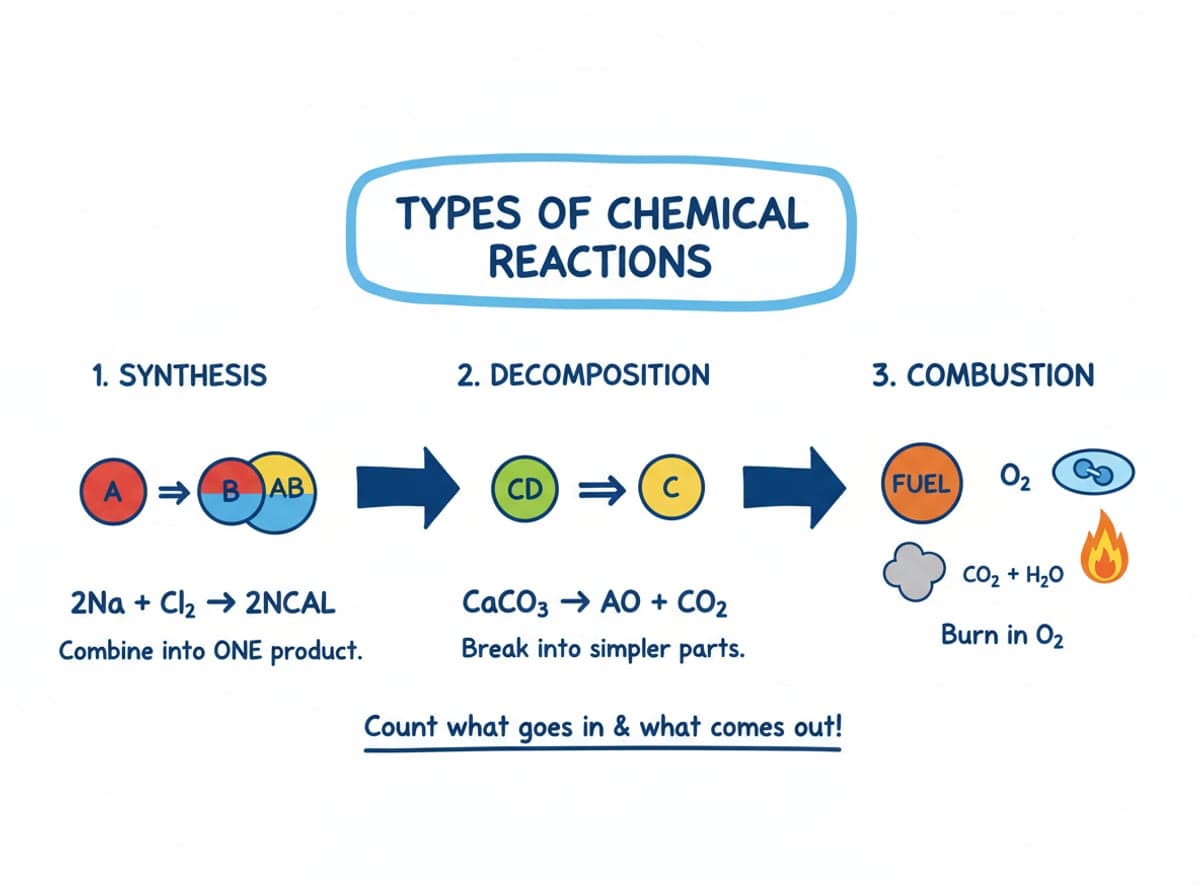
Combustion is the burning of a fuel in oxygen. A hydrocarbon such as CH4 burning in O2 gives CO2 and H2O plus energy, which is why combustion reactions feel hot and usually need a spark to start. Heat is not written as a product in the equation, but it is the signature of this type, and the oxygen is the fuel's partner.
Other types exist, including replacements. Single replacement has one element take the place of another, and double replacement swaps partners between two compounds. The reliable method is to count the reactants and products and name the pattern. Memorize the shapes, not the elements, and the classification becomes quick. A replacement equation always shows an element alone on one side, and that alone can help you spot it from across the page.
The common mistake is calling every bright and glowing reaction combustion. Look at the shape of the equation first: what combines, what splits, what swaps, and only then decide the type. A synthesis can glow, and a decomposition can be quiet, so the structure of the equation wins. What glows or what steams feels like evidence, but the equation's shape is what matters.
Keep this idea
Count reactants and products: combining is synthesis, splitting is decomposition, fuel plus oxygen is combustion.
The practice checks apply only to the displayed examples. Follow your teacher’s guidance for your own assignments.
Get help with your own questionA practice lesson each week.
A short practice lesson for your inbox. Free, with a one-click unsubscribe.
Search all 106 free lessons for “Types of chemical reactions”