Claims, evidence and reasoning
One small step at a time. Ask for a clue whenever you need one.
Ask about your own question- Step 1
- Step 2
- Step 3
- New question
Label and fix: City buses should be free. In Tallinn, residents ride free and car traffic in the centre fell. It would help people.
Common mix-up
In this example, a student wrote City buses should be free. In Tallinn, residents ride free and car traffic in the centre fell. It would help people..
Priya had a claim and a real fact, and she finished by restating the claim in softer words. The paragraph looked complete, so she assumed the argument was complete too.
Guided example. Your answers aren’t saved or sent.
See why this works
Why does “because it's true” get circled?
Every sentence in the paragraph is true, and the paragraph still does not argue anything. What is missing is the sentence that links the evidence to the claim.
A claim, the evidence for it, and the reasoning that shows why the evidence supports the claim.
An argumentative paragraph usually has three kinds of sentence, and each does a different job. The claim states what you want the reader to accept. The evidence gives the fact, quotation or example you found. The reasoning explains why that evidence makes the claim more likely to be true. Miss the third one and the reader is left to make the connection themselves — which they usually will not.
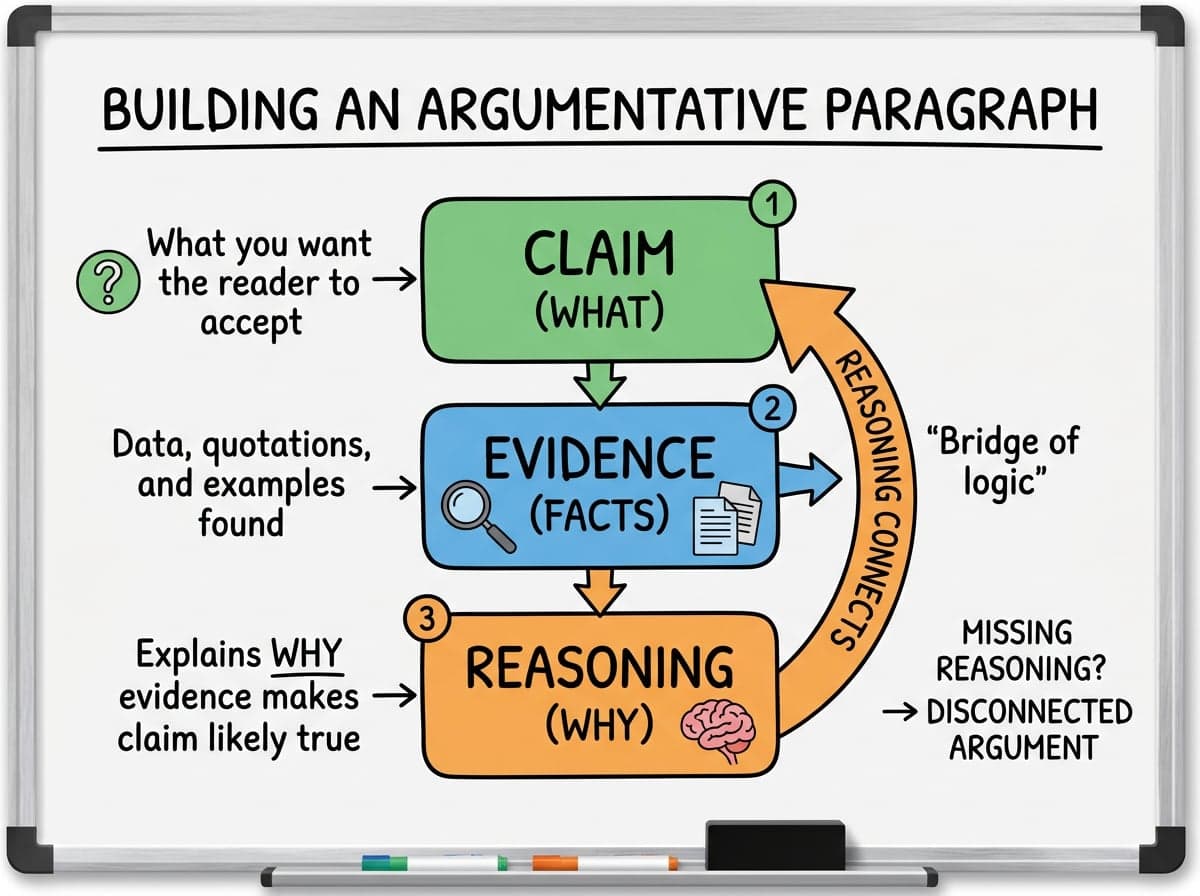
Look at: “City buses should be free. In Tallinn, residents ride free and car traffic in the centre fell. It would help people.” The first sentence is the claim. The second is evidence. The third is not reasoning; it is the claim again in different words. A reader can see the fact and still ask how it bears on your point.
Reasoning sounds like this: “Because the fare is what stops people making a short trip by bus, removing it puts more of those trips on public transport — which is why Tallinn saw centre traffic fall.” It takes one specific part of the evidence and states the link out loud. That single move is what examiners call analysis, and it is the most common thing missing from a student paragraph.
A useful check is to read only your claim and your evidence and ask whether a sceptical classmate could accept both and still disagree with you. If they could, the paragraph needs reasoning. If they could not, you have finished the job — and adding a further sentence would only repeat yourself.
Keep this idea
In an argument paragraph, state the claim, give the evidence, then spend a sentence explaining why that evidence supports the claim. A paragraph with a claim and a fact but no link looks finished and argues nothing.
The practice checks apply only to the displayed examples. Follow your teacher’s guidance for your own assignments.
Get help with your own questionA practice lesson each week.
A short practice lesson for your inbox. Free, with a one-click unsubscribe.
Search all 106 free lessons for “Claims, evidence and reasoning”