
Topic sentences and paragraph structure
One small step at a time. Ask for a clue whenever you need one.
Ask about your own question- Step 1
- Step 2
- Step 3
- New question
Tidy this paragraph: Dogs make great pets. They are loyal. My cousin has a cat. Dogs also get you outside for walks.
Common mix-up
In this example, a student wrote Dogs make great pets. They are loyal. My cousin has a cat. Dogs also get you outside for walks..
Sam kept the paragraph together because every sentence was about pets generally. The paragraph was about why dogs make good pets, so the sentence about his cousin's cat was pulling in a different direction.
Guided example. Your answers aren’t saved or sent.
See why this works
Why does my paragraph feel like two paragraphs?
A reader gets to the third sentence and loses the thread. Usually that is not because the writing is hard — it is because the paragraph is quietly doing two jobs at once.
One paragraph, one job: a topic sentence announces it and every other sentence serves it.
A paragraph is a unit of thought, not a block of text. Its topic sentence announces the single idea the paragraph will develop, and every other sentence either supports that idea or explains it. When a paragraph has one job, a reader can follow it without effort. When it has two, the reader has to work out for themselves where the second one started.
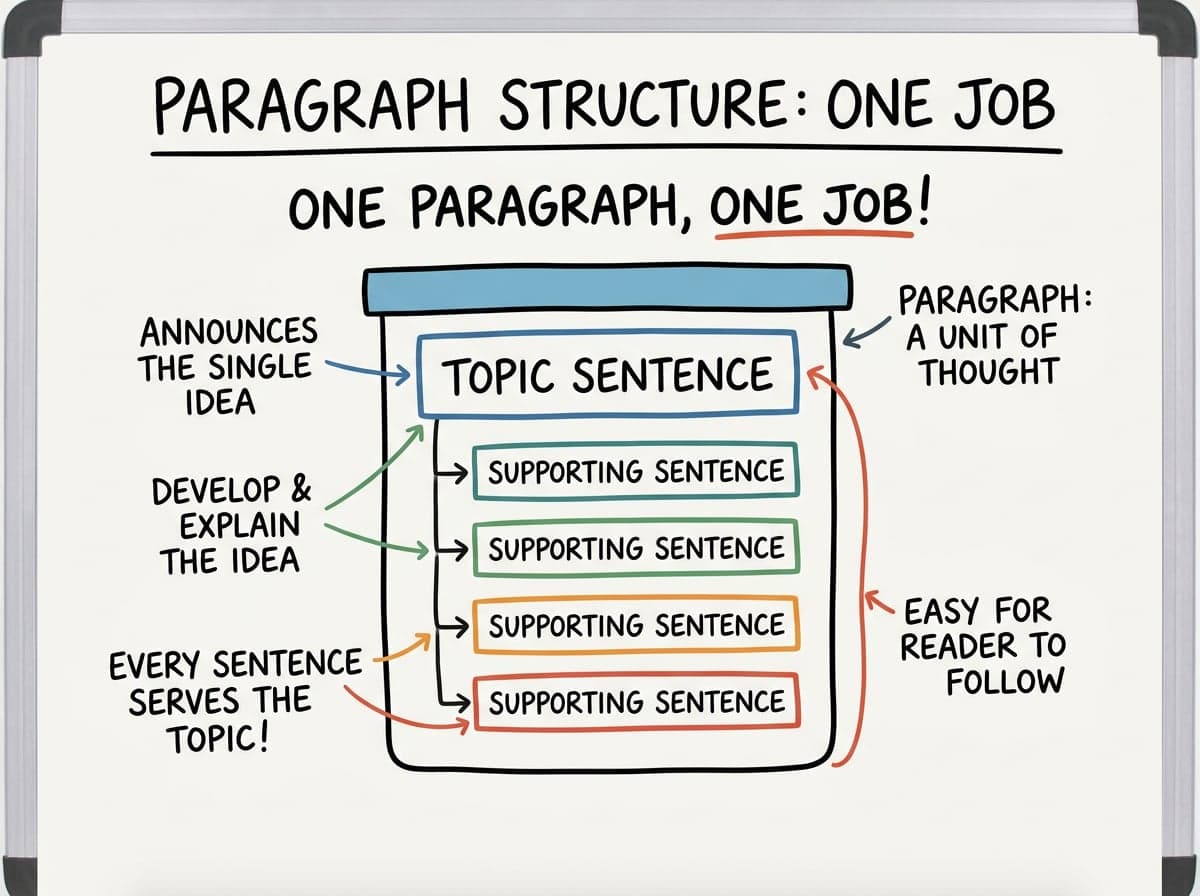
That is what makes a paragraph feel like two. Look at: “Dogs make great pets. They are loyal. My cousin has a cat. Dogs also get you outside for walks.” Three of those sentences serve the topic sentence. The third one is about a different animal and a different point, so the reader is briefly somewhere else and then has to come back.
The fix is rarely to delete it. A sentence that does not belong usually means the idea inside it belongs somewhere else — its own paragraph, or a later section of the essay. Moving it is often better than cutting it, and it costs you nothing to decide which.
Order matters too, once the paragraph has one job. Put the topic sentence first unless you have a reason not to, then arrange the supporting sentences so each one builds on the one before. A reader who can predict where you are going is a reader who will still be with you at the end of the paragraph.
Keep this idea
Give every paragraph one job, announced by its first sentence. When a sentence does not serve that job, move it to where it belongs instead of deleting it, then check that the supporting sentences build in a sensible order.
The practice checks apply only to the displayed examples. Follow your teacher’s guidance for your own assignments.
Get help with your own questionA practice lesson each week.
A short practice lesson for your inbox. Free, with a one-click unsubscribe.
Search all 106 free lessons for “Topic sentences and paragraph structure”