
Thesis statements
One small step at a time. Ask for a clue whenever you need one.
Ask about your own question- Step 1
- Step 2
- Step 3
- New question
Improve this thesis: School uniforms affect students.
Common mix-up
In this example, a student wrote School uniforms affect students..
Maya wrote a sentence that was true, so it felt safe. She had named a topic instead of choosing a side, which left her body paragraphs with nothing to prove.
Guided example. Your answers aren’t saved or sent.
See why this works
Why does my teacher say my thesis is vague?
You wrote “School uniforms affect students” and the margin says “so what?”. The sentence is true, and that is exactly the problem: nobody could argue with it.
A thesis takes a side and previews the reason, so a reader can disagree with it.
A topic tells your reader what the essay is about. A thesis tells them what you are going to argue about it. “School uniforms affect students” is a topic sentence wearing a thesis costume: uniforms affect students by existing, which nobody disputes. A reader who agrees with you before reading a word has nothing to do.
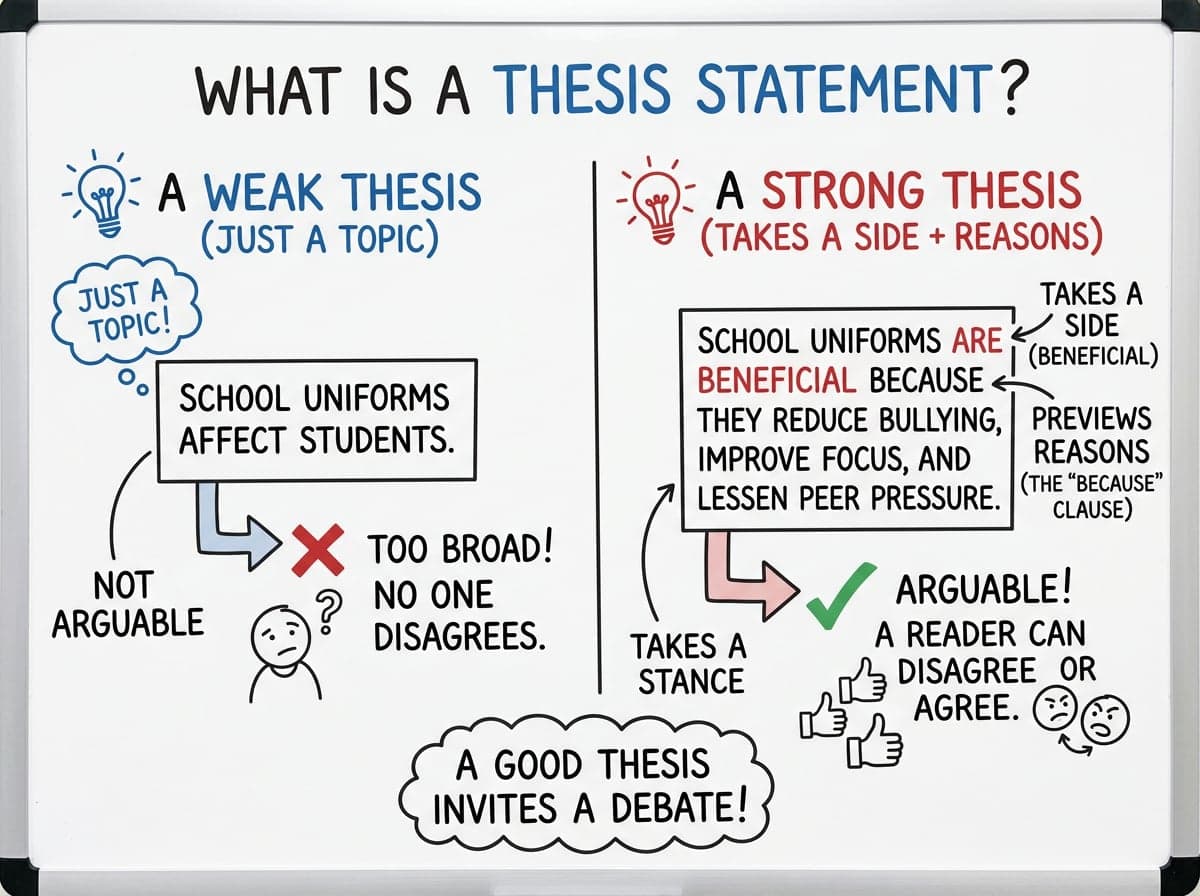
The test is disagreement. Could a thoughtful person write the opposite? “School uniforms improve focus by removing morning clothing decisions” passes, because someone could argue that uniforms do not improve focus at all. “School uniforms affect students” fails, because there is no opposite to write. If you cannot imagine the other side, you have written a fact, not an argument.
A thesis also previews the reason, and the reason is what your body paragraphs will each develop. Watch the difference between announcing a plan and making a claim. “This essay will discuss school uniforms” tells the reader what you are about to do; “School uniforms improve focus because they remove morning decisions” tells them what you are going to prove. Teachers mark the second one, not the first.
Vagueness is usually a missing decision. You have not yet chosen which effect matters most, so the sentence stays wide enough to avoid being wrong. Choose the side you can support with the evidence you actually have, narrow the claim until it is specific, and the sentence stops being vague. If your evidence is thin, narrow the claim further rather than widening it.
Keep this idea
A thesis is a claim someone could argue against, plus the reasons you will develop. If you cannot write the opposite of your sentence, you have named a topic — narrow it, take a side, and preview the reason your evidence can support.
The practice checks apply only to the displayed examples. Follow your teacher’s guidance for your own assignments.
Get help with your own questionA practice lesson each week.
A short practice lesson for your inbox. Free, with a one-click unsubscribe.