What are those bars my child draws for word problems?
What is a bar model, and why draw a picture instead of just writing an equation?
A bar model is a rectangle drawn to hold the numbers in a word problem and show how they relate. One bar can stand for a whole that is split into its parts, or two bars can be placed one above the other to compare two amounts. The drawing turns the sentence into something the child can do arithmetic on.
Why it looks different from what you were taught
If you were taught to hunt for key words in a word problem — "in all" means add, "left" means subtract — the bars look like drawing for its own sake. The bar model moves the decision somewhere else: instead of matching a phrase to an operation, the child draws which amount is the whole and which amounts are its parts, and the operation follows from the picture.
In a part-whole bar, a single rectangle stands for the total, and it is cut into the pieces the problem names. If the whole is known and one part is known, the missing piece is the difference between them, so the work is a subtraction. If both parts are known and the whole is missing, the work is an addition. The same bar answers both kinds of question, which is why it is taught before the child is told which operation to use.
In a comparison bar, two bars are drawn one above the other, and the longer bar is the larger amount. The piece by which it sticks out is the difference between the two amounts. That layout is used for "how many more" and "how many fewer" questions.
The bars do not need to be drawn to scale. They are a way of writing down the structure of the problem, in the same way an equation is, and a quick, crooked drawing does the job.
The parts of the method
- Part-whole bars
- One bar is the whole. It is divided into sections, one for each part named in the problem. Known amounts get their numbers written in, and the unknown amount gets a question mark.
- Comparison bars
- Two bars, one above the other, with the longer bar standing for the larger amount. The overhang at the end is the difference. Used when a problem compares two amounts rather than breaking one amount into pieces.
- Labels and question marks
- The bars are labeled as the child reads: the total goes over the whole bar, each part goes in its section. The question mark shows exactly what the problem is asking for, so there is no doubt about what to solve for.
- From picture to equation
- Once the bar is drawn, the arithmetic is one step. A part-whole bar with the whole and one part known means subtracting the part from the whole; the picture has already decided the operation, so the child writes the number sentence and finishes it.
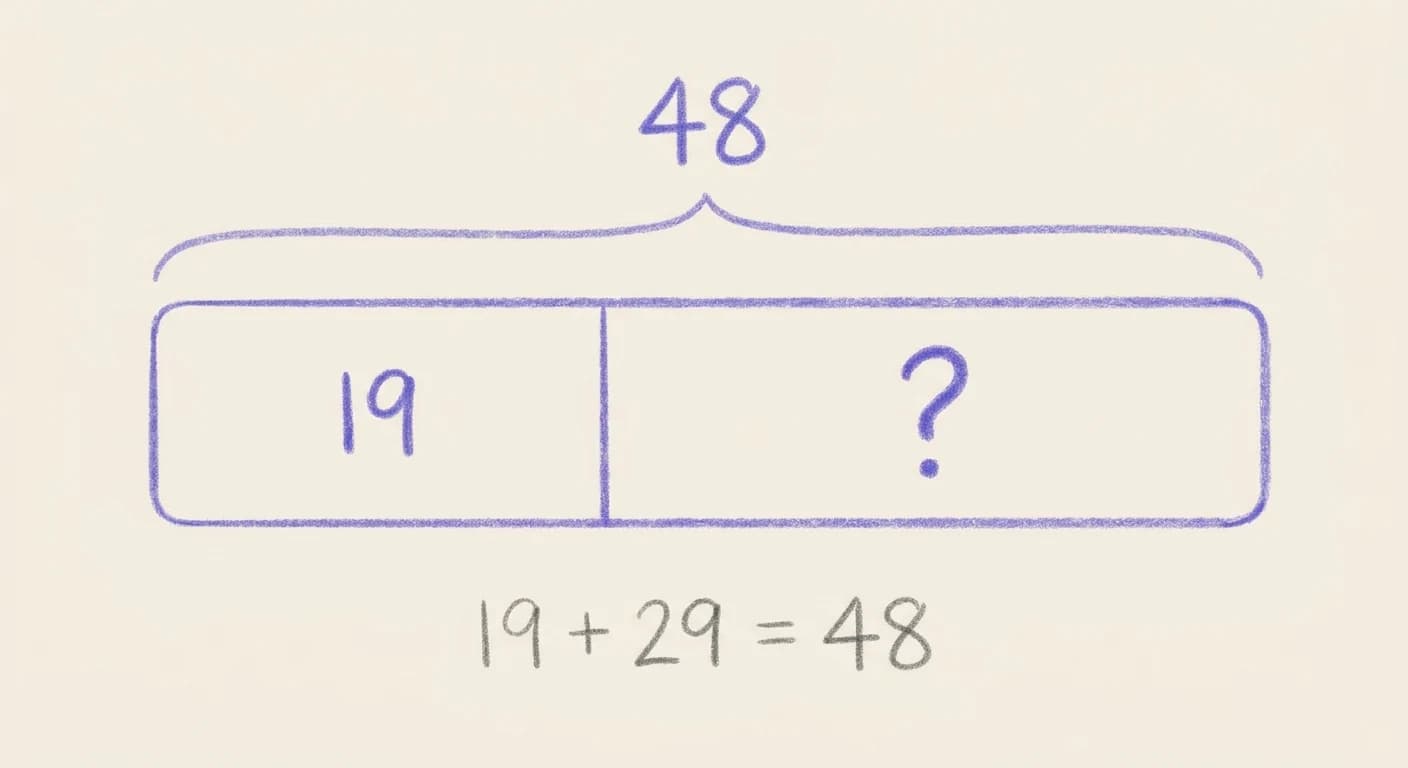
A worked example: A shelf holds 48 books. 19 of them are fiction. How many are non-fiction?
- One bar labeled 48 — the whole shelfThe 48 is the total, so it goes above the single bar.
- The bar split into two sections: 19 and ?The two kinds of book are the two parts. The fiction part is known, so 19 goes in that section and the unknown non-fiction part gets the question mark.
- 48 − 19 = 29The whole minus the known part gives the missing part. The drawing already showed that this was a subtraction.
- 19 + 29 = 48Checking that the two parts fill the whole bar confirms the answer.
29 non-fiction books, because 48 − 19 = 29 and 19 + 29 = 48.
What you can do at the table
- Ask which number is the whole before anything is drawn. Most of the difficulty in these problems is deciding whether the amount in the story is a total or a part, and that question settles it.
- Ask whether the problem needs one bar split into pieces or two bars to compare. A story that mentions two separate things being compared gets comparison bars; a story about one thing made of pieces gets a part-whole bar.
- Leave the drawing rough. Insisting on straight lines and accurate lengths slows the child down without changing a single number on the page.
- Read the question mark out loud. "The question mark is the non-fiction books, so what do we know about the whole bar?" That keeps attention on the answer being asked for rather than on the drawing.
The move that backfires: Do not write the equation for your child before they have drawn the bar, even when the arithmetic is obvious to you. The drawing is the part being taught and assessed, and an equation handed over early turns the model into decoration the child copies without using. If they are stuck, ask what the whole is and what the parts are, and let the bars come from their answer.
Free lessons that teach this step
What is the opposite of adding 7?
To undo an addition, subtract the same amount from both sides; the equation stays balanced.
Try the lesson freeWhich number goes first in a ratio?
A ratio lists numbers in the exact order they are named, then simplifies by dividing both parts by the same factor.
Try the lesson freeIf tonight’s question is not on this list
Bring the actual question — typed, or a photo of the page — and Clue gives one clue at a time and asks your child for the next step. The first 5 questions are free, follow-ups included, with no sign-up and no card.
Try 5 questions freeMethods are described as they are commonly taught, and your school may use different names for the same steps. Check with your child’s teacher when the working has to match their expectations.