
Ratios
One small step at a time. Ask for a clue whenever you need one.
Ask about your own question- Step 1
- Step 2
- New question
A class has 10 students who ride the bus and 6 who walk. What is the ratio of walkers to bus riders in simplest form?
Common mix-up
In this example, a student wrote 5:3.
Nia simplified 10:6 instead of 6:10. She got the right simplification idea but answered the ratio of bus riders to walkers, not walkers to bus riders.
Guided example. Your answers aren’t saved or sent.
See why this works
Which number goes first in a ratio?
Nia counted 10 bus riders and 6 walkers and wrote the ratio of walkers to bus riders as 5:3. She answered a different question than the one asked.
A ratio lists numbers in the exact order they are named, then simplifies by dividing both parts by the same factor.
A ratio compares two quantities in a fixed order. Walkers to bus riders means the walkers' count goes first, then the bus riders' count. With 6 walkers and 10 bus riders, the ratio starts as 6:10, where the order itself carries meaning. Flip the numbers and you are comparing a different pair, even if the two counts are exactly the same as before.
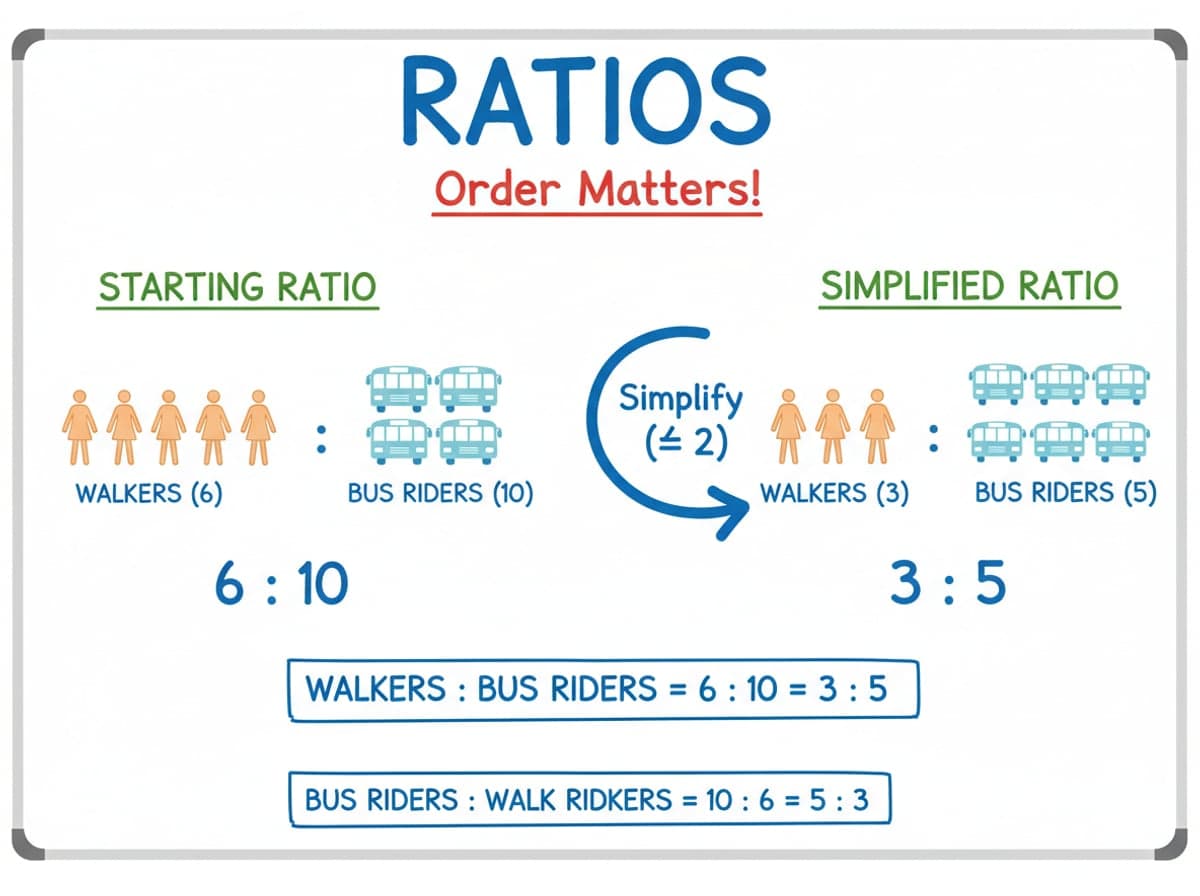
Nia's mistake was simplifying 10:6 instead of 6:10. Ten to six is the ratio of bus riders to walkers, which is a true statement but not the one the question asked for. She simplified the right idea in the wrong order, and simplifying never fixes the order: 10:6 simplifies to 5:3, still the reverse of what was wanted. Order is not a style choice; it is part of the answer itself.
The fix is a simplification, exactly like a fraction: divide both parts by the same number so the comparison does not change. The largest number dividing both 6 and 10 is 2, so 6:10 becomes 3:5 because 6 / 2 = 3 and 10 / 2 = 5. Both counts shrink, but the relationship between them stays the same. Scale up or down, and the ratio only changes its dress, not its size.
Check by scaling back up: 3:5 times 2 is 6:10, the original counts. Dividing both parts keeps the ratio equivalent, just like simplifying a fraction, and the order stays walkers first because that is how the question was worded. Say the ratio out loud as you write it: three walkers for every five bus riders. Said aloud, the ratio states the question back, order included.
Keep this idea
Read the order in the question carefully, then simplify both parts of the ratio by the same factor.
The practice checks apply only to the displayed examples. Follow your teacher’s guidance for your own assignments.
Get help with your own questionA practice lesson each week.
A short practice lesson for your inbox. Free, with a one-click unsubscribe.