
Percent increase and decrease
One small step at a time. Ask for a clue whenever you need one.
Ask about your own question- Step 1
- Step 2
- New question
A jacket costs $50. The price increases by 20%. What is the new price?
Common mix-up
In this example, a student wrote 10.
Zara computed the 20% rise correctly but stopped there. She treated the amount of change, $10, as if it were the new price.
Guided example. Your answers aren’t saved or sent.
See why this works
Which number is the new price?
Zara found that 20% of $50 is $10 and handed me $10 as the new price. The $10 was the increase, not the result.
For an increase, add the percent amount to the original; for a decrease, subtract it from the original.
A percent increase asks for a new total: the original price plus the raise. The raise itself is 20% of the original, not 20% of nothing. So the plan is two moves: find 20% of $50, which is $10, then add it to the original price. The percent never replaces the price; it only tells you how much extra to add.
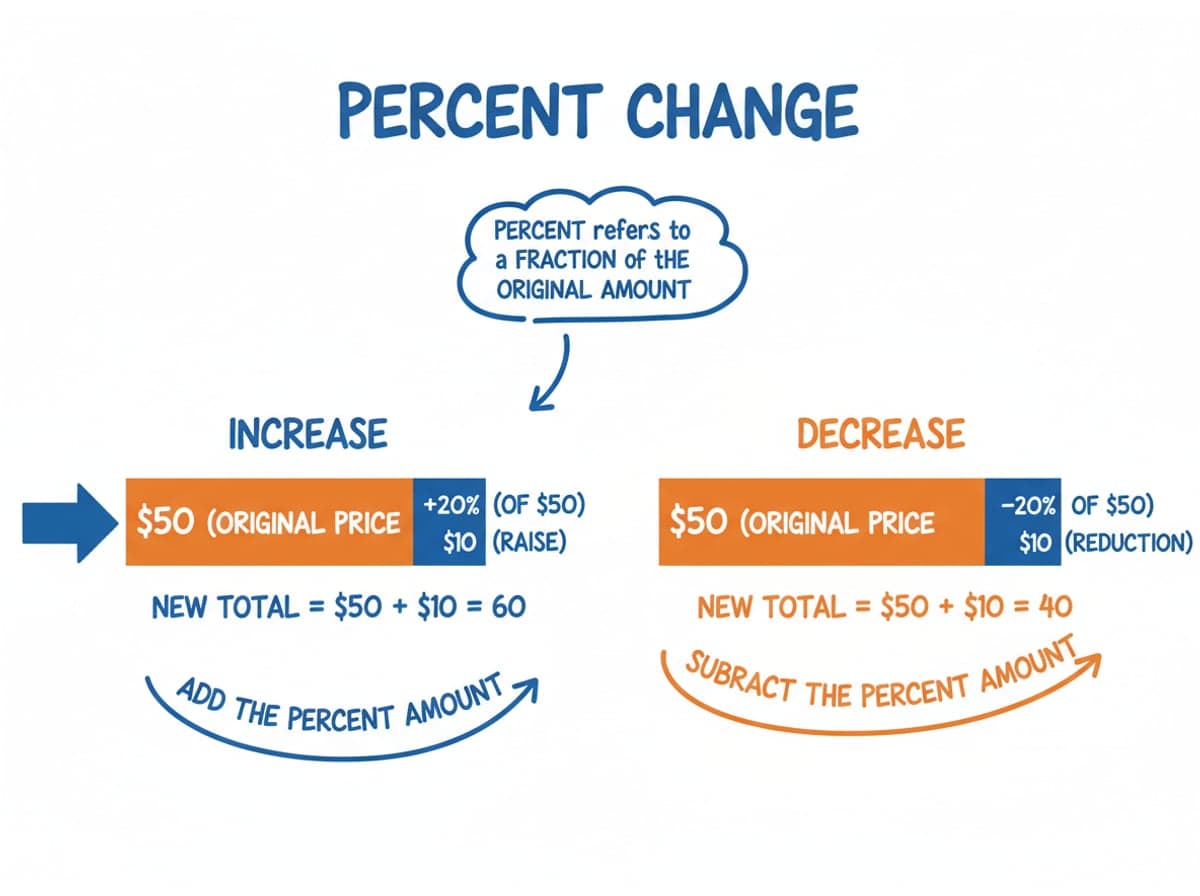
Zara's mistake was stopping after the first move. Her $10 was the size of the increase, the part that gets added. A jacket that was $50 and goes up in price cannot still cost $10 afterwards, and that quick sanity check is a good habit to apply every time. Asking whether the answer is plausible would have caught the error before it was submitted.
The fix is one clean comparison: original plus change equals new price. Here $50 + $10 = $60. The percent amount is always found against the original amount, because the percent describes a piece of that original, and then that piece is added or subtracted. One sentence summarizes the whole job: find the piece, then move it. Write the original price next to the percent, and the add or subtract choice becomes obvious.
Check the answer by reversing: a $60 jacket dropped back down by the same $10 would lose 10/60, roughly 16.7%, not 20%. That shows why you never take the percent off the new price. The reverse check confirms that $60 is right for this problem, and the whole percent story has a single logical spine. Original, change, result: those three numbers tell the whole story.
Keep this idea
Find the percent amount of the original, then add it for an increase or subtract it for a decrease.
The practice checks apply only to the displayed examples. Follow your teacher’s guidance for your own assignments.
Get help with your own questionA practice lesson each week.
A short practice lesson for your inbox. Free, with a one-click unsubscribe.
Search all 106 free lessons for “Percent increase and decrease”