
Unit rates
One small step at a time. Ask for a clue whenever you need one.
Ask about your own question- Step 1
- Step 2
- Step 3
- New question
Amara buys 3 apples for $2.40. What is the unit rate in dollars per apple?
Common mix-up
In this example, a student wrote 1.25.
Ben did 3 / 2.40 = 1.25, which is apples per dollar. To get dollars per apple he needed 2.40 / 3, money divided by items.
Guided example. Your answers aren’t saved or sent.
See why this works
How much does one apple cost?
Ben paid $2.40 for 3 apples and divided 3 by 2.40, getting 1.25. He computed apples per dollar instead of dollars per apple.
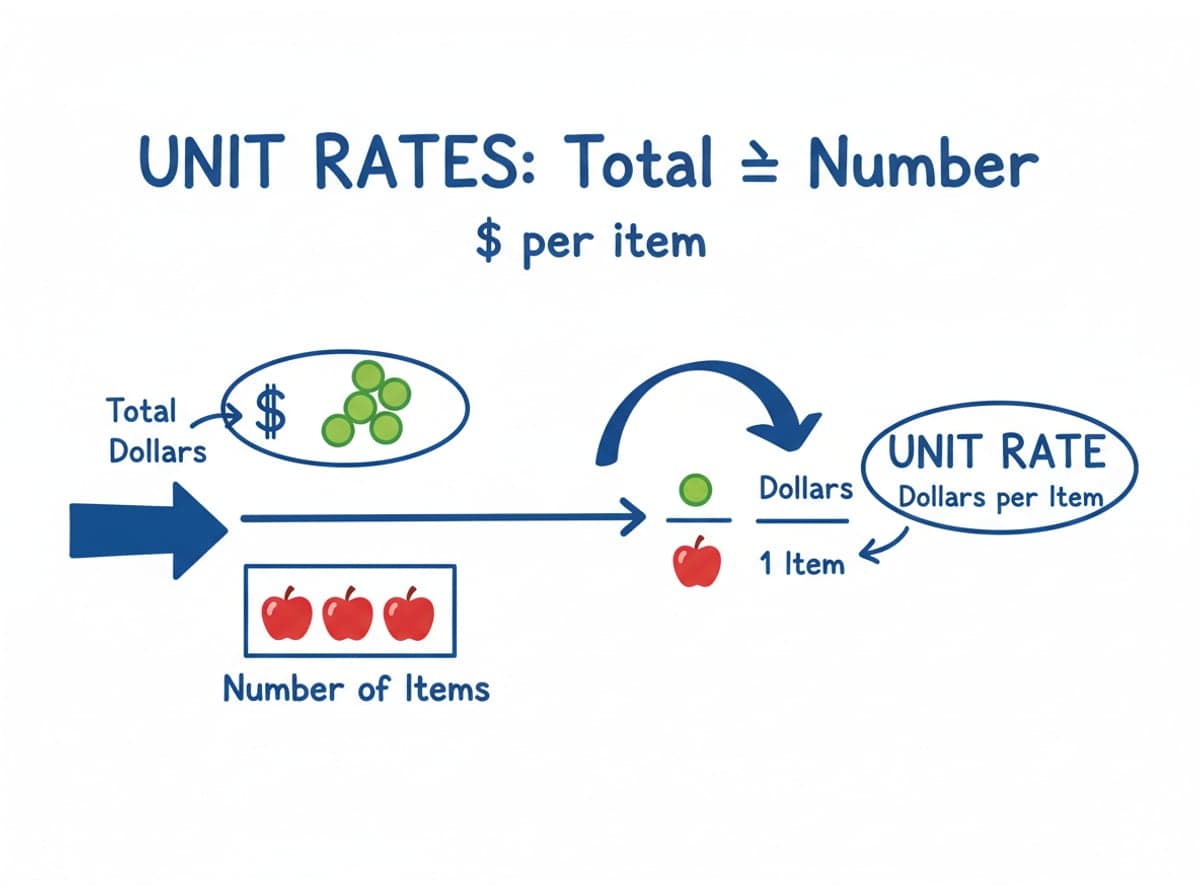
A unit rate divides the total by the number of items: total dollars divided by number of items gives dollars per item.
A unit rate is a ratio with a 1 on the bottom: dollars per single apple. The problem gives $2.40 for 3 apples, and the question is what one apple costs. The total money goes on top, and the number of apples goes on the bottom, because the unit is dollars per apple. Read the phrase out loud and the order falls out: dollars per apple means dollars divided by apples.
Ben's mistake was the reverse: he did 3 / 2.40 = 1.25. That computes apples per dollar, which is a real rate but not the one asked for. Dividing the wrong way is the classic unit-rate error, and the units at the end always betray it: 1.25 of what? Apples per dollar, not dollars per apple. Always attach the units to the number before you trust it.
Working in cents keeps the math tidy. $2.40 is 240 cents, and spreading those across 3 apples gives 240 / 3 = 80 cents per apple. The division is cleaner in whole cents, and there is nothing scary about the decimal until the final step, when 80 cents becomes $0.80, the unit rate in dollars per apple. Cents first, dollars at the end, and the decimal lands in the right place.
Check with multiplication: 3 apples at $0.80 each total $2.40, exactly the original price. A unit rate should always multiply back to the original total, which is the quickest way to confirm that you divided in the right order. If the numbers do not reproduce the original price, flip the division and try again. The check turns a rate problem into a multiplication problem, which is much easier to trust.
Keep this idea
Divide the total by the number of items, and let the units (dollars per item) decide which number goes on top.
The practice checks apply only to the displayed examples. Follow your teacher’s guidance for your own assignments.
Get help with your own questionA practice lesson each week.
A short practice lesson for your inbox. Free, with a one-click unsubscribe.