
Percent of a number
One small step at a time. Ask for a clue whenever you need one.
Ask about your own question- Step 1
- Step 2
- New question
What is 15% of 80?
Common mix-up
In this example, a student wrote 120.
Ivan converted 15% to 1.5, moving the decimal one place instead of two, so his result was ten times too big at 120.
Guided example. Your answers aren’t saved or sent.
See why this works
What does percent of really mean?
Ivan found 15% of 80 by computing 1.5 * 80 and wrote 120. He moved the decimal the wrong way when converting 15%.
Percent means per hundred, so 15% is 0.15, and of means multiply.
Percent is a special ratio: it compares a number to 100. Fifteen percent means 15 out of every 100, which as a decimal is 0.15. The percent sign only says out of 100; it does not change the digits, only their place value. So converting is just moving the decimal point, and the point moves left because hundredths are smaller than ones.
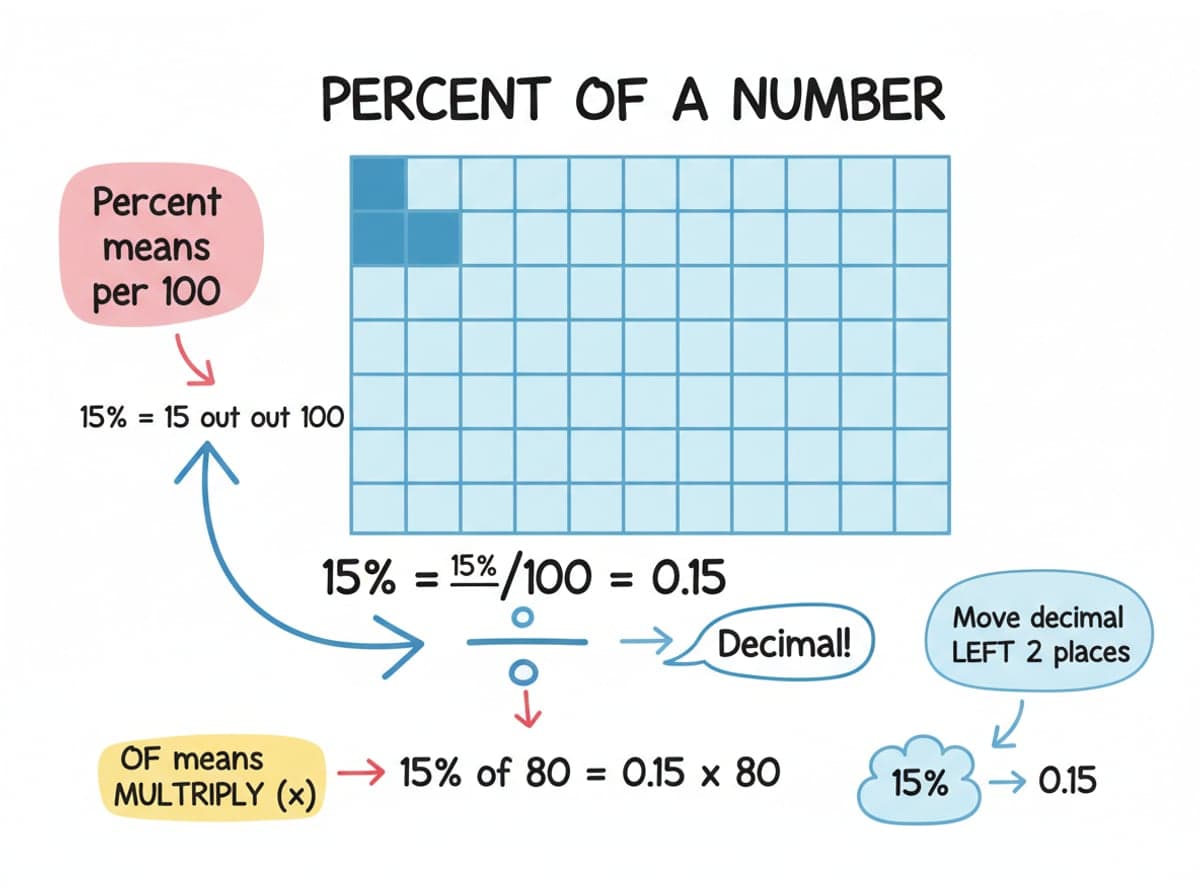
Ivan's mistake was moving the decimal one place instead of two. He turned 15% into 1.5, which is 150 per hundred, ten times too big. Then 1.5 * 80 = 120, a result that is way more than the number he started with, a red flag since 15% of anything should be a fraction of it. Ten times too big in the conversion means ten times too big in the answer.
The fix is converting correctly. 15% = 15 / 100 = 0.15, then multiply: 0.15 * 80. Fifteen times 80 is 1200, and 0.15 has two decimal places, so the product is 12. That is less than 80, exactly what a percent of a number should be, and the place-value shift lands the decimal logically. Convert once, carefully, and the multiply is the easy half of the job.
Check in a friendly way: 10% of 80 is 8, and 5% of 80 is 4, so 10% + 5% = 15% gives 8 + 4 = 12. Two independent methods landing on the same number is the strongest sign the answer is right. Split the percent into friendly pieces whenever the decimal math feels slippery. The friendly-pieces route also works for many other percent problems.
Keep this idea
Convert the percent to a decimal by moving the point two places left, then multiply.
The practice checks apply only to the displayed examples. Follow your teacher’s guidance for your own assignments.
Get help with your own questionA practice lesson each week.
A short practice lesson for your inbox. Free, with a one-click unsubscribe.