
Proportions
One small step at a time. Ask for a clue whenever you need one.
Ask about your own question- Step 1
- Step 2
- New question
Solve for x: 6/10 = 30/x.
Common mix-up
In this example, a student wrote 18.
Tess multiplied the two numerators and divided by one denominator: 6 * 30 / 10 = 18. The correct pairing puts the 30 opposite the x.
Guided example. Your answers aren’t saved or sent.
See why this works
Where do the cross products come from?
Tess solved 6/10 = 30/x by computing 6 * 30 / 10 and got 18. The cross products were paired wrong.
In a proportion the cross products are equal: a/b = c/d means a * d = b * c.
A proportion says two ratios are the same: 6/10 = 30/x claims that 6 to 10 is the same scaling as 30 to x. Both sides must stay in balance, and multiplying the diagonal pairs keeps that balance: 6 * x must equal 10 * 30. The two fractions are different names for the same ratio, so whatever the left ratio pairs must pair up the same way on the right.
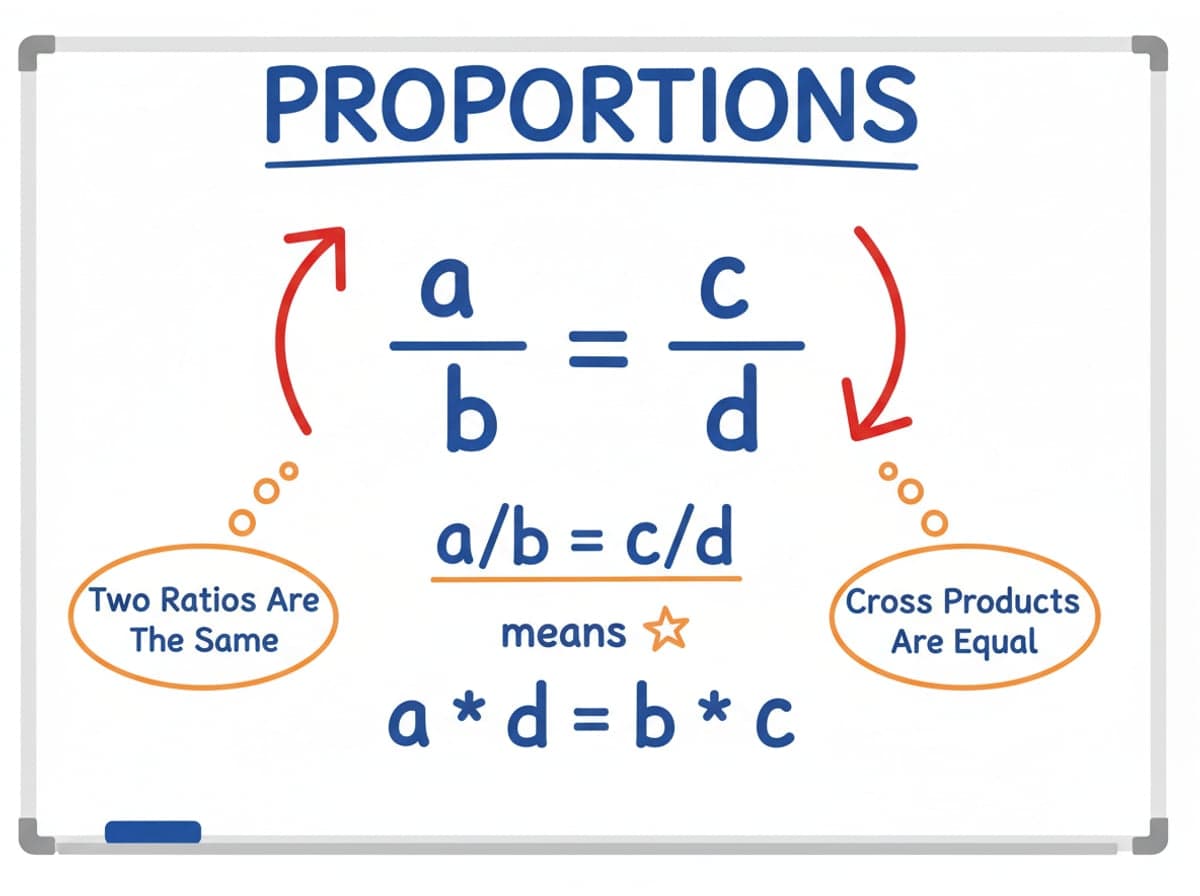
Tess's mistake was pairing the tops together: 6 * 30 / 10. She multiplied the two numerators and divided by one denominator. That mixes the ratios and breaks the equality, which is why her answer 18 did not satisfy 6/10 = 30/x when checked. The pairing is diagonal, not horizontal, and the diagonals are the only products that stay balanced.
The fix is diagonal pairing: the 6 opposite the x, and the 10 opposite the 30. So 6x = 10 * 30, which means 6x = 300. Then divide both sides by 6, and x = 50. The arithmetic is all multiplication and division; the only decision is which numbers belong together, so decide the pairing before you multiply anything.
Check by substitution: 30/50 = 0.6 and 6/10 = 0.6, so the two ratios really are equal, and the equation still holds. Whenever the computed value is a guess, substituting it back into the original proportion is the test that catches a crossed pair. The check takes ten seconds and it never lies. Ten seconds of checking beats an unverified answer every single time.
Keep this idea
Pair the diagonals when cross multiplying, then check the answer in the original proportion.
The practice checks apply only to the displayed examples. Follow your teacher’s guidance for your own assignments.
Get help with your own questionA practice lesson each week.
A short practice lesson for your inbox. Free, with a one-click unsubscribe.