
Why is my child moving numbers around instead of just adding?
What are make ten and compensation, and why is the answer not enough on its own?
Make ten and compensation are ways of rewriting a problem so the adding happens in your head. You shift a small amount from one number to the other to land on a friendly number — 10, 100, or a whole ten. The total does not change, and being able to say why is the part the page is testing.
Why it looks different from what you were taught
If you learned to add by lining the numbers up in columns and carrying, you learned a method that always works and never asks you to think about the numbers themselves. The strategies on the page are the opposite trade: fewer written marks, and a deliberate choice about which numbers to move.
Making ten is the first place a child is asked to notice that 8 + 7 is easier if you think of the 7 as 2 + 5, because the 2 finishes the 8 off to 10. The 7 has not been changed — it has been split, and the two amounts still add to the same thing.
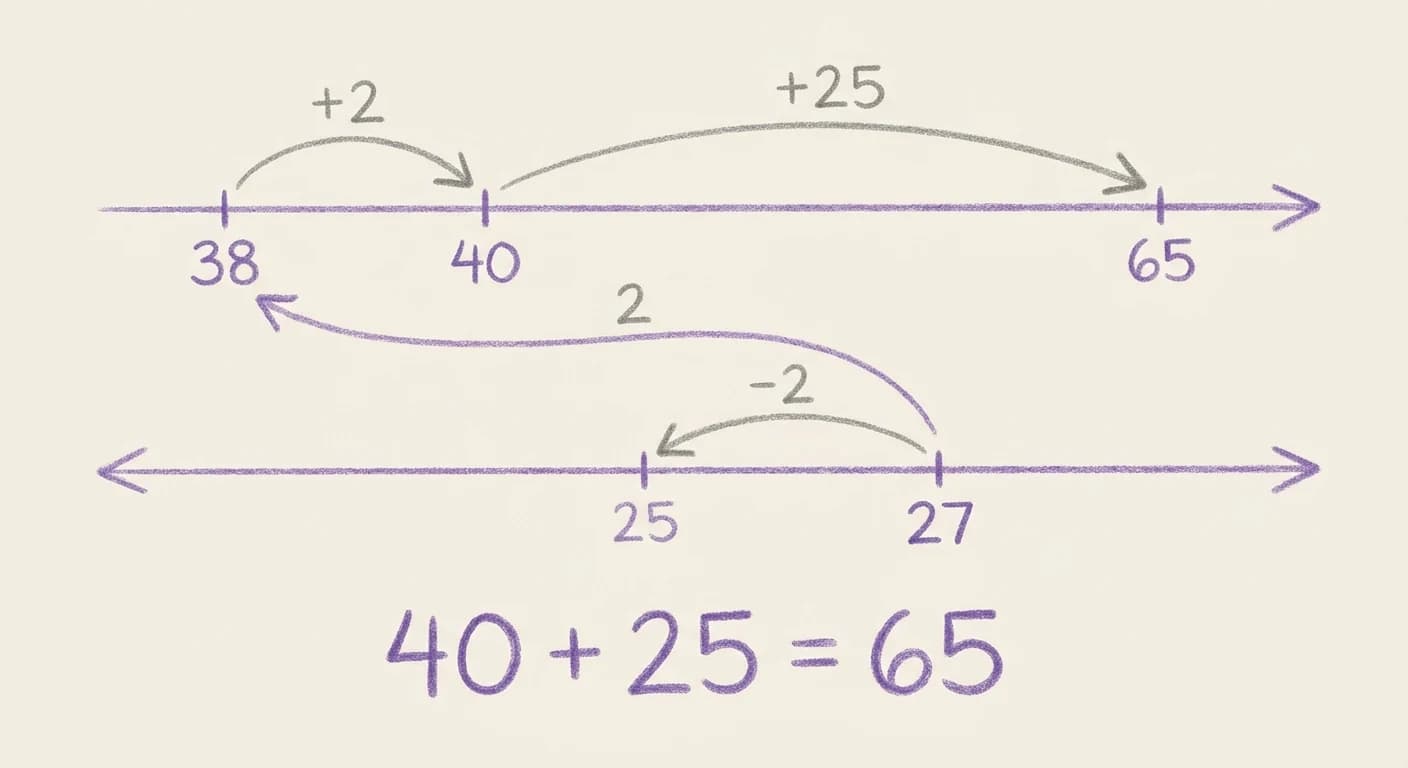
Compensation does the same job with larger numbers. Moving 2 from the 27 to the 38 turns 38 + 27 into 40 + 25, which is a problem most people can do without writing anything down. This is why the working looks like numbers wandering between lines.
The answer on its own cannot show whether any of this happened. A child who writes 65 may have used the strategy, or may have guessed, or may have counted on their fingers. Asking for the explanation is how the teacher can tell the difference, which is why the strategy is marked, not just the total.
The parts of the method
- Making ten
- For 8 + 7, ask what 8 needs to reach 10 — it needs 2. Since 7 = 2 + 5, the problem becomes 10 + 5 = 15. The 7 is split into the part that finishes the ten and whatever is left over.
- Compensation
- Take a small amount off one number and put the same amount onto the other. 38 + 27 becomes 40 + 25. Because the amount moved is the same on both sides, the total is unchanged.
- Friendly numbers
- A friendly number is one you can add without effort: a multiple of ten, or a multiple of a hundred. 40 is friendlier than 38 because adding 25 falls straight out of counting by tens.
- Saying why
- The method is only complete when the child can say what they moved and why the total is still the same. "I gave 2 to the 38 to make 40" is the sentence the strategy is meant to produce.
A worked example: 38 + 27
- 38 + 2 = 40Move 2 from the 27 to the 38 to land on a multiple of ten.
- 27 − 2 = 25Whatever comes off one number has to come off the other, so the total does not change.
- 40 + 25 = 65Adding a multiple of ten is the easy step the whole move was for.
- 38 + 27 = 65The check: the original problem gives the same answer as the rewritten one.
65 — the same answer you get from 38 + 27 carried out line by line.
What you can do at the table
- Ask "what does the 38 need to become a friendly number?" before looking at the answer. The choice of what to move is the skill; the addition is the easy part.
- Keep the two changes tied together out loud: 2 onto one number, 2 off the other. Children who drop the second half get a wrong answer and conclude the strategy is broken.
- Let your child use the long written method to check a strategy answer. Comparing the two is useful work, and it settles disagreements about whether the answer is right.
- If the explanation is halting but the answer is right, that is normal at first. The strategy is new and the sentence takes practice.
The move that backfires: When the answer is coming slowly, it is natural to say the answer out loud to end the frustration. That ends the practice the page is actually asking for — the point is the reasoning, and a supplied answer leaves nothing to check. Asking what the number would need to become, and waiting, keeps the work with the child.
Free lessons that teach this step
Why can't I just add 7 and 5?
When signs differ, subtract the smaller size from the bigger one and keep the sign of the number that is farther from 0.
Try the lesson freeWhy can't I just go left to right?
Multiplication and division happen before addition and subtraction, no matter which appears first in the expression.
Try the lesson freeIf tonight’s question is not on this list
Bring the actual question — typed, or a photo of the page — and Clue gives one clue at a time and asks your child for the next step. The first 5 questions are free, follow-ups included, with no sign-up and no card.
Try 5 questions freeMethods are described as they are commonly taught, and your school may use different names for the same steps. Check with your child’s teacher when the working has to match their expectations.