
Order of operations
One small step at a time. Ask for a clue whenever you need one.
Ask about your own question- Step 1
- Step 2
- New question
What is 3 + 4 * 5?
Common mix-up
In this example, a student wrote 35.
Jordan added 3 + 4 = 7 first, then multiplied 7 * 5 = 35. He treated the expression as if parentheses joined the first two numbers.
Guided example. Your answers aren’t saved or sent.
See why this works
Why can't I just go left to right?
Jordan computed 3 + 4 * 5 by moving left to right: 3 + 4 = 7, then 7 * 5 = 35. The convention says multiply first.
Multiplication and division happen before addition and subtraction, no matter which appears first in the expression.
The expression 3 + 4 * 5 is a short way of describing a real situation. Picture 4 bags of 5 apples plus 3 loose apples. You would count the 4 * 5 apples inside the bags first, then add the 3 loose ones. That is why multiplication gets done first: it describes one grouped amount, while addition shows separate amounts lying side by side.
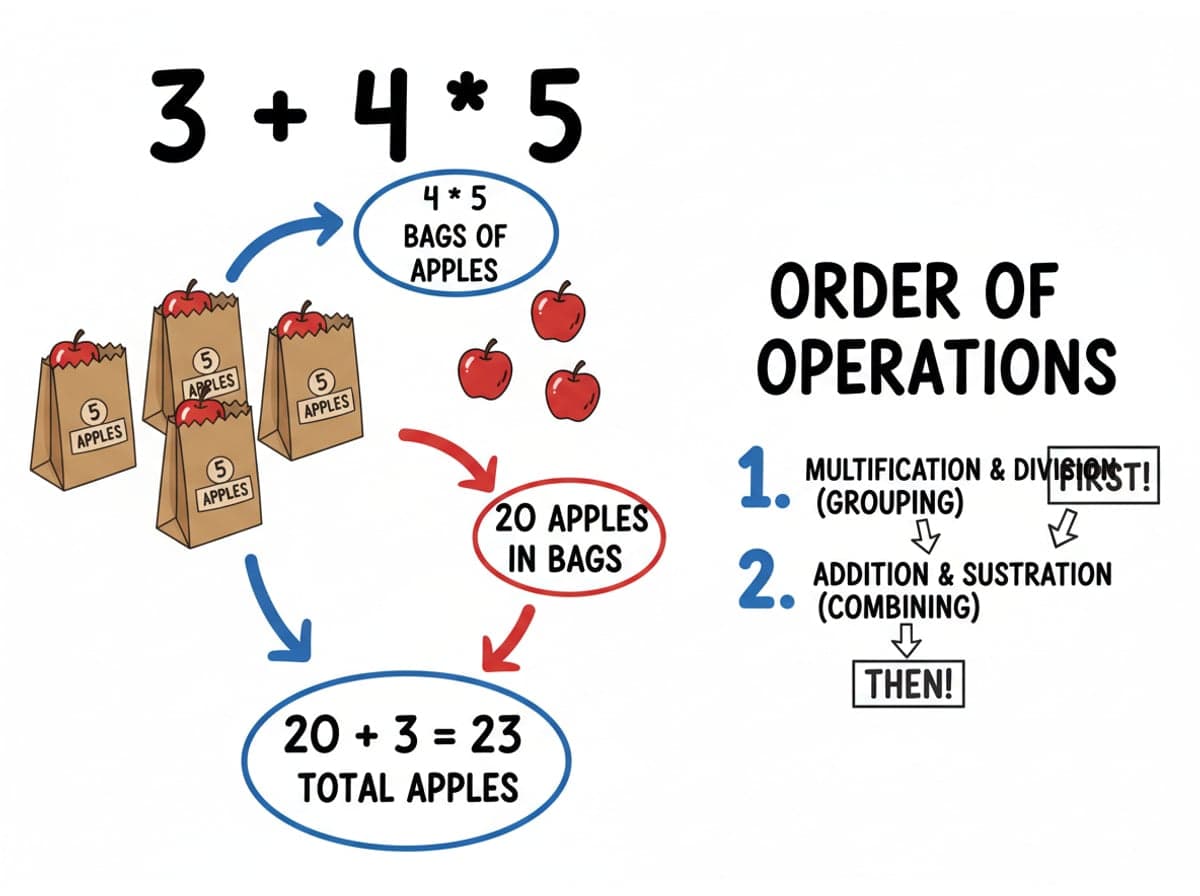
Jordan went left to right, adding 3 + 4 = 7 first. That changed the meaning: he computed (3 + 4) * 5 = 35, which is 7 groups of 5. Left to right is only the rule when the operations have equal rank, like 6 - 2 + 4, where going left to right gives the agreed answer. With mixed ranks, left to right stops being safe.
The fix begins inside the expression: find the multiplication and do it first. 4 * 5 = 20, so the expression shrinks to 3 + 20. Then the addition is the only move left, and 3 + 20 = 23. One operation at a time, and the long expression shortens step by step into the answer. Cross off each computed part as you go, and nothing gets reused twice.
Check by reading 3 + 20 as a situation: 3 apples and 20 apples is 23 apples. The written conventions exist so that anyone reading the expression computes the same value, and multiplying before adding is the order everyone agrees on. If the words for 3 + 4 * 5 were instead (3 + 4) * 5, parentheses would say so.
Keep this idea
Compute multiplication and division before addition and subtraction, even when the multiplication appears later in the expression.
The practice checks apply only to the displayed examples. Follow your teacher’s guidance for your own assignments.
Get help with your own questionA practice lesson each week.
A short practice lesson for your inbox. Free, with a one-click unsubscribe.