
Zero and negative exponents
One small step at a time. Ask for a clue whenever you need one.
Ask about your own question- Step 1
- Step 2
- New question
What is 2^-3?
Common mix-up
In this example, a student wrote -8.
Noor read the minus in the exponent as a minus in the answer, writing -8. The exponent's sign controls the reciprocal, not the sign of the value.
Guided example. Your answers aren’t saved or sent.
See why this works
What happened when the exponent went negative?
Noor computed 2^-3 as -8. She treated the exponent's sign as the answer's sign, but exponents and values are different things.
A negative exponent means the reciprocal: 2^-3 = 1/2^3. Any nonzero base to the power 0 is 1.
An exponent counts how many times a base is multiplied. The exponent -3 is not a number being multiplied into the answer; it is an instruction about the position of the base. Minus three means the base moves to the bottom of a fraction. The minus is about position, and the number 3 is about how many copies, so the two parts do two different jobs.
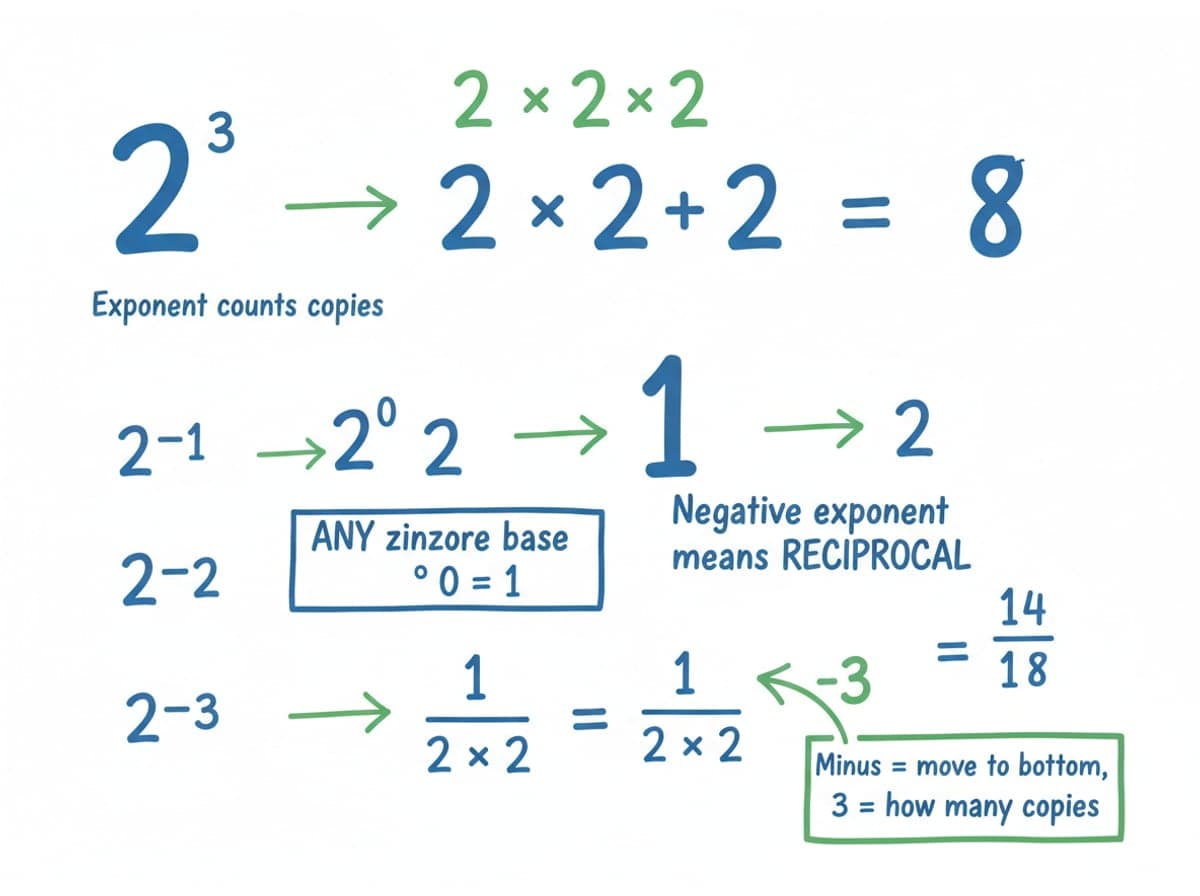
Noor's mistake was reading the minus sign as a property of the answer, so she wrote -8. A negative exponent never makes the result negative; it makes the result a reciprocal, a positive number smaller than 1. A minus in the exponent is a direction for the base, and the value it produces is always positive as long as the base is positive.
The fix has two beats. First evaluate the positive power: 2^3 = 8. Then take the reciprocal: 2^-3 = 1/8. The one on top is the key move, because the negative exponent flips the base to the other side of the fraction bar. Do the positive power first, and the negative exponent just decides where that value goes. Evaluate the power, then position it: the negative exponent never touches the sign of the value.
The same pattern explains 2^0 = 1. Each step down halves the value: 2^3 = 8, 2^2 = 4, 2^1 = 2, 2^0 = 1, and 2^-1 = 1/2. The sequence never jumps to a negative number, so the rule fits the pattern it came from, and the halving habit predicts any zero or negative exponent. Halving is the engine behind the rules, so the rules never feel arbitrary.
Keep this idea
A negative exponent means reciprocal, never a negative number; any nonzero base to the power 0 equals 1.
The practice checks apply only to the displayed examples. Follow your teacher’s guidance for your own assignments.
Get help with your own questionA practice lesson each week.
A short practice lesson for your inbox. Free, with a one-click unsubscribe.
Search all 106 free lessons for “Zero and negative exponents”