
Subtracting signed numbers
One small step at a time. Ask for a clue whenever you need one.
Ask about your own question- Step 1
- Step 2
- New question
What is 5 - (-3)?
Common mix-up
In this example, a student wrote 2.
Diego treated the negative inside the parentheses as a plain 3. He did 5 - 3 = 2, which subtracts a positive number, not a negative one.
Guided example. Your answers aren’t saved or sent.
See why this works
What does minus a negative really mean?
Diego saw 5 - (-3) and wrote 2, as if the problem were 5 - 3. But the two minus signs are doing different jobs.
Subtracting a negative is the same as adding its opposite: 5 - (-3) becomes 5 + 3.
The first minus sign is the operation minus, which normally means a move left on the number line. The second minus belongs to the number -3, a location three steps to the left of 0. Subtracting a negative move sends the walk the opposite way: instead of moving left 3, you move right 3. Starting at 5 and moving right 3 lands on 8, and that is exactly what adding 3 would do.
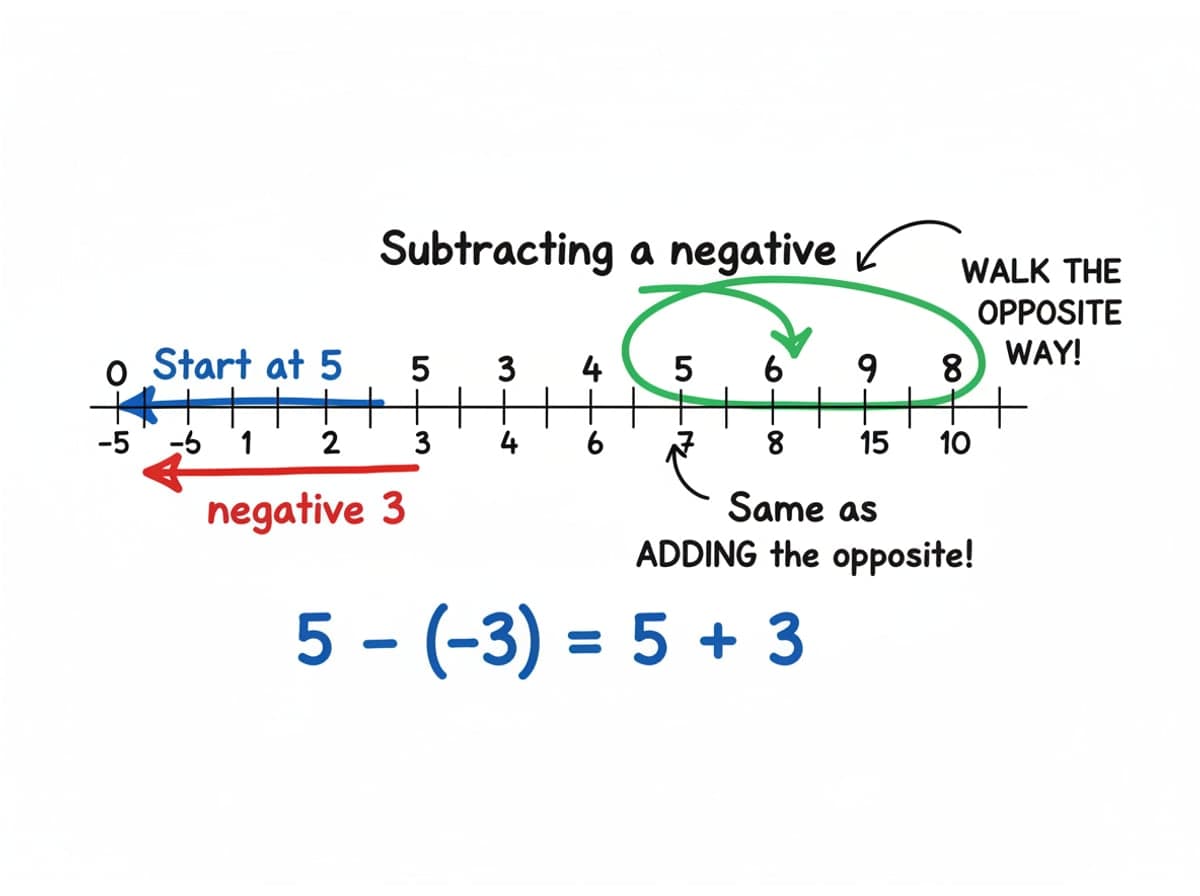
Diego's mistake was to read the second sign as a subtraction too, so he did 5 - 3 = 2. That would be right for 5 - 3, but the problem has a negative number inside the parentheses, and a negative changes the direction of the move. His walk went left 3 when it should have gone right 3, so he landed on the wrong side of the number line.
The fix is a rewrite rule: minus a negative means plus the positive. So 5 - (-3) becomes 5 + 3. Two minus signs in a row simplify to one plus sign, just like saying you are not unhappy, which means you are happy. Rewrite first, then compute, so the direction of the move is decided while the expression is still simple.
Now the sum is easy: 5 + 3 = 8, so 5 - (-3) = 8. You can check it on a number line: start at 5 and move right 3, landing on 8. Or run the check backwards: 8 - 3 = 5, so a move of left 3 from 8 returns to the start, confirming that moving right 3 brought you to exactly the right place.
Keep this idea
When you see minus a negative, rewrite it as plus the positive, then add.
The practice checks apply only to the displayed examples. Follow your teacher’s guidance for your own assignments.
Get help with your own questionA practice lesson each week.
A short practice lesson for your inbox. Free, with a one-click unsubscribe.
Search all 106 free lessons for “Subtracting signed numbers”