
Multiplying and dividing signed numbers
One small step at a time. Ask for a clue whenever you need one.
Ask about your own question- Step 1
- Step 2
- New question
What is (-3)(-4)?
Common mix-up
In this example, a student wrote -12.
Priya saw a negative sign in the problem and made the answer negative. She used a one-negative rule instead of counting the two negatives that were there.
Guided example. Your answers aren’t saved or sent.
See why this works
What do two negatives in a row do?
Priya multiplied -3 by -4 and wrote -12. She remembered that negatives matter, but she got the rule backwards.
Same signs give a positive result; different signs give a negative result.
Take the sizes first: 3 * 4 = 12. The only question left is the sign, and signs are decided by how many negatives you are working with. One negative flips the result to negative; two negatives flip it twice and bring it back to positive. The sizes never change because of the signs: 3 times 4 is 12 whether the factors are positive or negative.
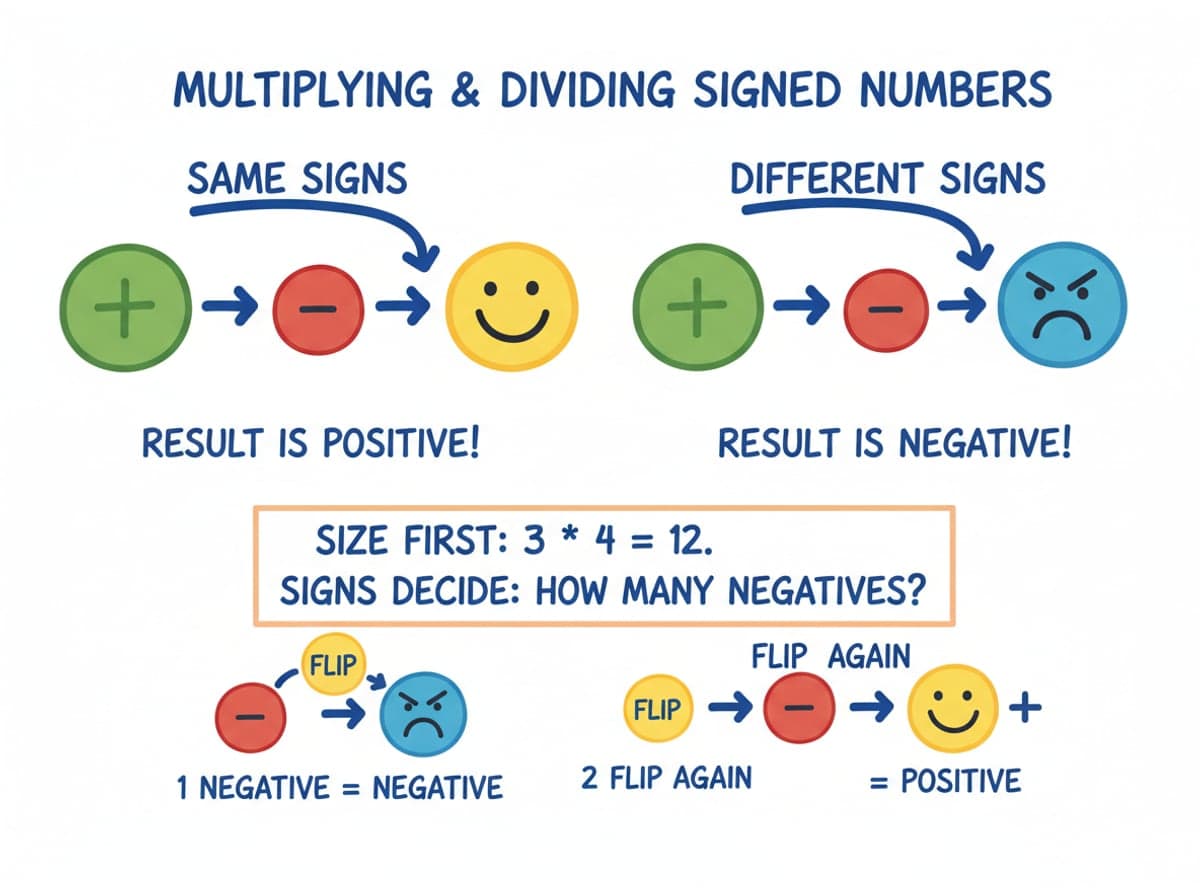
Priya's mistake was counting one negative sign instead of two. She saw that a negative existed and made the answer negative. With two negative factors, the second negative undoes the first, like removing a debt: taking away three debts of 4 each leaves you with 12 in your pocket, richer, not poorer. The first negative says go left; the second says go back to the right.
The rule works for division too, because division is multiplication in reverse. Same signs give positive, different signs give negative: -24 / -6 = 4, but 24 / -6 = -4. Whether you are splitting or grouping, the count of negatives does the same job, so one rule answers both operations. Division is the same sign dance wearing a different hat, so one habit covers everything.
So the system is: multiply or divide the sizes, then count the negative signs. An even count means positive; an odd count means negative. Count first, and the sign at the end is never a guess. Write the count down in the margin if you need to, and the minus signs will stop sneaking past you. The rule even survives a triple-negative, where an odd count wins again.
Keep this idea
Count the negative signs: an even count gives a positive result, an odd count gives a negative result.
The practice checks apply only to the displayed examples. Follow your teacher’s guidance for your own assignments.
Get help with your own questionA practice lesson each week.
A short practice lesson for your inbox. Free, with a one-click unsubscribe.
Search all 106 free lessons for “Multiplying and dividing signed numbers”