
Scientific notation
One small step at a time. Ask for a clue whenever you need one.
Ask about your own question- Step 1
- Step 2
- New question
Write 4500 in scientific notation.
Common mix-up
In this example, a student wrote 45 * 10^2.
Evan counted 4 digits in 4500 and used exponent 4. The decimal only moves 3 places, because the leading digit already sits to the left.
Guided example. Your answers aren’t saved or sent.
See why this works
Where does the decimal point go?
Evan wrote 4500 as 4.5 * 10^4. He counted the digits instead of the decimal jumps.
Scientific notation is a number from 1 to 10 times a power of 10; the exponent counts the decimal places the point moves.
Scientific notation is a compact way to write very large or very small numbers: a leading number between 1 and 10, times a power of 10. The power of 10 absorbs the zeros, and the leading number carries the digits. Forty-five hundred becomes 4.5 times a power of ten, and the wording one number between 1 and 10 decides where the leading number stops.
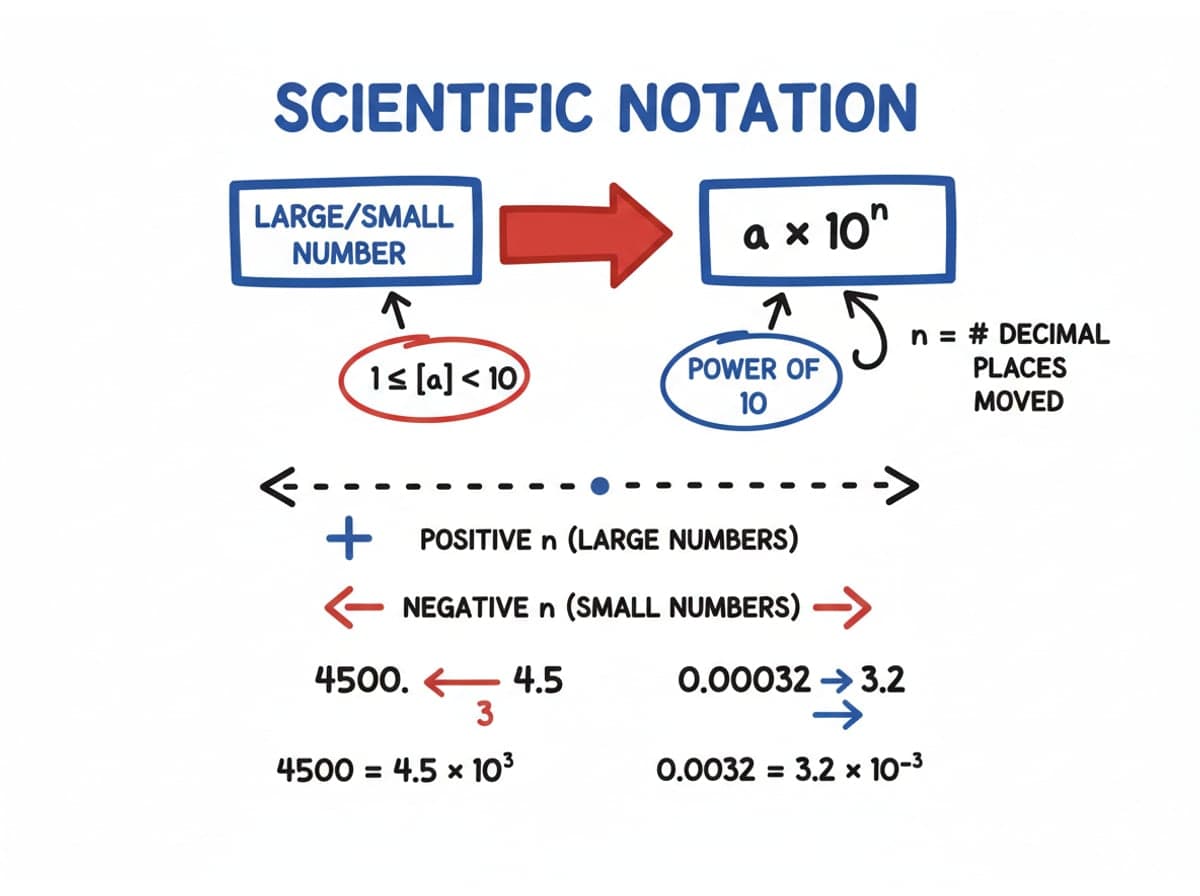
Evan's mistake was counting the digits. He saw four digits in 4500 and used exponent 4, writing 4.5 * 10^4, which equals 45,000, ten times too big. The exponent counts jumps of the decimal point, not digits in the number. Four digits can still give a three-jump move, because the leading digit sits where the point starts. The jump count is the job, and the digits only decide the leading number.
The fix is to move the point. In 4500, the decimal hides at the end: 4500. Move it left until a number between 1 and 10 remains, landing on 4.5. The jump passed three places, so the exponent is 3, giving 4.5 * 10^3. Mark the start and end positions of the point, then count the digits between them. Then match the count to the exponent and the notation writes itself.
Check by multiplying back: 4.5 * 10^3 means 4.5 * 1000 = 4500, the original number. For small numbers, the same walk goes right, so 0.00029 becomes 2.9 * 10^-4. The direction of the walk decides the sign of the exponent, and the distance walked decides its size. Walk right for small numbers, walk left for big ones, and the sign follows the walk.
Keep this idea
Move the decimal point so the leading number is between 1 and 10, and use the jump count as the exponent, negative for small numbers.
The practice checks apply only to the displayed examples. Follow your teacher’s guidance for your own assignments.
Get help with your own questionA practice lesson each week.
A short practice lesson for your inbox. Free, with a one-click unsubscribe.