
Adding signed numbers
One small step at a time. Ask for a clue whenever you need one.
Ask about your own question- Step 1
- Step 2
- New question
What is -7 + 5?
Common mix-up
In this example, a student wrote 12.
Maya added 7 and 5 to get 12, then dropped the signs entirely. She treated both numbers as plain counts instead of moves in opposite directions.
Guided example. Your answers aren’t saved or sent.
See why this works
Why can't I just add 7 and 5?
Maya added -7 and 5 and got 12. She counted the sizes of both numbers but forgot that they move in opposite directions.
When signs differ, subtract the smaller size from the bigger one and keep the sign of the number that is farther from 0.
A number like -7 is a location on a number line: 7 steps to the left of 0. The number 5 is 5 steps to the right. Adding them means taking both moves at once, so start at -7 and step 5 places to the right. One move goes left and the other goes right, so the walk ends wherever the two pushes balance out, not where either push alone would take you, and that walk lands at -2.
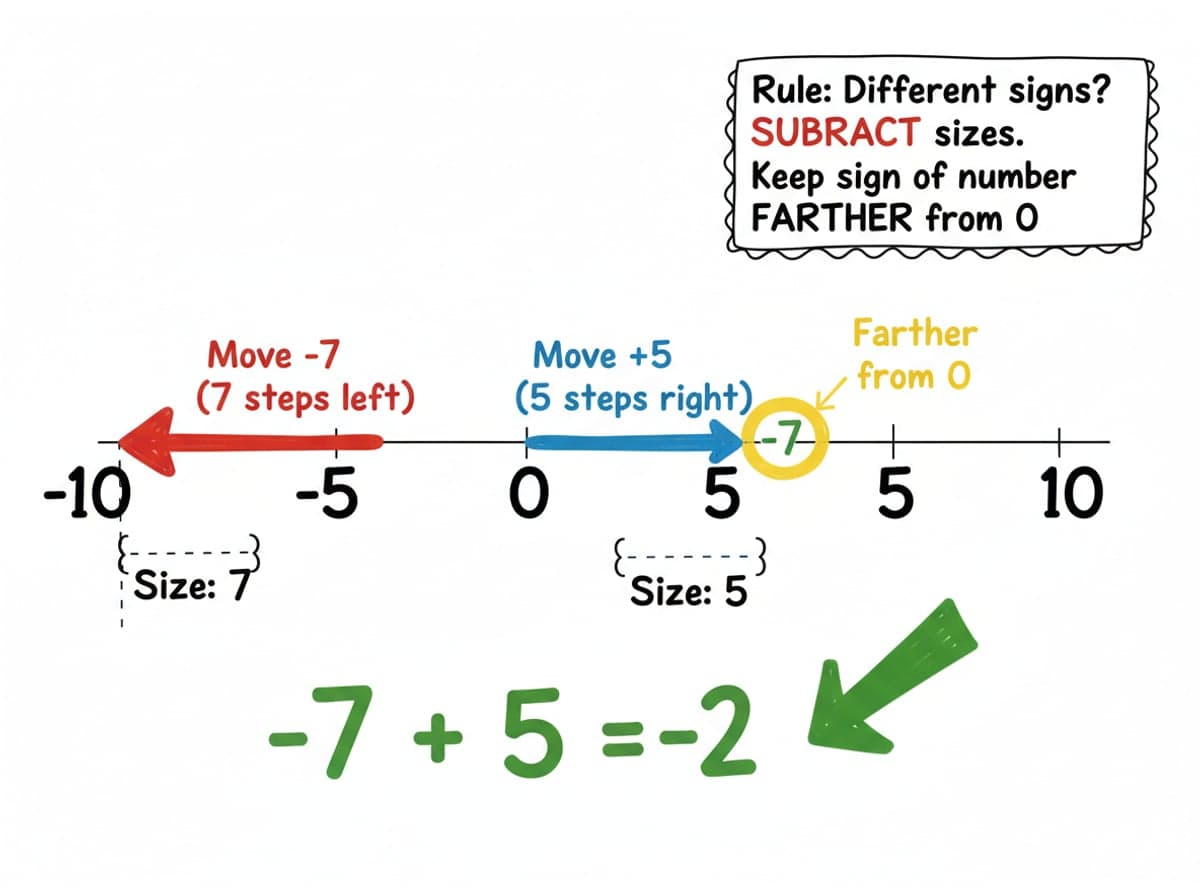
Maya's mistake was to add the sizes, 7 + 5 = 12, and then drop the signs entirely. That only works when both numbers move the same direction, like 7 + 5 where every step goes right. Here one move is left and one is right, so the two forces fight each other instead of stacking. The starting position matters too: the walk begins at -7, not at 0.
The fix is a tug-of-war. Ask which move is bigger: 7 steps left beats 5 steps right, so the answer will be negative. How many steps are left over? 7 - 5 = 2. Because the bigger move goes left, those 2 leftover steps are negative, and the result is -2. A picture of the two walks helps too: seven arrows pointing left, five arrows pointing right, and the two leftover arrows point left.
Check on the number line: start at -7, hop 5 steps right, and land on -2. Whenever the signs differ, subtract the smaller size from the bigger one and keep the sign of the move that is farther from 0. The sign decision and the size decision are separate jobs, so do them one at a time, and the tug-of-war answer falls out cleanly.
Keep this idea
When the signs differ, subtract the smaller size from the bigger one and keep the sign of the number that is farther from 0.
The practice checks apply only to the displayed examples. Follow your teacher’s guidance for your own assignments.
Get help with your own questionA practice lesson each week.
A short practice lesson for your inbox. Free, with a one-click unsubscribe.