
Exponent rules
One small step at a time. Ask for a clue whenever you need one.
Ask about your own question- Step 1
- Step 2
- New question
What is 2^3 * 2^2?
Common mix-up
In this example, a student wrote 64.
Rafi multiplied the exponents 3 and 2, treating the product rule like a power of a power rule. For a product of like bases, the exponents add.
Guided example. Your answers aren’t saved or sent.
See why this works
Why do exponents add when I multiply?
Rafi computed 2^3 * 2^2 by multiplying the exponents: 3 * 2 = 6, so he wrote 2^6 = 64. The exponents should add.
Multiplying powers with the same base adds the exponents: a^m * a^n = a^(m+n).
A power is shorthand for repeated multiplication. 2^3 is three 2s multiplied together, and 2^2 is two 2s multiplied together. When you multiply the two groups, you are multiplying five 2s in a row, and 5 is exactly 3 + 2, the sum of the exponents. Expand both powers first and the shortcut is just counting: three factors times two factors leaves five factors.
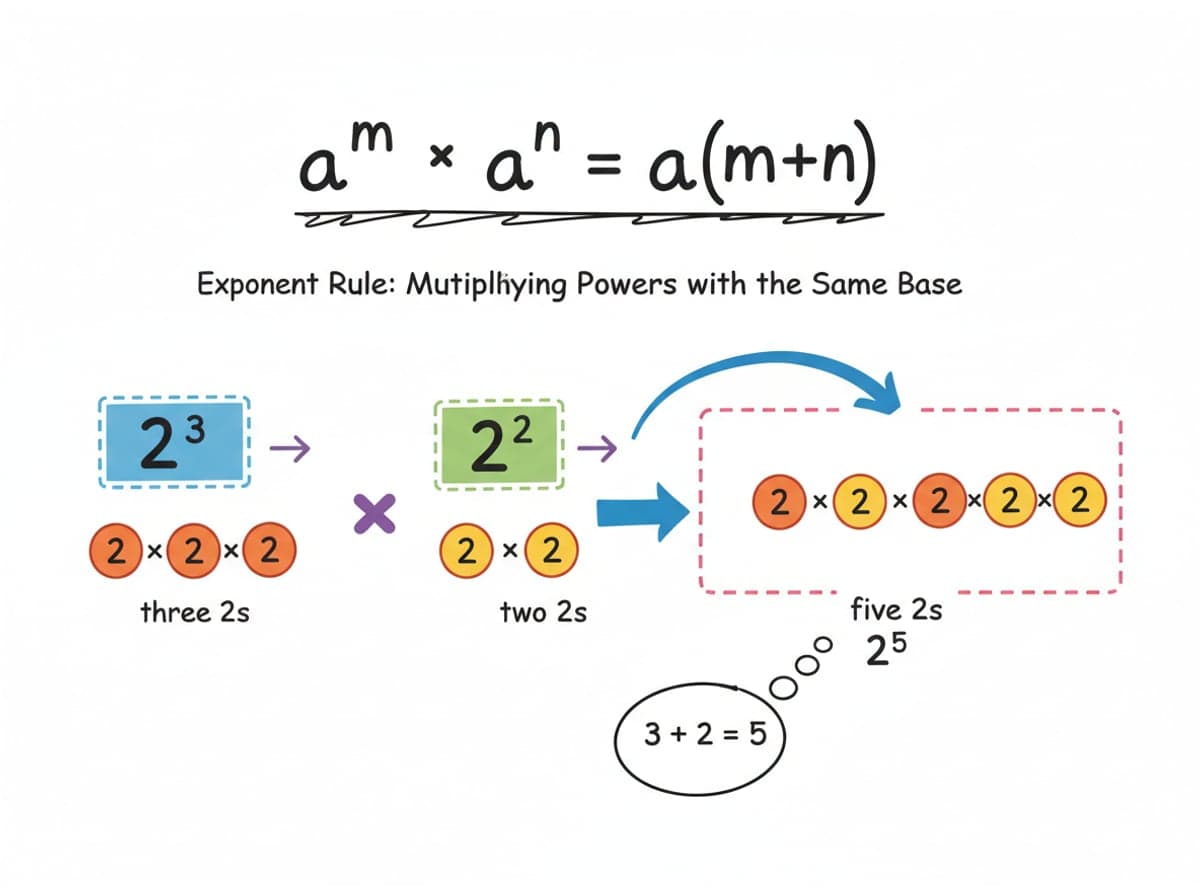
Rafi's mistake was multiplying the exponents, 3 * 2 = 6. That rule belongs to a different situation: 2^(3*2) would mean a power raised to a power, or (2^3)^2, which is a power of a power. Multiplying when you are multiplying the powers themselves adds a layer that is not in the problem, and his answer 2^6 = 64 is far too big.
The fix is to count the factors. 2^3 * 2^2 = (2 * 2 * 2) * (2 * 2) = 2^5 by length. Then evaluate: 2^5 = 32. Each doubled step, 2, 4, 8, 16, 32, confirms the count of five factors, and the fifth doubling lands on 32, exactly the product of 8 and 4. The doubling chain is its own built-in check, because each link must double.
Check with the expanded forms: 8 * 4 = 32 matches 2^5, so the rule gives the same number as counting. The same base is the key condition: this shortcut only works when the bases match, and the exponents add because the factors join in one long chain of the same repeated base. Different bases, and the shortcut sits out: the counting way still works.
Keep this idea
Multiplying like bases adds exponents; dividing like bases subtracts them.
The practice checks apply only to the displayed examples. Follow your teacher’s guidance for your own assignments.
Get help with your own questionA practice lesson each week.
A short practice lesson for your inbox. Free, with a one-click unsubscribe.