
Why is my child subtracting over and over to do division?
What are partial quotients, and why is the division not written the way I learned it?
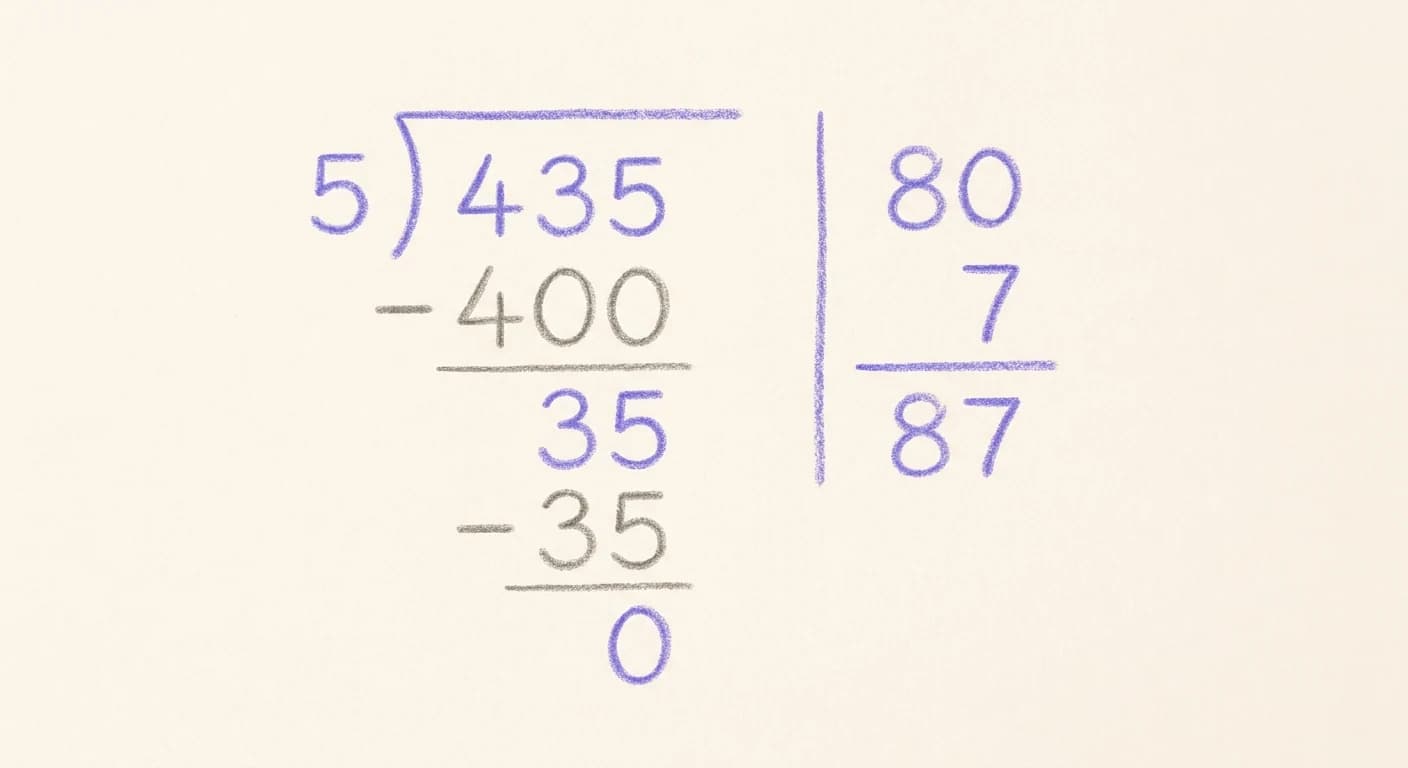
That column of subtractions down the side of the page is partial quotients. Instead of finding one digit of the answer at a time, your child subtracts a large, easy multiple of the divisor, writes down the multiple used, and repeats until nothing is left. The multiples written on the side are added at the end to get the quotient. It is the same answer you would get from long division.
Why it looks different from what you were taught
If you learned long division as a fixed loop — divide, multiply, subtract, bring down, move to the next digit — the page in front of you looks unfinished. There is a pile of subtractions beside the division bracket, the numbers get smaller as you read down, and no digit of the answer appears anywhere obvious until the very bottom.
Only the order of work has changed. The standard method asks the child to guess one digit of the quotient at a time, which means the size of every chunk is forced by place value. Partial quotients reverses that: the child picks a chunk of any convenient size, writes the size down, subtracts it, and keeps going on whatever is left. Two children can use different sizes of chunk, take different numbers of lines, and both be right.
It is not guessing. Every subtraction starts from the amount actually still on the page, and every chunk subtracted has to be a multiple of the divisor and no larger than what remains. If a child subtracts a chunk that is too big, the remainder goes below zero and that is visible on the page, so the mistake catches itself. That is why the method is taught before the digit-by-digit algorithm: the work is self-checking rather than dependent on the child picking the right digit in the right column.
The parts of the method
- What the question is asking
- 435 ÷ 5 asks how many 5s fit into 435. Everything under the bracket is an amount being used up, not a set of digits to be read one at a time.
- Friendly multiples
- The child thinks of multiples of the divisor that are easy to compute and not bigger than what remains. For 435 ÷ 5, 5 × 80 = 400 is a good first chunk because it is easy and leaves only 35. 5 × 100 = 500 would be too big, because 500 is more than 435.
- Subtracting and recording the multiple
- The chunk comes off the running total, and the multiple used is written to the side. Subtracting 400 from 435 leaves 35, and 80 goes in the quotient column.
- Repeating on the remainder
- The next chunk is chosen from what is left, not from the original number. From 35, the convenient multiple is 5 × 7 = 35, which leaves 0 and finishes the problem. If the remainder had been 42, the child could still take 5 × 8 = 40 and be left with 2.
- Adding the chunks
- The numbers written on the side are the sizes of the chunks, so adding them gives the quotient. 80 + 7 = 87, and 87 × 5 = 435, which checks the answer.
A worked example: 435 ÷ 5
- 435 ÷ 5How many 5s fit into 435.
- 5 × 80 = 400, so take out 80 fives80 is chosen because this chunk is easy and 400 is less than 435.
- 435 − 400 = 3535 is what is still unaccounted for. The 80 is written in the quotient column.
- 5 × 7 = 35, so take out 7 more fivesThe next chunk is chosen from the 35 that remains, not from the original 435.
- 35 − 35 = 0Nothing is left, so the division is finished.
- 80 + 7 = 87The chunks taken out are added. This is the quotient, not a separate step.
87, because 80 + 7 = 87 and 87 × 5 = 435.
What you can do at the table
- Ask how many 5s have been taken out so far. That keeps the running total in view, which is the one thing that is easy to lose track of when the page has many lines on it.
- Ask where the next chunk came from. A child who says "there were 35 left, so I took seven 5s" understands the method; the number of lines on the page does not matter.
- Tell them a smaller chunk is allowed. Taking out 5 × 10 = 50 at a time is slower but still correct, and a child who is unsure of the big multiples will get there anyway.
- Point out that the final check — quotient times divisor equals the original number — is available on every problem. 87 × 5 = 435 confirms the work without redoing it.
The move that backfires: Do not stop the problem halfway and move your child onto the digit-by-digit algorithm because the column of subtractions looks long and slow. Saying "just guess the first digit and carry" mid-sentence asks them to abandon the method that is being taught and graded, and the standard algorithm is deliberately scheduled for later, once the reasoning about multiples and remainders is secure.
Free lessons that teach this step
Why multiply everything inside the brackets?
Copy the whole group: 3(x + 2) = 3x + 6.
Try the lesson freeWhat is the opposite of adding 7?
To undo an addition, subtract the same amount from both sides; the equation stays balanced.
Try the lesson freeIf tonight’s question is not on this list
Bring the actual question — typed, or a photo of the page — and Clue gives one clue at a time and asks your child for the next step. The first 5 questions are free, follow-ups included, with no sign-up and no card.
Try 5 questions freeMethods are described as they are commonly taught, and your school may use different names for the same steps. Check with your child’s teacher when the working has to match their expectations.