
Distributive property
One small step at a time. Ask for a clue whenever you need one.
Ask about your own question- Step 1
- Step 2
- Step 3
- New question
Solve 3(x + 2) = 21.
Common mix-up
In this example, a student wrote 3x + 2 = 21.
The outside 3 has multiplied x, but it still needs to multiply the 2.
Guided example. Your answers aren’t saved or sent.
See why this works
Why multiply everything inside the brackets?
If you multiplied the x but left the other number alone, you have found a useful place to pause. The outside number counts copies of the whole group.
Copy the whole group: 3(x + 2) = 3x + 6.
Imagine three bags. Each bag contains x counters and two extra counters. Opening the bags gives you three copies of x and six extra counters. Nothing was added or lost; the same contents are just written without bags. That is what distributing does to brackets.
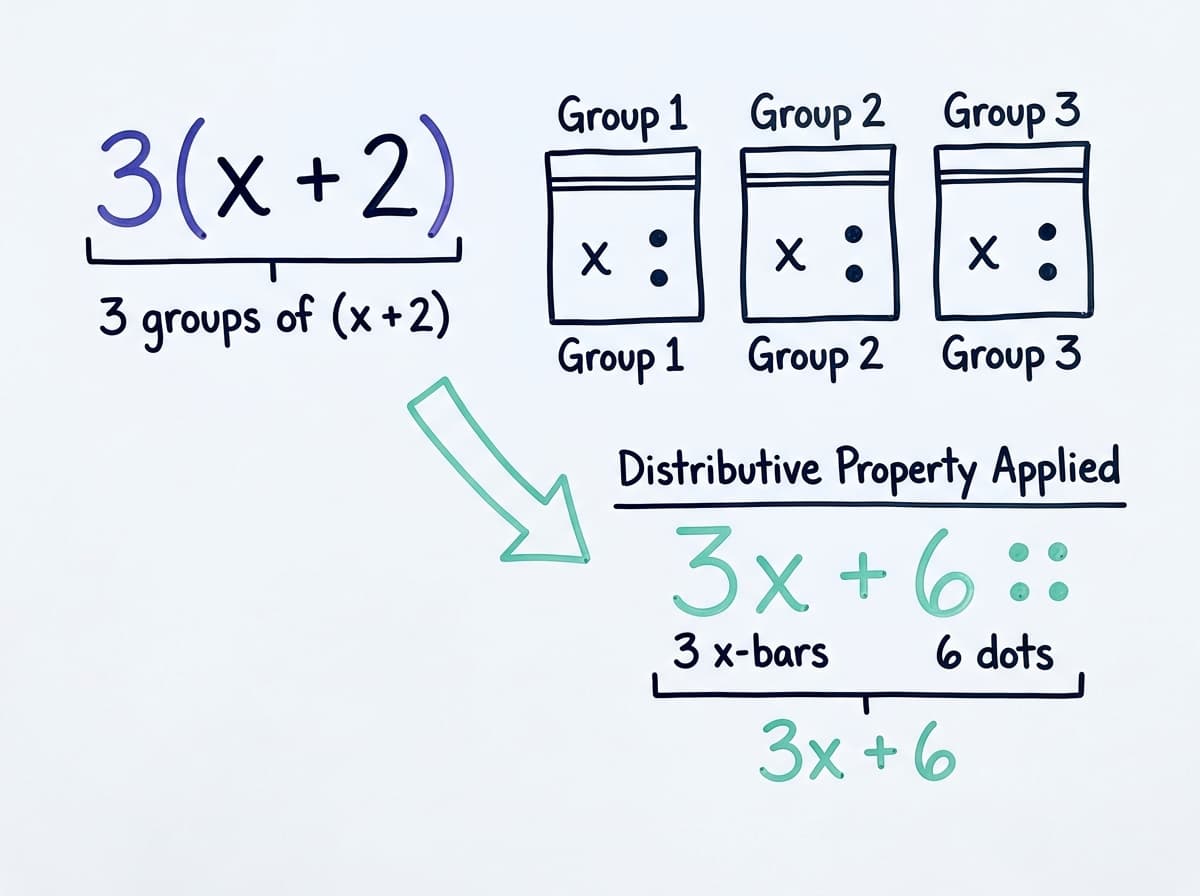
In 3(x + 2) = 21, the line 3x + 2 = 21 counts the extra counters from only one bag. The corrected left side is 3x + 6. You can also write 6 + 3x: changing the order of addition does not change its value.
Now solve 3x + 6 = 21. Subtract 6 from both sides to keep them equal, leaving 3x = 15. Divide both sides by 3 to get x = 5. Check in the original equation: 3(5 + 2) = 3 × 7 = 21. The check reconnects your answer to the question you started with.
There is another valid route: divide both sides of the original equation by 3 first, giving x + 2 = 7. Then subtract 2. You do not always have to expand brackets first. Here, practicing expansion helps you notice why every part of a group matters.
Keep this idea
An outside multiplier applies to every term inside the brackets. Keep both sides equal as you solve, then check in the original equation.
The practice checks apply only to the displayed examples. Follow your teacher’s guidance for your own assignments.
Get help with your own questionA practice lesson each week.
A short practice lesson for your inbox. Free, with a one-click unsubscribe.