
Distance and midpoint
One small step at a time. Ask for a clue whenever you need one.
Ask about your own question- Step 1
- Step 2
- Step 3
- New question
Find the distance between the points A(1, 2) and B(4, 6).
Common mix-up
In this example, a student wrote d = 3 + 4 = 7.
The student added the coordinate differences without squaring anything, computing the distance as 3 + 4 = 7.
Guided example. Your answers aren’t saved or sent.
See why this works
How far apart are A(1, 2) and B(4, 6)?
Two points give you a right triangle in disguise. The legs are the changes in x and y; the distance is the hypotenuse.
Distance = sqrt((x2 - x1)^2 + (y2 - y1)^2); midpoint = ((x1 + x2)/2, (y1 + y2)/2).
The distance between two points is the length of the hypotenuse of a right triangle you can sketch around them. For A(1, 2) and B(4, 6), the horizontal change is 4 - 1 = 3 and the vertical change is 6 - 2 = 4. Those two legs are the skeleton of the Pythagorean theorem.
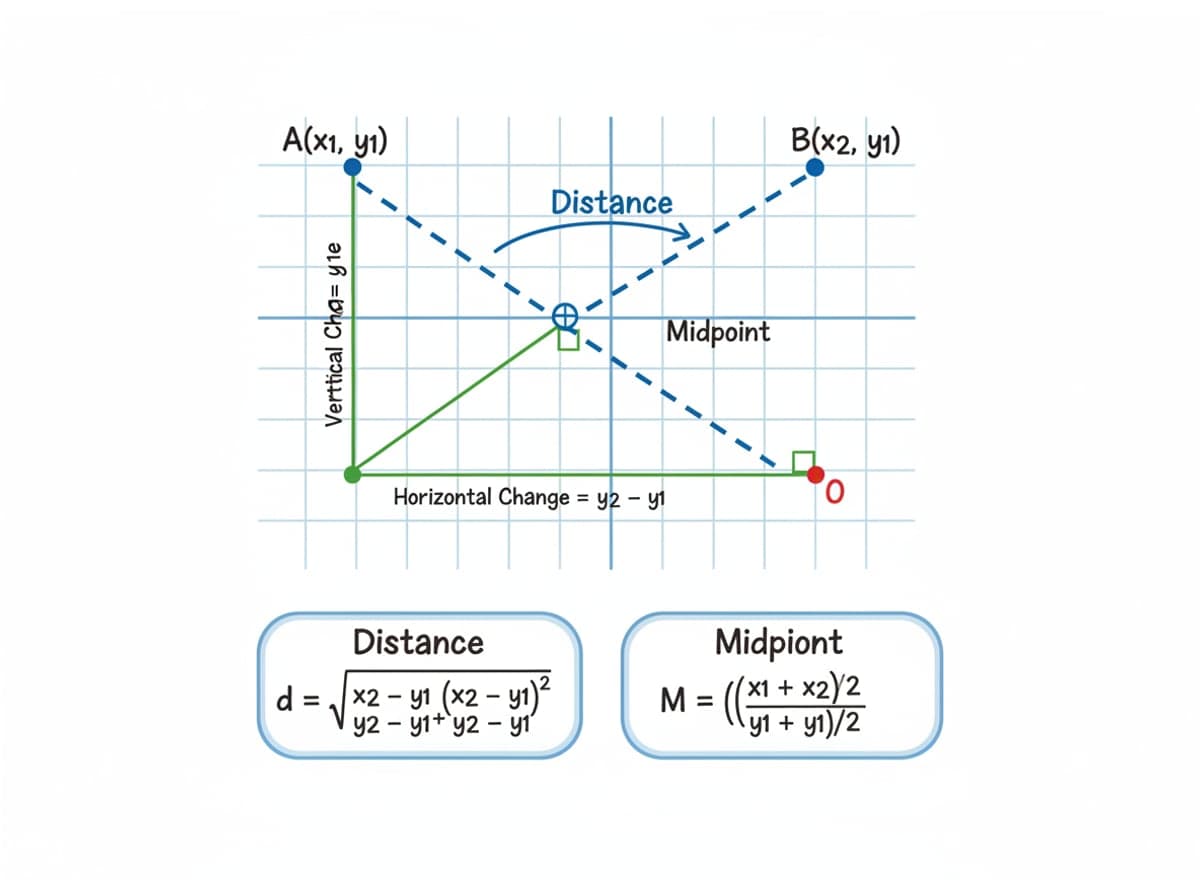
Square the legs, add, and take the square root: sqrt(3^2 + 4^2) = sqrt(9 + 16) = sqrt(25) = 5. The formula does exactly this with coordinates: sqrt((x2 - x1)^2 + (y2 - y1)^2). The most common slip is to subtract after squaring, or to skip the squares entirely and add 3 + 4, which gives 7 instead of 5.
The midpoint is a different animal: it is an average, not a length. To find it, average the x-coordinates and average the y-coordinates separately. For P(-1, 4) and Q(5, 2), the midpoint is ((-1 + 5)/2, (4 + 2)/2) = (2, 3). The midpoint of a segment always lies exactly halfway along it.
Distance and midpoint are two formulas with two different operations: distance builds a right triangle and uses squares, while midpoint splits each coordinate in half. When a problem gives two points, decide first whether it wants a length or a location, and the formula follows.
Keep this idea
Distance needs differences and squares; midpoint needs averages. Either way, handle the x and y coordinates separately and label the answer.
The practice checks apply only to the displayed examples. Follow your teacher’s guidance for your own assignments.
Get help with your own questionA practice lesson each week.
A short practice lesson for your inbox. Free, with a one-click unsubscribe.