
Special right triangles
One small step at a time. Ask for a clue whenever you need one.
Ask about your own question- Step 1
- Step 2
- New question
In a 30-60-90 right triangle, the leg opposite the 30-degree angle is 5. How long is the hypotenuse?
Common mix-up
In this example, a student wrote h = 5*sqrt(3).
The student used the long leg as the hypotenuse and wrote h = 5 * sqrt(3), forgetting that the hypotenuse is double the short leg.
Guided example. Your answers aren’t saved or sent.
See why this works
In a 30-60-90 triangle, what is the hypotenuse if the short leg is 5?
A 30-60-90 triangle has fixed ratios between its sides. Know one side and the other two follow without any trigonometry.
In a 30-60-90 triangle: short leg s, long leg s * sqrt(3), hypotenuse 2s.
Every 30-60-90 triangle is a half of an equilateral triangle, and that is why its sides always follow one ratio. If the short leg, opposite the 30-degree angle, is s, then the hypotenuse is twice as long, 2s, and the leg opposite the 60-degree angle is s * sqrt(3). The angles fix the ratio forever.
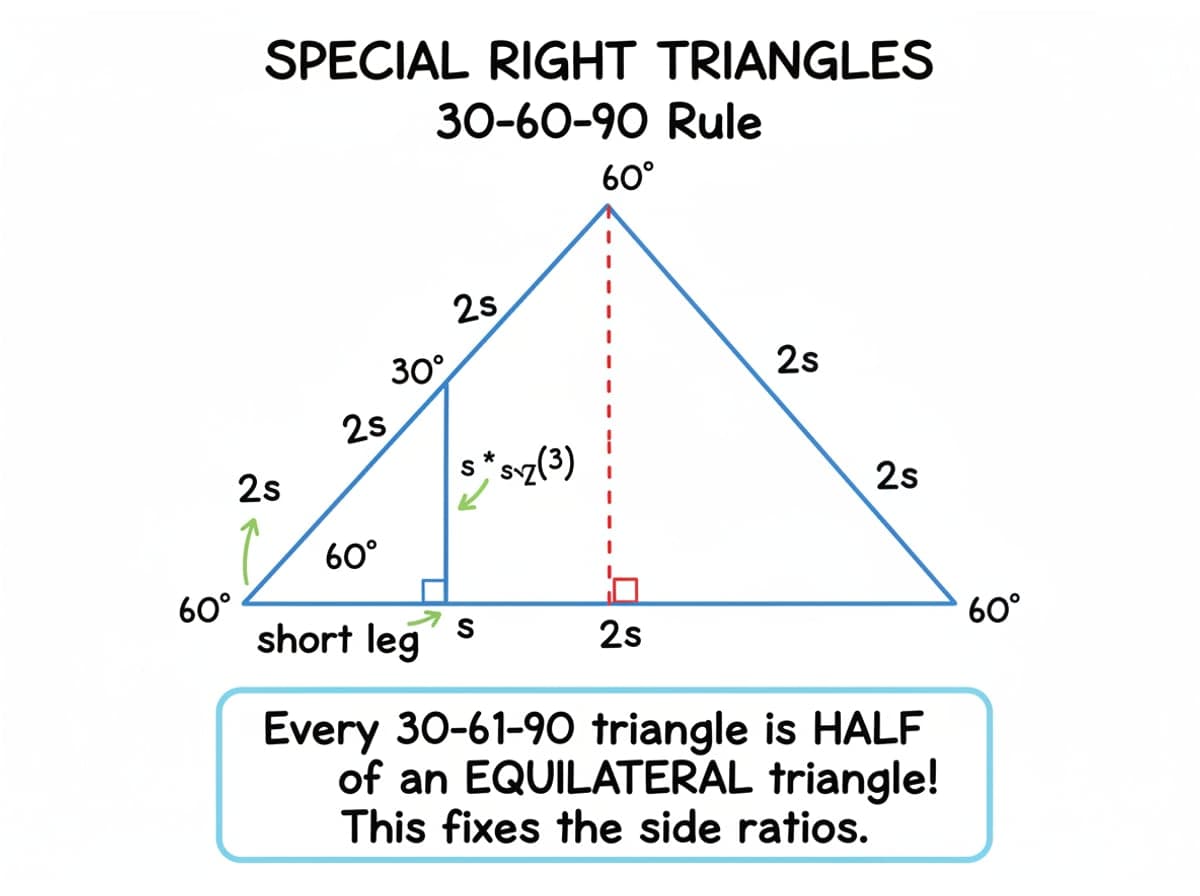
Start by identifying the short leg: it is the side opposite the 30-degree angle, the shortest side in the triangle. With the short leg equal to 5, the hypotenuse is simply double: 2 * 5 = 10. Doubling is not optional here; it comes from the equilateral triangle folded in half along its altitude.
The long leg is the short leg times sqrt(3): 5 * sqrt(3). Leave the radical exact. Writing about 8.66 loses precision and invites round-off errors in later problems, and exact form is what geometry asks for. The three sides in order are then 5, 5 * sqrt(3), and 10.
A common mix-up swaps the roles of the two legs or treats the long leg as the hypotenuse. Remember that the hypotenuse is the side across from the right angle, and it is always the largest. The ratio also works in the opposite direction: given the hypotenuse, divide by 2 to recover the short leg, and multiply that by sqrt(3) for the other leg.
Keep this idea
Memorize the ratio s, s*sqrt(3), 2s, and find the short leg first: it sits opposite the 30-degree angle.
The practice checks apply only to the displayed examples. Follow your teacher’s guidance for your own assignments.
Get help with your own questionA practice lesson each week.
A short practice lesson for your inbox. Free, with a one-click unsubscribe.