
The Pythagorean theorem
One small step at a time. Ask for a clue whenever you need one.
Ask about your own question- Step 1
- Step 2
- Step 3
- New question
A right triangle has legs of length 6 and 8. How long is the hypotenuse?
Common mix-up
In this example, a student wrote 14.
Frida added the legs directly, 6 + 8 = 14. The theorem is about areas, so each leg must be squared before the sum is taken.
Guided example. Your answers aren’t saved or sent.
See why this works
Why can't I just add the two legs?
Frida found the hypotenuse of a right triangle with legs 6 and 8 by adding 6 + 8 = 14. The lengths must be squared first.
In a right triangle, the squares of the legs add to the square of the hypotenuse: a^2 + b^2 = c^2.
The Pythagorean theorem is about areas, not lengths. On a right triangle, two squares sit on the legs and one sits on the hypotenuse, and the two leg squares always cover exactly the same area as the hypotenuse square. That is why the legs get squared before they are added: the formula adds areas, and the areas come from the side lengths.
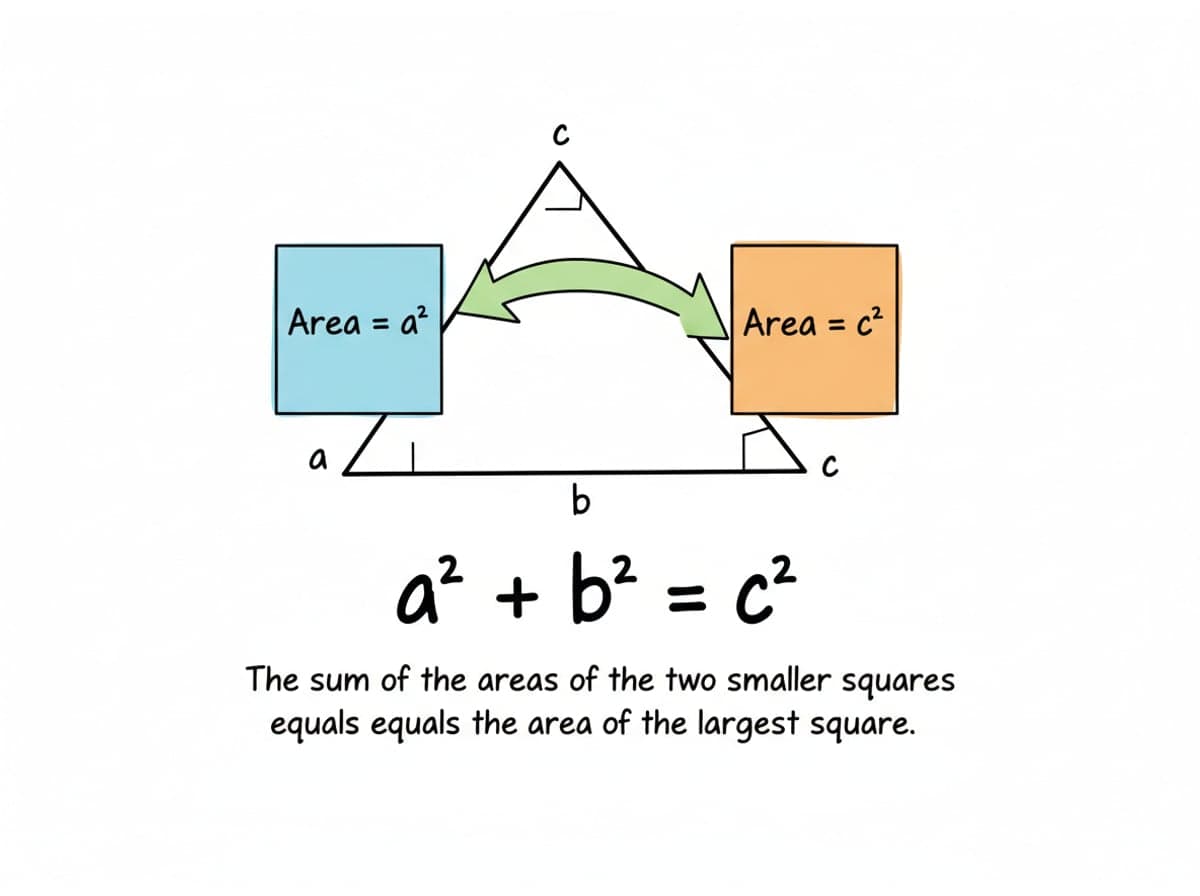
Frida's mistake was adding the bare lengths: 6 + 8 = 14. A hypotenuse must be shorter than the sum of the two legs, and 14 equals 6 + 8 exactly, which is the flat, degenerate case of a triangle, not a real one. The equality fails too: 36 + 64 is not 14^2. Adding lengths never produces the diagonal; the diagonal is always shorter than the sum of the two legs.
The fix follows the formula. Square the legs: 6^2 = 36 and 8^2 = 64. Add them: 36 + 64 = 100, so c^2 = 100. Then take the square root: c = 10, because 10 * 10 = 100. The 100 is an area, and the side length is the square root of that area. The square root undoes the squaring, and the units come back to length.
Check the answer in the original triangle: 36 + 64 = 100 and 10^2 = 100, so the sides satisfy a^2 + b^2 = c^2. A quick sanity check also helps: the hypotenuse must be longer than either leg but shorter than the sum of both legs, and 10 fits that window between 8 and 14. The window check works on every right triangle, not just this one.
Keep this idea
Square the legs, add the squares, then take the square root; never add the bare legs.
The practice checks apply only to the displayed examples. Follow your teacher’s guidance for your own assignments.
Get help with your own questionA practice lesson each week.
A short practice lesson for your inbox. Free, with a one-click unsubscribe.