
Triangle angle sum
One small step at a time. Ask for a clue whenever you need one.
Ask about your own question- Step 1
- Step 2
- New question
Two angles of a triangle measure 65 degrees and 42 degrees. What is the measure of the third angle?
Common mix-up
In this example, a student wrote 107.
Hana added 65 + 42 = 107 and stopped. That is the subtotal the third angle must complete, not the third angle itself.
Guided example. Your answers aren’t saved or sent.
See why this works
Where did the 180 degrees go?
Hana found the third angle of a triangle with angles 65 and 42 by writing 107. She added the two she had and never finished the problem.
The interior angles of a triangle always total 180 degrees, so subtract the two known angles from 180.
The angles inside any triangle, no matter its shape, add up to 180 degrees, a half turn. So a triangle is a fixed budget: the three angles divide up 180 degrees, and no more. Knowing two of them tells you exactly what the third must be, because the third takes whatever is left in the budget. Rip the corners off a paper triangle and their edges form a straight line.
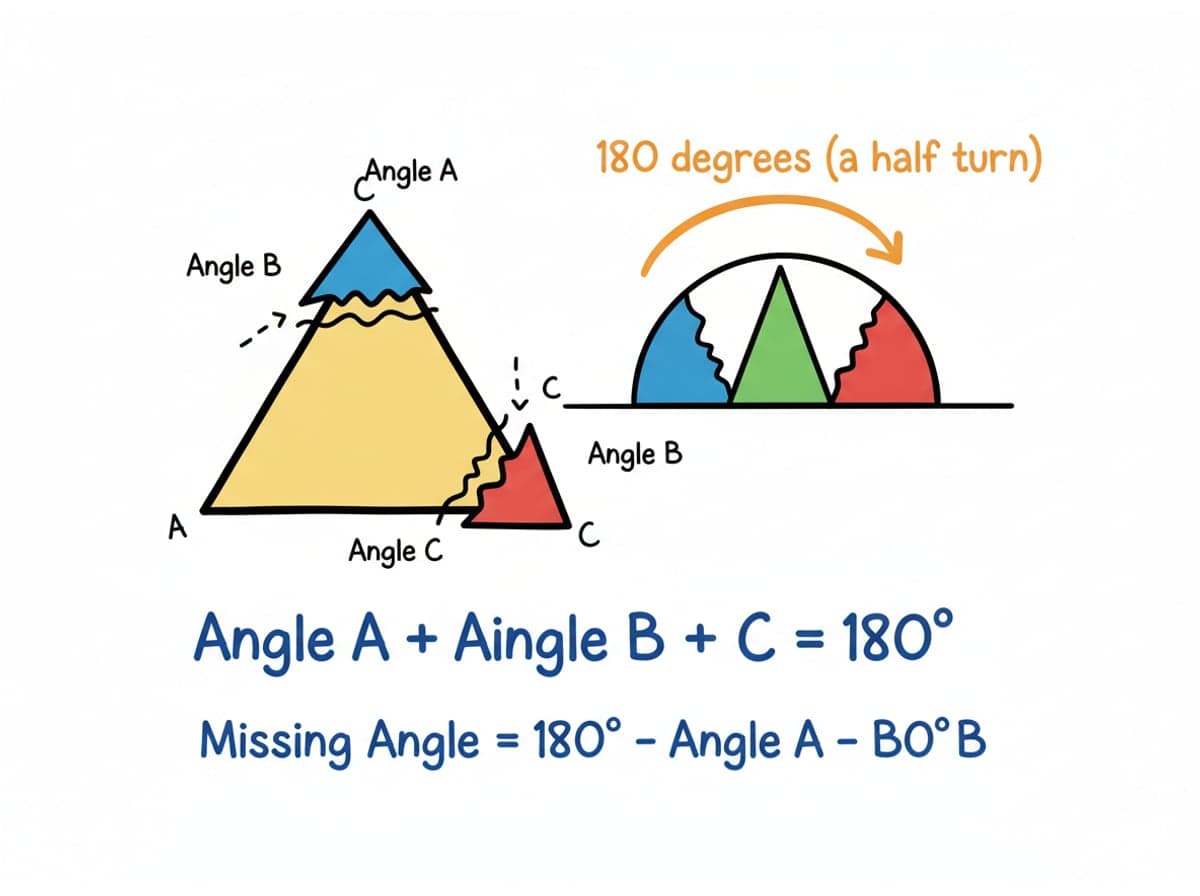
Hana's mistake was stopping at the subtotal. She added 65 + 42 = 107, which is the part of the budget the two known angles use up. That number is not the third angle; it is the amount the two known angles have already spent. She reported the spending instead of what was left. Finish the sentence the question started: subtract what is spent from the budget.
The fix is one subtraction: the third angle takes whatever budget is left. So 180 - 107 = 73, and the third angle measures 73 degrees. Each step is a simple addition or subtraction around the constant total, and the constant is the only thing that never changes: the sum is always 180 degrees. Even a skinny triangle with a tiny angle obeys the same total.
Check by adding all three: 65 + 42 + 73 = 180, exactly the full budget. Also a shape sanity check helps: a triangle's three angles are all less than 180, and 73 is comfortably in the range, so the answer is plausible. The check takes one addition and proves the budget is fully used. Angles that total more or less than the budget cannot belong to one triangle.
Keep this idea
Always subtract the two known angles from 180 degrees, and add them back to check.
The practice checks apply only to the displayed examples. Follow your teacher’s guidance for your own assignments.
Get help with your own questionA practice lesson each week.
A short practice lesson for your inbox. Free, with a one-click unsubscribe.