
Why does my child draw a rectangle to multiply?
What is the area model, and why not just use the standard method?
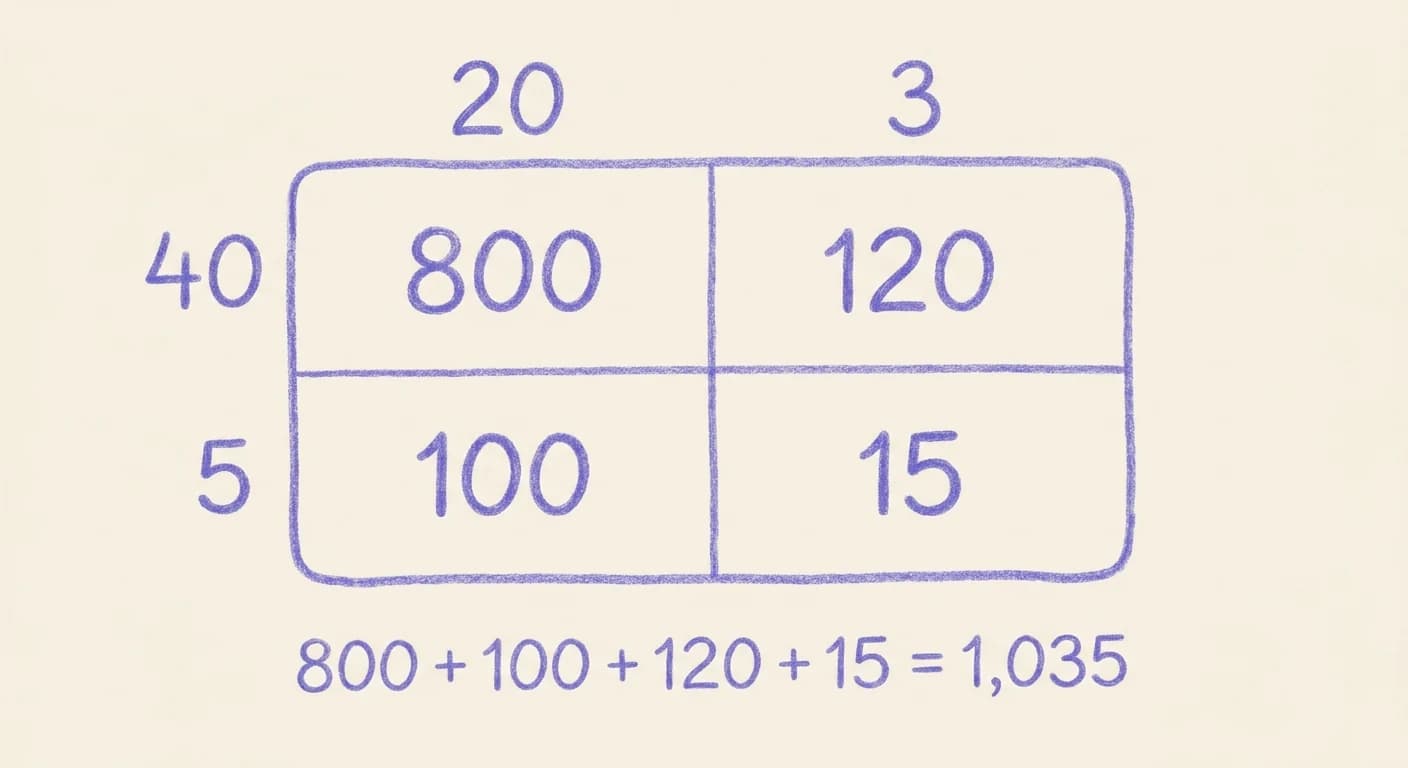
That rectangle is the area model. It splits a multiplication into four smaller multiplications you can do in your head, then adds them. It is the same arithmetic you learned — it just shows where each part of the answer comes from.
Why it looks different from what you were taught
If you learned 23 × 45 by multiplying the ones, carrying, and multiplying the tens, you learned a method that arrives at 1,035 efficiently but hides why it works. The area model takes the same problem apart in the other direction: it shows all four pieces before adding them up.
Nothing is being made harder. The four multiplications inside the rectangle (20 × 40, 20 × 5, 3 × 40, 3 × 5) are exactly the products the standard method computes too — the standard method just writes them on top of one another instead of side by side.
The rectangle is not a picture of an actual field. It is a bookkeeping device: one side is one factor split into place-value parts, the other side is the other factor split the same way, and each cell of the grid is one product.
The parts of the method
- Splitting into place value
- 23 becomes 20 + 3 and 45 becomes 40 + 5. This is the same splitting your child already does when adding two-digit numbers mentally.
- The rectangle
- Draw a rectangle whose sides are the two factors, marked at the splits. It divides into four smaller rectangles: 20 × 40, 20 × 5, 3 × 40 and 3 × 5.
- Partial products
- Each cell is one multiplication. Write the product inside it — 800, 100, 120, 15. These are the 'partial products'; the standard algorithm produces the same four numbers in a different arrangement.
- Adding the parts
- Add the four products to get the full answer. 800 + 100 + 120 + 15 = 1,035.
A worked example: 23 × 45
- 23 → 20 + 3, and 45 → 40 + 5Split both factors at their place values.
- 20 × 40 = 800The big cell: two tens-by-tens pieces.
- 20 × 5 = 100Same row, the other column.
- 3 × 40 = 120The other row, same column as the 800.
- 3 × 5 = 15The small corner cell.
- 800 + 100 + 120 + 15 = 1,035Adding the partial products is the last step, not a separate method.
1,035 — the same answer the standard method gives.
What you can do at the table
- Ask about one cell at a time: "what is this little rectangle measuring?" Each cell is one multiplication your child can already do.
- Point out that the four numbers at the end are the same numbers that appear in the standard method. The rectangle is not a replacement for what you know; it explains it.
- Let your child draw it badly. The grid does not need to be to scale for the arithmetic to be right.
- If your child can explain why the corner cell is 3 × 5, they understand the method — that explanation is the point of the exercise.
The move that backfires: Do not push your child back to the standard algorithm mid-problem because it is faster for you. Being asked to abandon the method being taught, mid-sentence, is where homework evenings go wrong — and the standard method is usually the next thing they are taught, deliberately, once the reasoning is secure.
Free lessons that teach this step
Why multiply everything inside the brackets?
Copy the whole group: 3(x + 2) = 3x + 6.
Try the lesson freeWhat is (x + 3)(x + 5) expanded?
Multiply First, Outer, Inner, Last, then combine the like terms.
Try the lesson freeWhy do exponents add when I multiply?
Multiplying powers with the same base adds the exponents: a^m * a^n = a^(m+n).
Try the lesson freeIf tonight’s question is not on this list
Bring the actual question — typed, or a photo of the page — and Clue gives one clue at a time and asks your child for the next step. The first 5 questions are free, follow-ups included, with no sign-up and no card.
Try 5 questions freeMethods are described as they are commonly taught, and your school may use different names for the same steps. Check with your child’s teacher when the working has to match their expectations.