
Multiplying binomials
One small step at a time. Ask for a clue whenever you need one.
Ask about your own question- Step 1
- Step 2
- New question
Expand (x + 3)(x + 5).
Common mix-up
In this example, a student wrote x^2 + 15.
The student multiplied only the first terms and the last terms, writing x^2 + 15 and leaving out the entire middle.
Guided example. Your answers aren’t saved or sent.
See why this works
What is (x + 3)(x + 5) expanded?
Every part of one binomial multiplies every part of the other. Four little products, then one tidy sum.
Multiply First, Outer, Inner, Last, then combine the like terms.
A binomial is two terms in a package, so a product of two binomials means four multiplications: each part of the first times each part of the second. FOIL is the compass for the four products: First, Outer, Inner, Last. For (x + 3)(x + 5), that means x * x, x * 5, 3 * x, and 3 * 5.
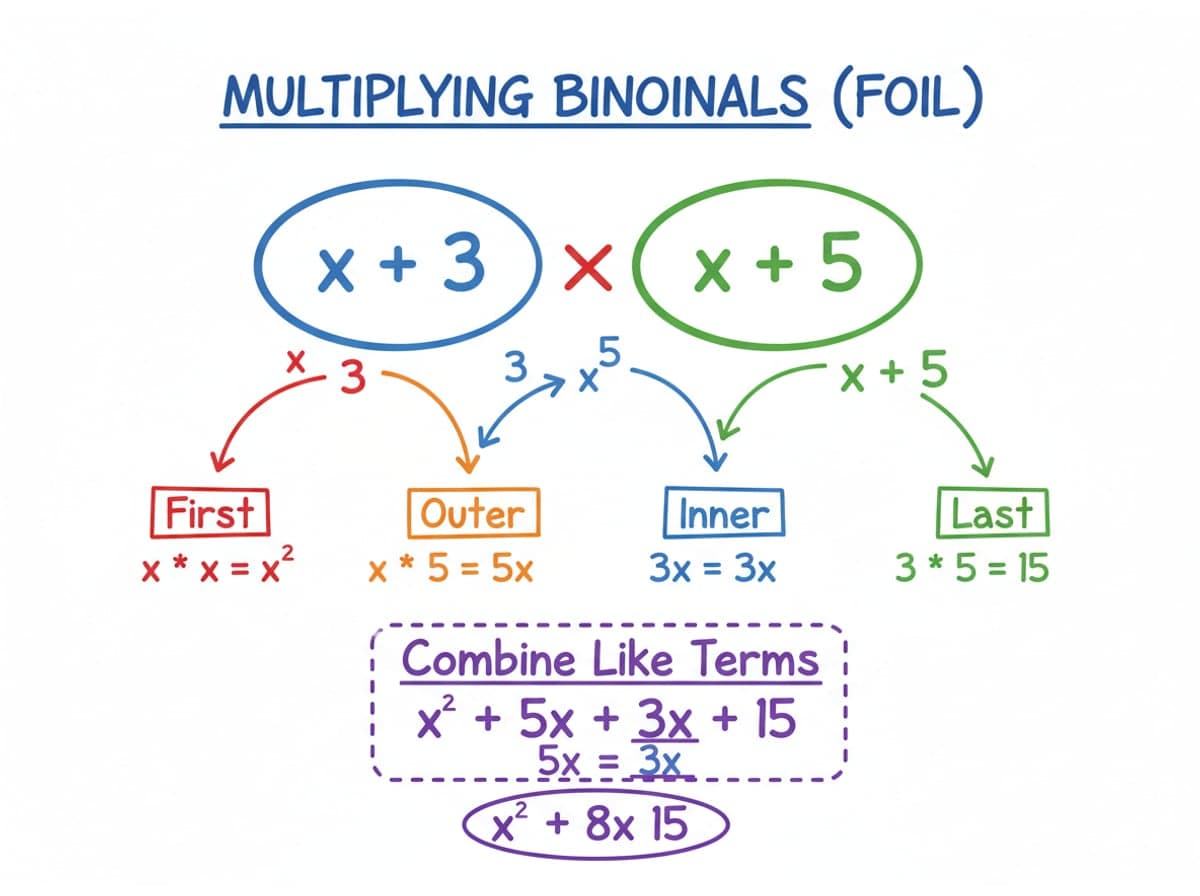
Write the four pieces: x^2, 5x, 3x, and 15. Nothing here is a mistake yet. The error comes from treating the product like two separate squarings: (x + 3)(x + 5) is not x^2 + 15. The two middle products, 5x and 3x, are real terms and they must be kept.
Now combine the middle terms. 5x plus 3x is 8x, leaving x^2 + 8x + 15. The coefficient of x, 8, is the sum of the two inside numbers of the original binomials. The constant 15 is their product: 3 * 5. In the special case (x + a)(x + b), the pattern is always x^2 + (a + b)x + ab.
Check the expansion by substituting a value. At x = 1, the original product is (1 + 3)(1 + 5) = 24, and the expansion gives 1 + 8 + 15 = 24. Matching numbers across any small input means the expansion is correct. FOIL applies to any binomial pair, not only the ones starting with a single x.
Keep this idea
Every piece multiplies every other piece. Sum the four products and combine the x terms, then verify with a quick substitution.
The practice checks apply only to the displayed examples. Follow your teacher’s guidance for your own assignments.
Get help with your own questionA practice lesson each week.
A short practice lesson for your inbox. Free, with a one-click unsubscribe.