
Arithmetic sequences
One small step at a time. Ask for a clue whenever you need one.
Ask about your own question- Step 1
- Step 2
- New question
Find the 20th term of the arithmetic sequence with a1 = 5 and common difference d = 4.
Common mix-up
In this example, a student wrote 85.
The student used a_n = a1 + n*d and computed 5 + 20 * 4 = 85, adding the difference one time too many.
Guided example. Your answers aren’t saved or sent.
See why this works
What is the 20th term of 5, 9, 13, ...?
An arithmetic sequence changes by the same amount every time. With the formula, the 20th term is one calculation away.
a_n = a1 + (n - 1)d: the difference is added (n - 1) times.
In an arithmetic sequence each term is the previous one plus a fixed amount. In 5, 9, 13, ..., the common difference d is 4. The first term a1 is 5. Everything about the sequence is described by these two numbers, so the 100th term can be computed without writing out a hundred entries.
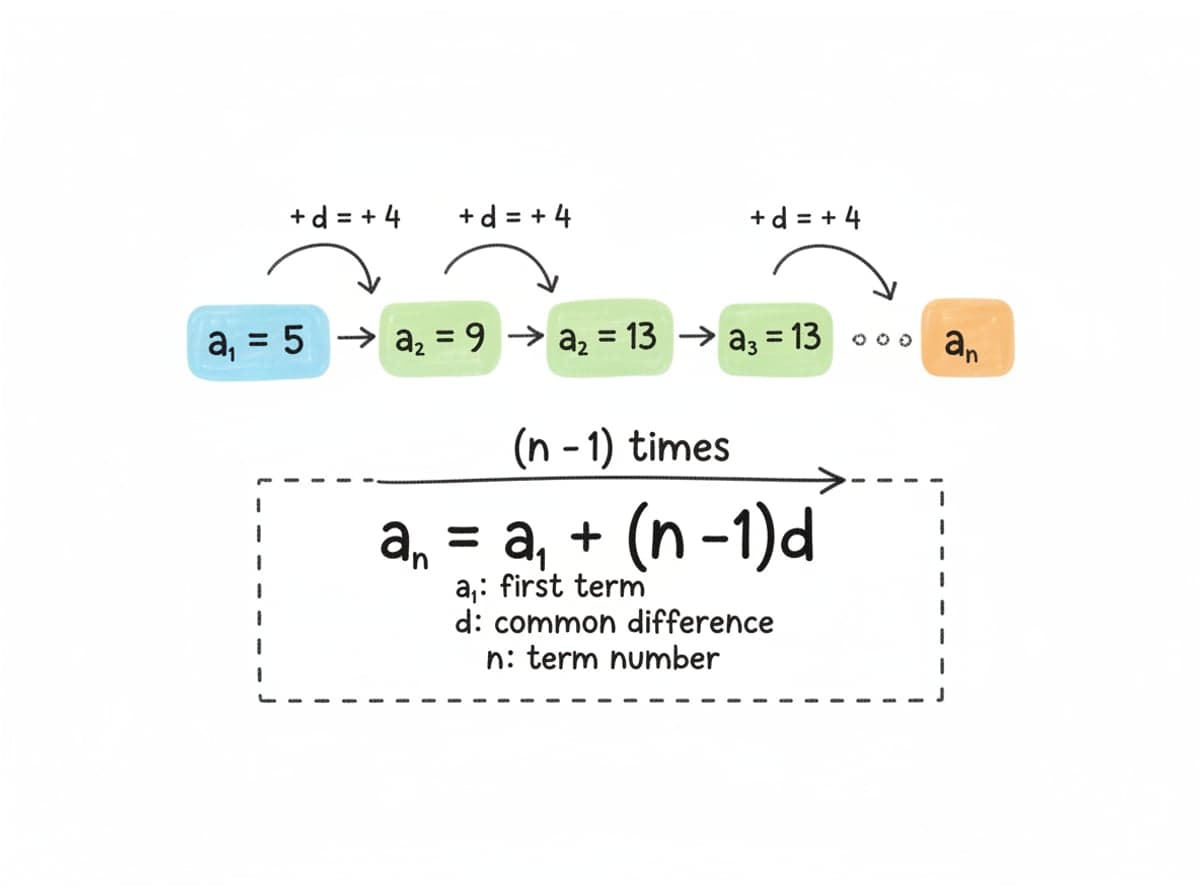
The formula a_n = a1 + (n - 1)d counts the jumps. To reach the 20th term from the 1st, you cross 19 gaps, not 20. The (n - 1) part is the number of additions of d, and it is one less than the term number. Listing the sequence shows why: 5, 9, 13, 17, the 4th term has had the difference added three times.
For the 20th term: a20 = 5 + 19 * 4 = 5 + 76 = 81. The most common mistake uses 20 additions and lands on 85, which is actually the 21st term. Off-by-one errors in sequences love the ends: the first term is already there, so it is not added again.
Check your work against the neighborhood. The 20th term sits after the 19th, which is 5 + 18 * 4 = 77, so 81 is the next step of 4 and fits the pattern. A nearby term is a cheap sanity check that catches the off-by-one slip without listing everything.
Keep this idea
In a_n = a1 + (n - 1)d, the (n - 1) counts the gaps. Adding one extra jump is the classic off-by-one slip.
The practice checks apply only to the displayed examples. Follow your teacher’s guidance for your own assignments.
Get help with your own questionA practice lesson each week.
A short practice lesson for your inbox. Free, with a one-click unsubscribe.