
Geometric sequences
One small step at a time. Ask for a clue whenever you need one.
Ask about your own question- Step 1
- Step 2
- New question
Find the 5th term of the geometric sequence with a1 = 2 and common ratio r = 3.
Common mix-up
In this example, a student wrote 486.
The student used exponent n instead of n - 1 and wrote a5 = 2 * 3^5 = 486.
Guided example. Your answers aren’t saved or sent.
See why this works
What is the 5th term of 2, 6, 18, ...?
In a geometric sequence, each term multiplies the last by the same ratio. That ratio is the engine of the whole sequence.
a_n = a1 * r^(n - 1): the ratio is multiplied (n - 1) times.
A geometric sequence grows by a multiplier, not an addend. In 2, 6, 18, ..., each term is the previous one times 3, so the common ratio r is 3 and the first term a1 is 2. The ratio is what turns a sequence into a giant multiplication problem.
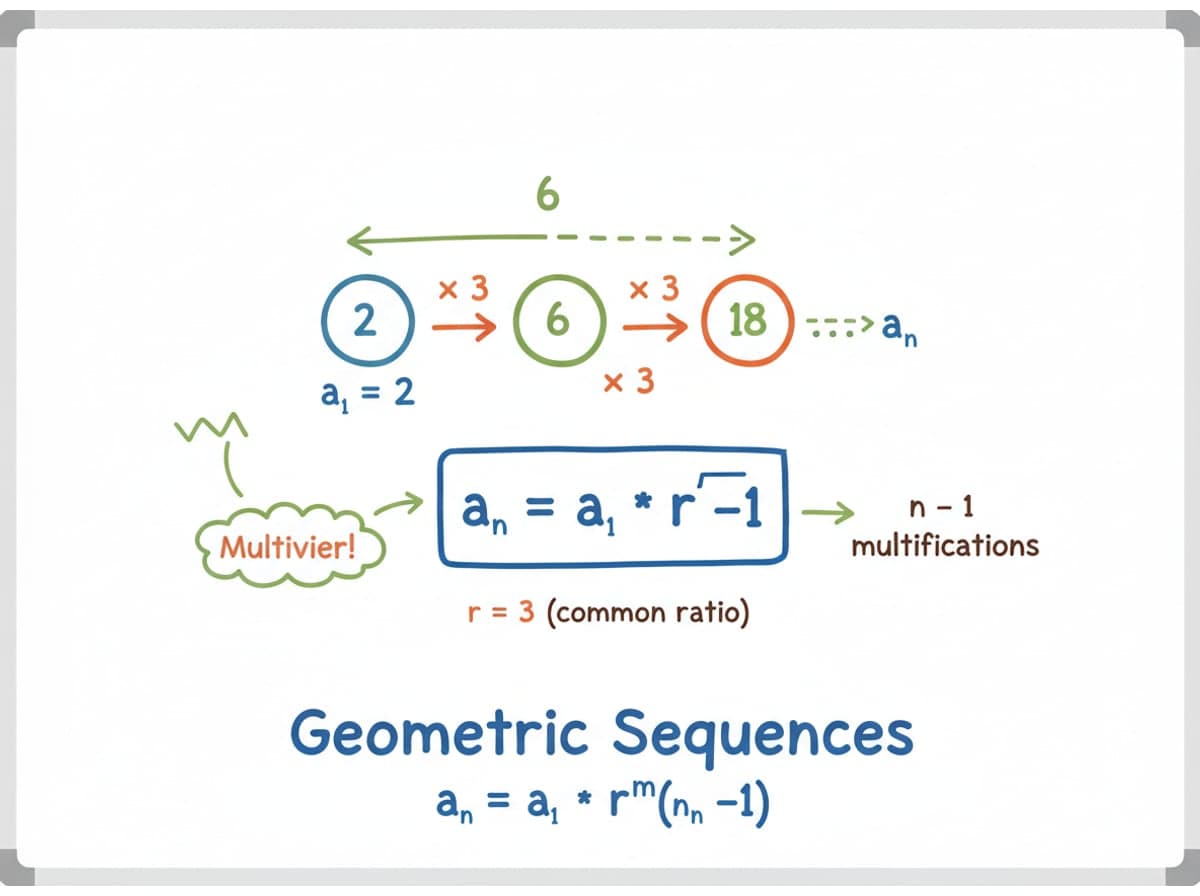
The formula a_n = a1 * r^(n - 1) counts the multiplications. The first term is already given, so the ratio is applied once per jump, not once per term. The 5th term has had the ratio applied four times: 2 * 3 * 3 * 3 * 3. The exponent is therefore 4, exactly one less than 5.
So a5 = 2 * 3^4 = 2 * 81 = 162. Using exponent 5 by mistake gives 486, which is the 6th term. Listing a short version of the sequence catches any doubt: 2, 6, 18, 54, 162, and the count of multiplications is visible in the exponents you visited.
The same exponent logic applies to decimals, negative ratios, and ratios less than one. The term number always counts one more than the exponent. Find the ratio by dividing any term by the one before it, then apply the formula. The growth may go up or down, but the pattern of exponent plus one never changes.
Keep this idea
In a_n = a1 * r^(n - 1), the exponent is one less than the term number. Confirm with a short list when unsure.
The practice checks apply only to the displayed examples. Follow your teacher’s guidance for your own assignments.
Get help with your own questionA practice lesson each week.
A short practice lesson for your inbox. Free, with a one-click unsubscribe.