
Completing the square
One small step at a time. Ask for a clue whenever you need one.
Ask about your own question- Step 1
- Step 2
- Step 3
- New question
Solve x^2 + 6x + 2 = 0 by completing the square.
Common mix-up
In this example, a student wrote x^2 + 6x + 9 = -2.
The student added 9 only to the left side, writing x^2 + 6x + 9 = -2 and unbalancing the equation.
Guided example. Your answers aren’t saved or sent.
See why this works
What do you add to make x^2 + 6x a perfect square?
A perfect square like (x + 3)^2 is easy to solve. Completing the square builds one on purpose, right in the middle of an equation.
Add (b/2)^2 to both sides to create a perfect square trinomial.
Some quadratics are one small step away from a perfect square. In x^2 + 6x + 2 = 0, the x^2 + 6x part nearly matches (x + 3)^2 = x^2 + 6x + 9. The 9 is missing, and the first move is to isolate that pair: subtract 2 from both sides, leaving x^2 + 6x = -2.
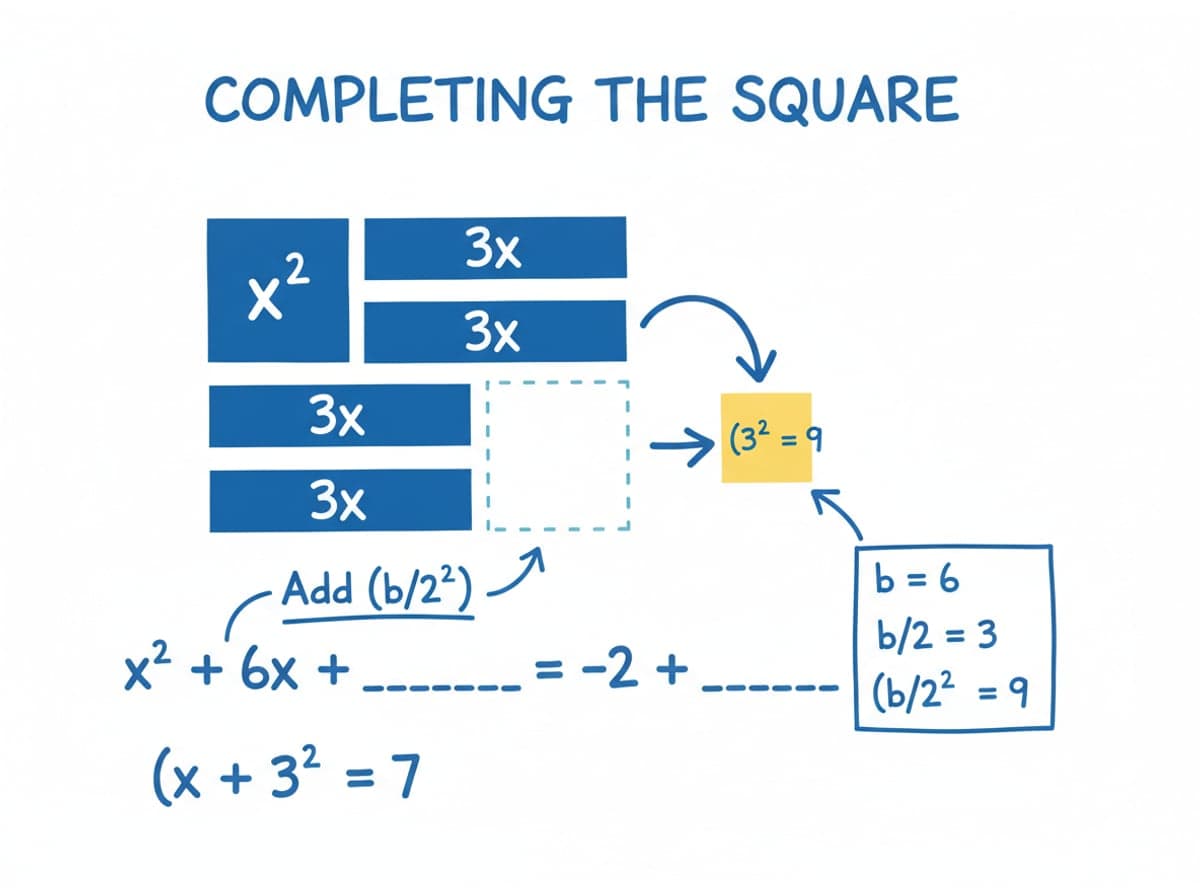
Now make the square deliberately. Take half of 6, which is 3, and square it to get 9. Add 9 to both sides: x^2 + 6x + 9 = -2 + 9. Adding to one side only would break the equality, and that is the most common slip in this method.
The left side is now a perfect square, so write it as (x + 3)^2 = 7. Take the square root of both sides: x + 3 = +/- sqrt(7). The plus or minus appears because both a positive and a negative number square to 7. Finish by subtracting 3, giving x = -3 +/- sqrt(7).
Substitute to check. With x = -3 + sqrt(7), the square is 16 - 6*sqrt(7), and 6x is -18 + 6*sqrt(7). Adding 2: everything cancels and the result is 0. The exact answers keep the radical, which is cleaner than a decimal estimate and is what exact algebra asks for.
Keep this idea
Move the constant, add (b/2)^2 to both sides, factor into a perfect square, then take square roots and undo the leftover number.
The practice checks apply only to the displayed examples. Follow your teacher’s guidance for your own assignments.
Get help with your own questionA practice lesson each week.
A short practice lesson for your inbox. Free, with a one-click unsubscribe.