
Simplifying rational expressions
One small step at a time. Ask for a clue whenever you need one.
Ask about your own question- Step 1
- Step 2
- Step 3
- New question
Simplify (x^2 - 9)/(x^2 + 5x + 6).
Common mix-up
In this example, a student wrote (-9)/(5x + 6).
The student crossed out the x^2 terms as if they were factors, writing the expression as if the squares simply disappeared.
Guided example. Your answers aren’t saved or sent.
See why this works
What is (x^2 - 9)/(x^2 + 5x + 6) in lowest terms?
A fraction like this simplifies only after you factor the top and the bottom. Cancellation happens between factors, never between single terms.
Factor each side completely, then cancel common factors, exactly as with fractions of numbers.
A rational expression is a fraction with polynomials. Simplifying it works only when the top and bottom are written as products. (x^2 - 9)/(x^2 + 5x + 6) cannot be reduced in its given form, because no term pairs up by itself. The first move is always to factor, and the difference of squares pattern takes care of the numerator.
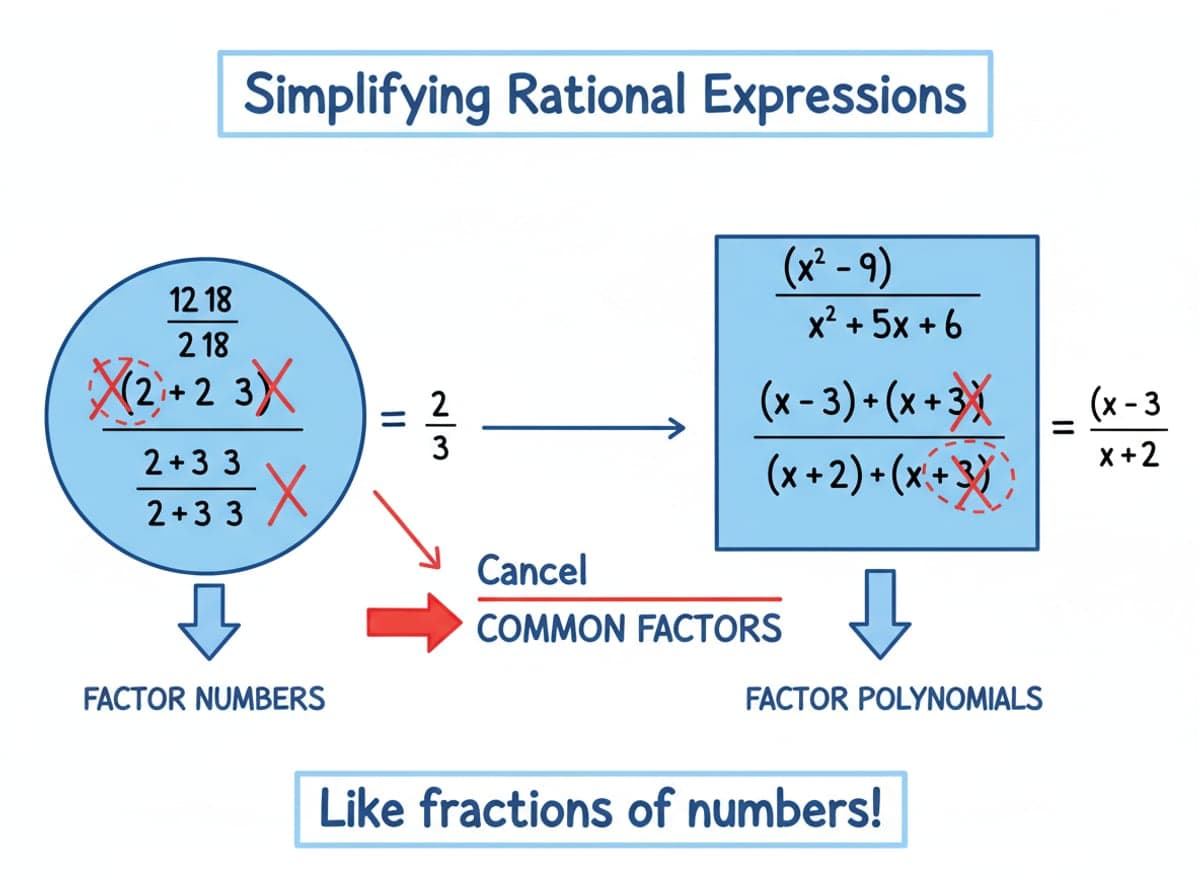
The numerator is a difference of squares: x^2 - 9 = (x - 3)(x + 3). The denominator is a trinomial, so find two numbers with product 6 and sum 5, which are 2 and 3: x^2 + 5x + 6 = (x + 2)(x + 3). Both pieces are now products, and the common factor x + 3 is visible in each.
Cancel the common factor: (x + 3) over (x + 3) divides to 1. The simplified form is (x - 3)/(x + 2). What cannot be cancelled is any single term: the x^2 terms are parts of sums, not factors, and crossing them out changes the expression entirely. Cancelling only ever removes factors that multiply the rest.
Keep the domain notes. The original expression is undefined for x = -3 and x = -2 because a denominator of zero appears there. The simplified form agrees at every other x, and it is a nicer picture of the same function. Checking by substituting a number into both forms is a quick way to confirm the simplification.
Keep this idea
Factor first, then cancel common factors only. Remember the excluded x values where a denominator was zero in the original.
The practice checks apply only to the displayed examples. Follow your teacher’s guidance for your own assignments.
Get help with your own questionA practice lesson each week.
A short practice lesson for your inbox. Free, with a one-click unsubscribe.
Search all 106 free lessons for “Simplifying rational expressions”