
Difference of two squares
One small step at a time. Ask for a clue whenever you need one.
Ask about your own question- Step 1
- Step 2
- New question
Factor x^2 - 36.
Common mix-up
In this example, a student wrote x^2 - 36 = (x - 6)(x - 6).
The student wrote (x - 6)(x - 6), which expands to x^2 - 12x + 36, not the x^2 - 36 they started with.
Guided example. Your answers aren’t saved or sent.
See why this works
Why is x^2 - 36 not (x - 6)(x - 6)?
x^2 - 36 looks like an ordinary binomial, but it carries a special pattern. A difference of two squares always factors into a sum times a difference.
a^2 - b^2 = (a - b)(a + b).
A difference of two squares means exactly what it says: a subtraction, a perfect square, and another perfect square. In x^2 - 36, the first term is x squared and the second is 6 squared, and a minus sign sits between them. Anything written as a^2 - b^2 follows one fixed factoring pattern.
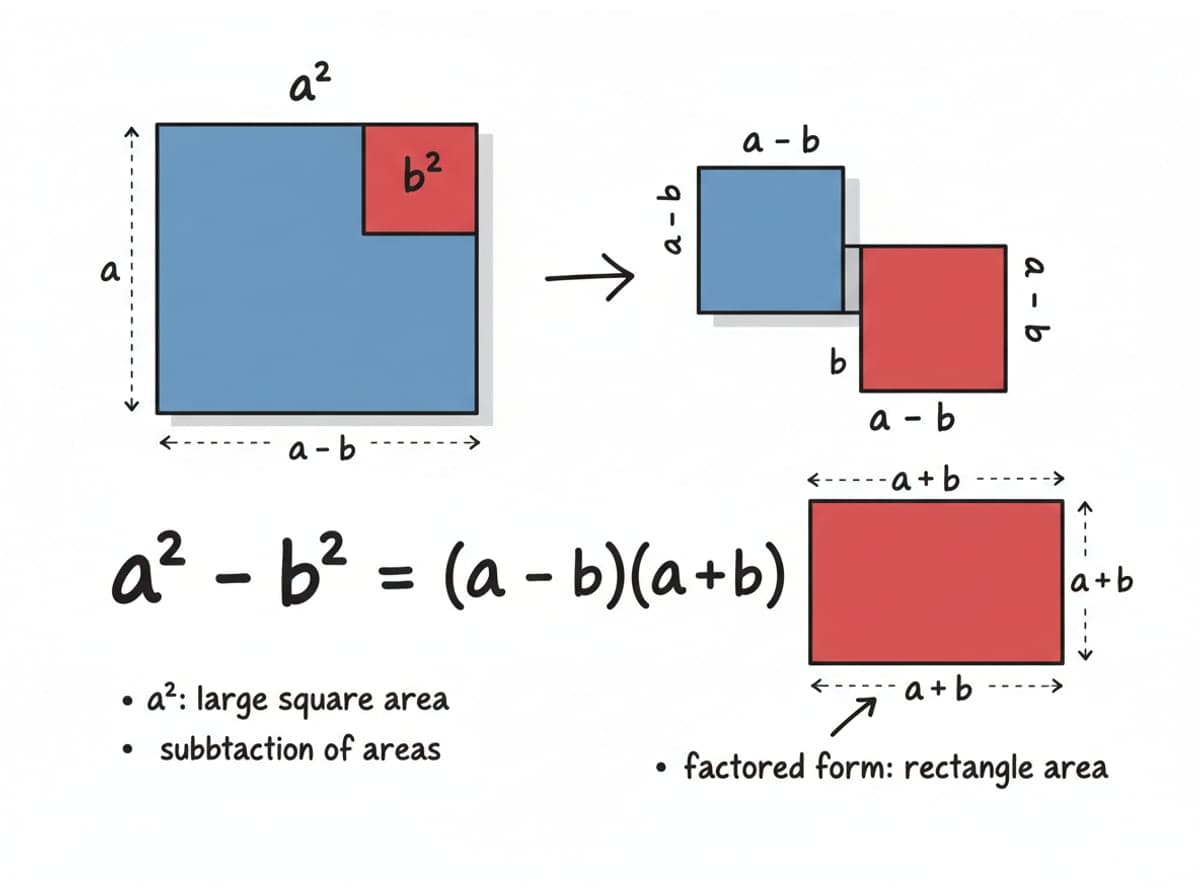
The pattern is a^2 - b^2 = (a - b)(a + b). Multiply the factors back and the middle terms vanish: (a - b)(a + b) = a^2 + ab - ab - b^2 = a^2 - b^2. The opposite signs are the whole trick, because the two middle products add to zero and only the squares survive.
So x^2 - 36 = (x - 6)(x + 6). Compare it with (x - 6)(x - 6), which is what a student might write by symmetry. That product is x^2 - 12x + 36, a perfect square with a middle term, and it does not match the original binomial at all.
The pattern only fits a subtraction of squares. x^2 + 36 cannot be factored this way, because a sum of squares keeps a middle term no matter which signs you try. When you see a minus and two perfect squares, use (a - b)(a + b) instantly; FOIL is your proof.
Keep this idea
A difference of two squares factors as (a - b)(a + b). One sign plus, one minus, and the middle terms cancel.
The practice checks apply only to the displayed examples. Follow your teacher’s guidance for your own assignments.
Get help with your own questionA practice lesson each week.
A short practice lesson for your inbox. Free, with a one-click unsubscribe.