
The discriminant
One small step at a time. Ask for a clue whenever you need one.
Ask about your own question- Step 1
- Step 2
- New question
How many real solutions does x^2 - 5x + 3 = 0 have?
Common mix-up
In this example, a student wrote b^2 - 4ac = 25 + 12 = 37, so two real solutions..
The student treated -4ac as +4ac and computed 25 + 12 = 37, ignoring the subtraction that is part of the formula.
Guided example. Your answers aren’t saved or sent.
See why this works
How many solutions does x^2 - 5x + 3 = 0 have?
Before solving a quadratic, the discriminant can tell you how many real answers it will have. One number, three cases.
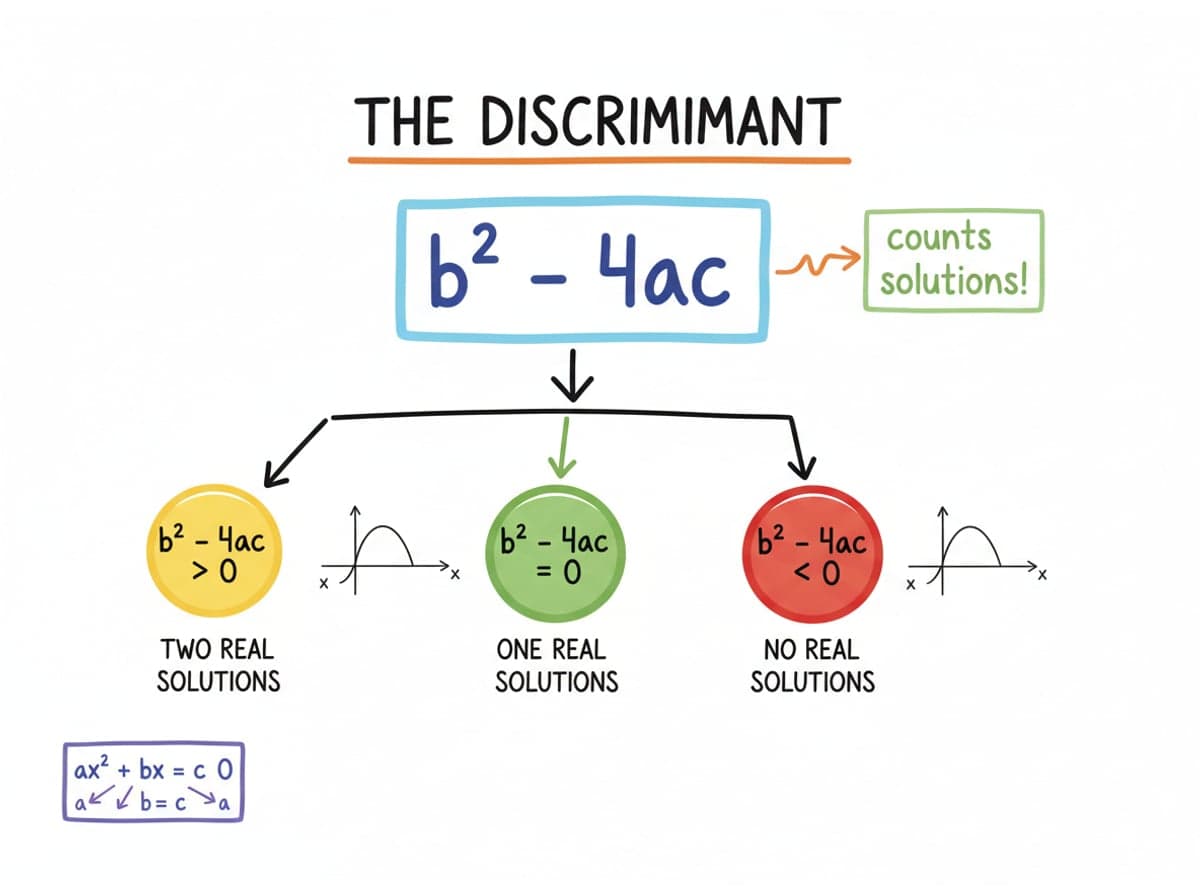
b^2 - 4ac: positive means two real solutions, zero means one, negative means none.
The quadratic formula carries everything you need to count solutions in one expression: b^2 - 4ac. That expression is called the discriminant. Read a, b, and c straight from the standard form ax^2 + bx + c = 0, so for x^2 - 5x + 3 = 0 you have a = 1, b = -5, and c = 3.
For this equation the discriminant is (-5)^2 - 4(1)(3) = 25 - 12 = 13. The most common arithmetic slip is to add 4ac instead of subtracting it, which gives 37 here. The minus sign belongs to the whole term: the formula takes b^2 and then subtracts the product of 4, a, and c.
The sign of the result decides everything. A positive discriminant means the square root in the formula is a real number, and the plus or minus produces two distinct real solutions. A zero discriminant produces exactly one, and a negative discriminant means no real solutions, because no real number squares to a negative.
The discriminant answers the question before you spend any time solving. A positive 13 here tells you the parabola crosses the x-axis twice, and the exact solutions are x = (5 +/- sqrt(13))/2. Substituting either value back gives zero, confirming both crossings.
Keep this idea
Compute b^2 - 4ac before solving. Its sign tells you how many real solutions exist, without solving the equation at all.
The practice checks apply only to the displayed examples. Follow your teacher’s guidance for your own assignments.
Get help with your own questionA practice lesson each week.
A short practice lesson for your inbox. Free, with a one-click unsubscribe.