
Why does my child draw a strip of boxes for a ratio problem?
What is a tape diagram, and why does it show up in ratio, rate and percent problems?
That strip of boxes is a tape diagram. Each box is one equal part, and the ratio tells you how many boxes to draw. You find what one box is worth, then multiply. It is a picture of the sharing, not a different kind of arithmetic.
Why it looks different from what you were taught
If you learned ratios as "3 to 5" written with a colon and then crossed multiplied, you learned a method that gives the answer without saying what the boxes mean. The tape diagram slows that down on purpose: it shows that a ratio of 3 : 5 describes parts of a total, and the actual amounts depend on how big the total is.
The strip is not drawn to scale and is not a picture of the beads. It is bookkeeping. Each box stands for one equal share, so a 3 : 5 ratio is drawn as three boxes against five boxes, and the whole strip is eight equal shares of whatever the total turns out to be.
The confusing part for most parents is that the ratio 3 : 5 does not mean 3 beads and 5 beads. It means three shares and five shares, where each share could be 1 bead, 8 beads or 100 beads. The diagram exists to keep the shares separate from the amounts.
The parts of the method
- One box, one equal part
- Every box in the strip is the same size and stands for the same amount. If the boxes are not equal, the diagram no longer means anything, so children are taught to draw them carefully even when the numbers are messy.
- The ratio gives the number of boxes
- A ratio of 3 : 5 is drawn as 5 boxes for one quantity and 3 boxes for the other — eight equal boxes in total. The numbers in the ratio count parts, not beads.
- Finding the value of one part
- When the total is known, divide the total by the number of boxes. Eight boxes holding 64 beads means each box holds 8. This single number is the piece everything else is built from.
- Multiplying back up
- Once one box is worth 8, each quantity is that value times its number of boxes: 3 × 8 and 5 × 8. The same diagram answers part-of-the-total and part-versus-part questions; only the boxes you label change.
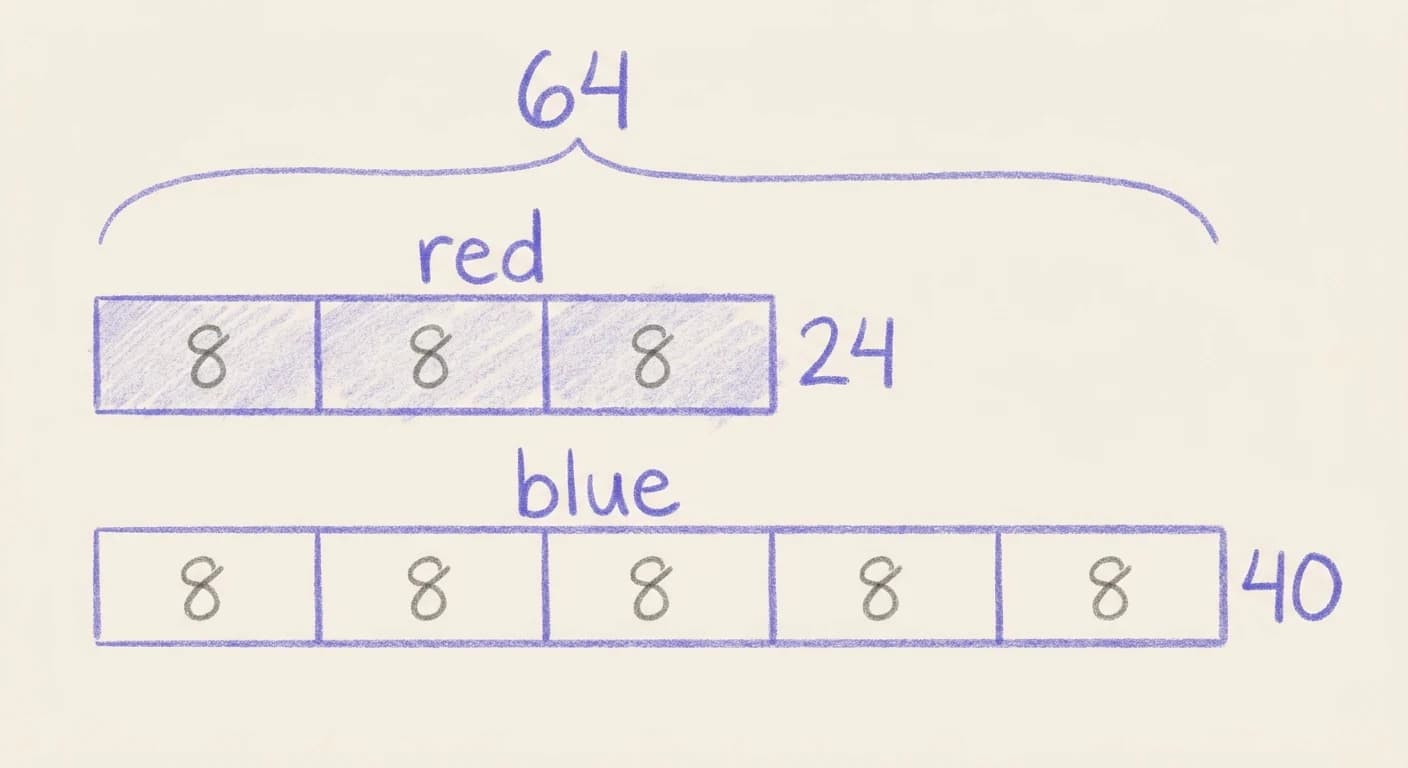
A worked example: The ratio of red beads to blue beads is 3 : 5. There are 64 beads in total. How many of each color are there?
- 3 + 5 = 8 equal partsThe ratio tells you how many boxes, not how many beads.
- 64 ÷ 8 = 8Sharing the 64 beads equally among 8 boxes means one box holds 8 beads.
- Red: 3 × 8 = 24Three boxes, each worth 8.
- Blue: 5 × 8 = 40Five boxes, each worth 8.
- 24 + 40 = 64The parts have to add back to the total you started with.
- 24 : 40 = 3 : 5Dividing both amounts by 8 returns the original ratio.
24 red beads and 40 blue beads. The two amounts add to 64, and 24 : 40 reduces to 3 : 5.
What you can do at the table
- Ask what one box is worth before asking for the answer. Almost every breakdown in these problems happens because a child starts multiplying by the ratio numbers too early.
- Label the boxes together — write 'red' over three of them and 'blue' over the other five. Naming the boxes keeps the parts from drifting into being the answers.
- Use small invented numbers to see the idea before the homework numbers. If a ratio of 1 : 2 is worth 3 beads total, each box is 1 bead, and the amounts are 1 and 2.
- The check is free and worth doing every time: add the two amounts and see if you get the total, then divide both amounts by the value of one part and see if you get the ratio back.
The move that backfires: The tempting shortcut is to say "the ratio is 3 to 5, so it is 3 red and 5 blue" to move the evening along. That answer ignores the total and undoes the point of the drawing, and when the child has to defend it in class the diagram will not back them up. Asking what one box is worth usually ends the stall without giving anything away.
Free lessons that teach this step
Which number goes first in a ratio?
A ratio lists numbers in the exact order they are named, then simplifies by dividing both parts by the same factor.
Try the lesson freeHow much does one apple cost?
A unit rate divides the total by the number of items: total dollars divided by number of items gives dollars per item.
Try the lesson freeWhere do the cross products come from?
In a proportion the cross products are equal: a/b = c/d means a * d = b * c.
Try the lesson freeIf tonight’s question is not on this list
Bring the actual question — typed, or a photo of the page — and Clue gives one clue at a time and asks your child for the next step. The first 5 questions are free, follow-ups included, with no sign-up and no card.
Try 5 questions freeMethods are described as they are commonly taught, and your school may use different names for the same steps. Check with your child’s teacher when the working has to match their expectations.